Rating: 8/10
When Stephen King wrote “The Long Walk” in 1979 under the pseudonym Richard Bachman, the novel’s bare bones and timeless premise were immediately cemented into King’s literary canon.
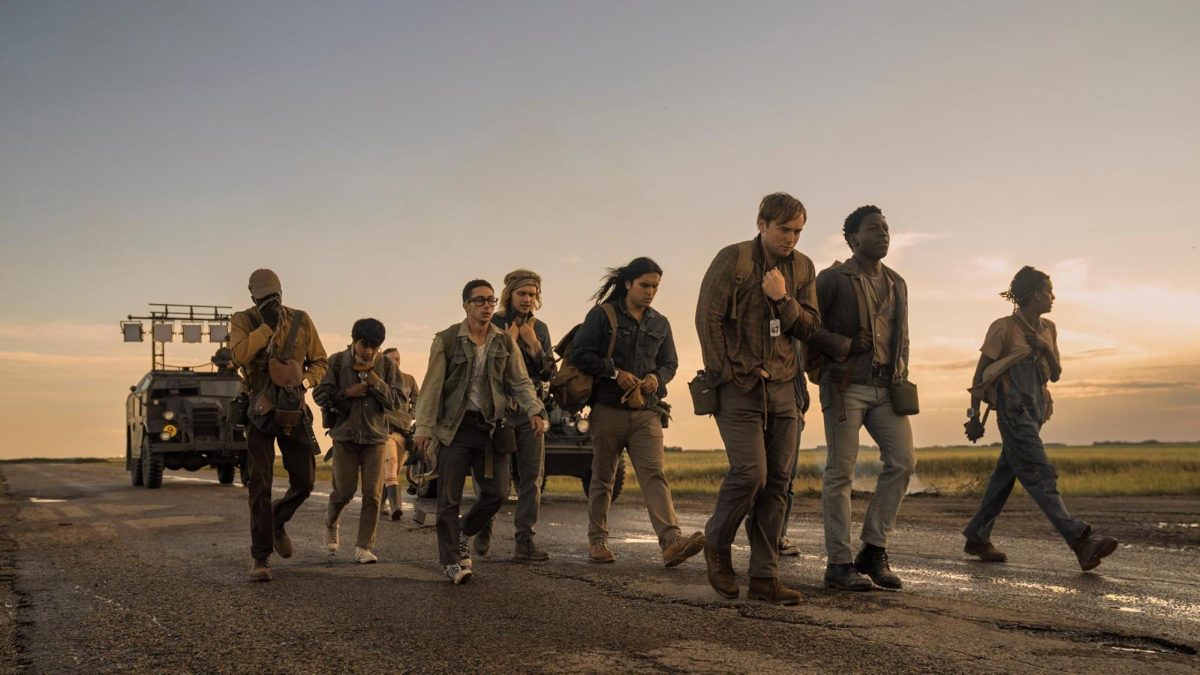
For an author with works as bizarre as “It” or as fantastical as “The Stand,” King’s stripped-down dystopian thriller is as simple and as menacing as they come. However many miles it takes, 100 young men walk nonstop until there’s only one left.
While the starting pool is halved for this screen adaptation, leading characters Raymond “Ray” Garraty and Peter McVries are on opposite ends of one desperate spectrum, speaking to the differences and commonalities that would bring the two to gamble with their lives.
Get The Daily Illini in your inbox!
Garraty, played by young everyman Cooper Hoffman, is the seemingly obvious protagonist of the film, bringing an amiable attitude matched by a thinly veiled boyish anger. Hoffman channels his late father, Philip Seymour Hoffman with his performance, tapping into the same world-weariness and frustration that make both actors so immensely sympathetic.
Garraty is countered by McVries, played by “Alien: Romulus” breakout David Jonsson. McVries is an expertly realized foil and friend to Garraty, bringing a warmth and eloquence that Jonsson argues, quite compellingly, is just as important to the boys’ survival as anything else.
While the two leads make for fascinating studies on their own, their work together is where “The Long Walk” truly soars. Dialogue between the two comprises a majority of the film’s runtime, and neither performer misses a single step.
With a (spoiler alert) four-day trek ahead of them, Garraty and McVries are given ample time to chat, with interactions ranging from simple musings on the New England roads to nuanced philosophical arguments over their fellow walkers’ misdeeds.
The very definition of a road movie, “The Long Walk” is a quietly intelligent chamber piece when it’s given the time to be. Meandering conversation between the shifting groups of bedraggled young men is the bulk of JT Mollner’s screenplay, but there’s a surprising emotional depth to the lessons taught and learned along the way.
“The Hunger Games” director Francis Lawrence gets behind the chair for this adaptation, and it’s something of a no-brainer. Graphic violence against rural landscapes is the defining visual language of both “The Hunger Games” and “The Long Walk,” and Lawrence is no stranger to the robust subgenre of teenage death games.
With that being said, the violence in “The Long Walk” is about as deftly balanced as a horror movie can be. Lawrence’s camera doesn’t shy away from the brutal reality of a shattered ankle or a deliberately placed gunshot wound, but there’s no gratuitous celebration of it a la “Saw” or “Terrifier.”
Much of the horror in “The Long Walk” is implied, whether it’s the dawning realization that a favorite character is losing speed or the off-screen gunshots that mean the crowd is now a little bit slimmer.
The world of “The Long Walk” is appropriately desperate for one in which state-mandated bloodshed is the monoculture. Mollner is acutely aware of what makes this setting so eerily similar to the administration of today.
The long walk itself is spearheaded by The Major, an Uncle Sam-esque portrait of militant persistence brought to life by Mark Hamill. While Hamill’s later career has arguably been best defined by his gravelly voice and penchant for overacting, both are called for with the presumably Trump-inspired Major.
Spewing as much blustery faux-patriotic tripe as he can fit in his 10 minutes of screentime, The Major is both the movie’s villain and a stand-in for its larger message. A competition to the death could easily be made into any metaphor under the sun, but “The Long Walk” is far too specific to be left up to interpretation.
When every dead body is another milestone for those left in the race, it’s all too clear how The Major and his party at large were able to turn their country into the dystopia Mollner presents us with.
An unyielding emphasis on working oneself to the bone and dying in the process is the true killer of “The Long Walk.” From the first few minutes, it’s clear this bloody contest is just a symptom of the totalitarian parasite that’s drained the life out of this hypothetical America.
“The Long Walk” presents a world where 49 die just for one to live, all in the service of a murky and intangible “greater good.” Mollner and Lawrence see the dangers of a meritocracy run amok, and they understand that whether we know it or not, we’re all a part of the Long Walk.