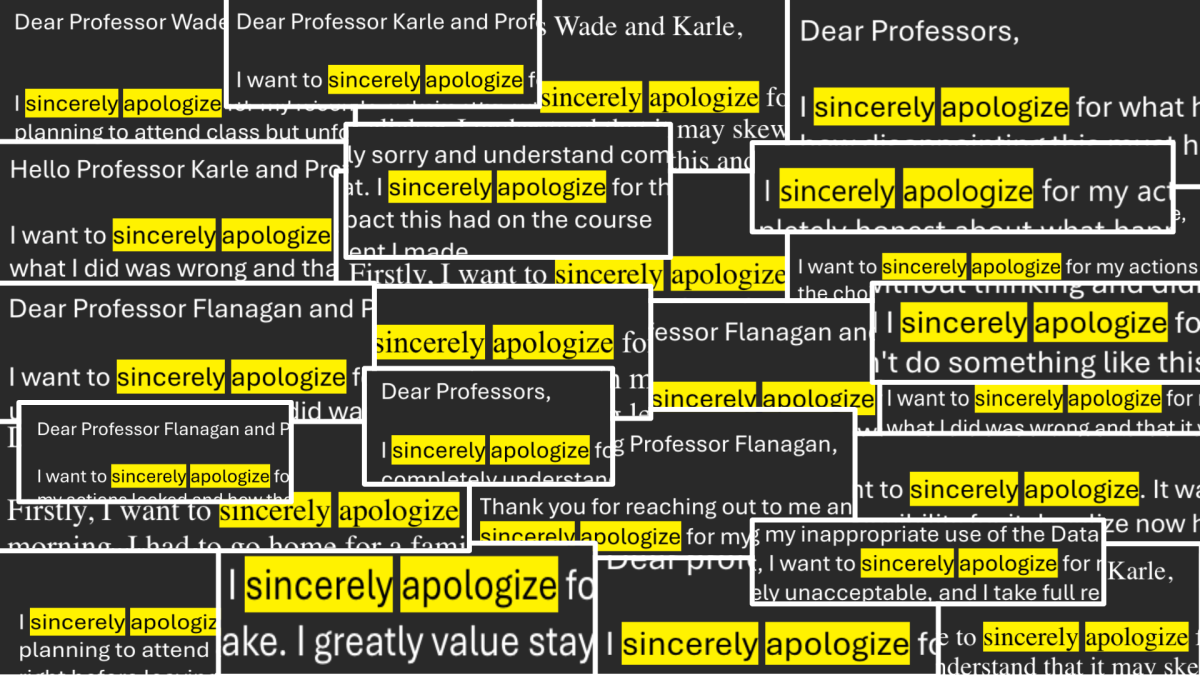
Two University professors unintentionally sparked a viral social media storm with the presentation slide they created addressing their students’ use of artificial intelligence to craft emails apologizing for cheating in the class.
A photo taken of the slide, created by Karle Flanagan, professor in LAS, and Wade Fagen-Ulmschneider, professor in Engineering, was uploaded to X, formerly known as Twitter, last week. It garnered 28 million views and continued to be spread to other platforms.
Flanagan and Fagen-Ulmschneider are the co-teachers of the class IS 107: Data Science Discovery, which is taken by 1,200 students across two sections and meets three times a week.
The professors created an app called Data Science Clicker, which prompts students to answer questions presented throughout class using a QR code. The app tracks students’ attendance and participation, which counts for 4% of their total grade in the class.
“We noticed one day that it seems like there were more people answering the Clicker questions than were actually in class,” Flanagan said.
Get The Daily Illini in your inbox!
This raised their suspicion about whether students were misusing the technology. Flanagan wrote emails to over 100 students who the app had found were answering questions from outside class, some from as far away as Chicago. She explained that if it happened again, they would have to advance their concerns to the College of LAS.
“We take academic integrity very seriously,” Fagen-Ulmschneider said.
Seeming to understand the severity, students responded to Flanagan’s email and apologized. The pair explained that the first email they received felt heartfelt, well-written and sincere, including the phrase, “I sincerely apologize for my misuse of the Data Science Clicker.”
“And then we got a second one,” Fagen-Ulmschneider said. “Exactly the same phrase: ‘I sincerely apologize for my misuse of the clicker,’ and then a third and a fourth and a fifth, and all of a sudden we had tons of emails that looked almost identical and realized that they were likely not actually written by our students. That first email didn’t feel that sincere anymore.”
Amelie Dall’erba is a freshman in LAS and a current IS 107 student. She expressed enjoyment for the class and the co-professors’ dynamic.
“I think that the design of the class is pretty lenient and … they try to make it so that you can avoid using ChatGPT and still get good grades and still finish the homework decently quickly,” Dall’erba said.
Dall’erba wasn’t aware that students were forging their attendance until the day that the professors presented screenshots of excerpts from dozens of student emails, all containing that same phrase.
“It became clear that the emails were also being written using AI,” Dall’erba said. “It was lighthearted, and it was funny, but it was also a good moment of realization. It’s a big issue.”
The professors spent a few minutes of class addressing the issue and swiftly moved on, considering it a good learning moment for the class. What they didn’t expect was for a student to take a photo of the slideshow and post it to social media, and for it to get as much traction as it did.
“Honestly, I’m shocked that anyone besides our students in the class actually saw this slide,” Flanagan said with a laugh.
The original photo uploaded to X has been viewed 28 million times and reposted over 4,000 times. Since then, the photo has also been circulating widely on platforms such as Instagram and Reddit. It has also been covered by the New York Times.
The fact that students were using ChatGPT for a simple task such as writing an email may have been surprising to some social media users; however, this event comes in the wake of many educators expressing their concerns about the effects of AI on learning.
Flanagan and Fagen-Ulmschneider are not fully opposed to the use of AI in the classroom and acknowledge many situations where it could be useful to students, such as using ChatGPT to create study questions before an exam.
“There’s a lot of these cases that I think it can enhance education, but I sometimes describe it as candy; it can be really delicious, but it can also be something that you maybe don’t want too much of,” Fagen-Ulmschneider said.