Rating: 9/10
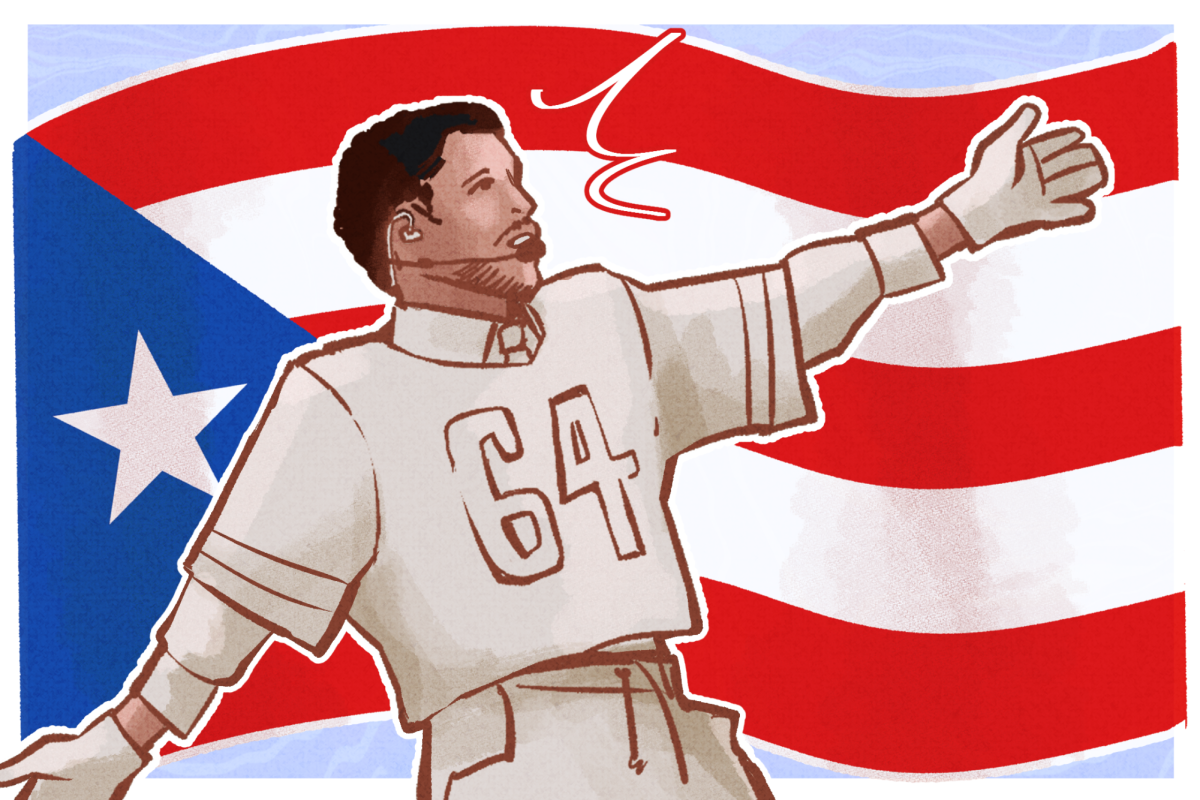
Super Bowl LX kicked off on Sunday at 5:30 p.m. As the clock ticked down to end the second quarter, the Seattle Seahawks dominated the New England Patriots with a score of 9-0. The real show, Bad Bunny’s halftime performance, was about to begin.
Bad Bunny has had quite the year. After releasing his album, “DeBÍ TiRAR MáS FOToS,” in January 2025, he won Album of the Year, along with two other awards, at the 2026 Grammy Awards.
It was announced in September 2025 that he would perform at the Super Bowl halftime show.
Bad Bunny is Puerto Rican and primarily makes music in Spanish; the announcement was met with polarizing reactions.
Get The Daily Illini in your inbox!
In response to Bad Bunny’s halftime announcement, Turning Point USA held its own version of the show, titled “ The All-American Halftime Show.” Streaming on YouTube, its performance included conservative musicians such as Kid Rock, Brantley Gilbert, Lee Brice and Gabby Barrett.
Turning Point USA’s stream pulled six million viewers, as opposed to the Super Bowl halftime show, which had 133.5 million viewers.
President Donald Trump called Bad Bunny’s performance “terrible” and not an accurate representation of America’s greatness.
Despite the narrative that the show would be for Spanish speakers only, Bad Bunny spoke at the Super Bowl LX halftime show press conference, where he said that viewers didn’t need to know Spanish to enjoy his performance.
“It’s going to be easy,” Bad Bunny said at the press conference. “People only have to worry about dancing.”
With this, viewers expected a high-energy performance. And it was delivered.
The show opened on a farm, as a jíbaro in white work clothes, pava and a guitar said, “Qué rico es ser latino.”
As the music began, an all-Spanish title card welcomed viewers to Benito Bowl.
Bad Bunny appeared in the field, football in hand, surrounded by more farmworkers and foliage as he performed “Tití Me Preguntó.”
Agriculture is important to Latino culture, both historically and economically; this felt like a tribute to the honest work many Latinos experience.
As the beat dropped, Bad Bunny walked into the scenery of Puerto Rican livelihood. From a group of older men playing dominoes to being sold a cup of piragua, imagery of Latino pride was loud and present.
The performance changed scenes, and a crowd of celebrities danced in front of a traditional Puerto Rican house. Cardi B, Karol G, Pedro Pascal and Young Miko, all Latino celebrities, were spotted.
Bad Bunny appeared on top of the casita where he delivered an energetic medley of “Yo Perreo Sola,” “Safaera” and “Party.” As dancers flooded the field, a party was in full swing.
Crashing through the roof of the house, Bad Bunny made his way to the field and greeted the audience while the strings of “MONACO” were played by a string quartet.
During the intro, Bad Bunny delivered powerful words of believing in oneself and how far that confidence can take a person.
“Si hoy estoy aquí en el Super Bowl LX, es porque nunca, nunca dejé de creer en mí,” Bad Bunny said. “Tú también deberías de creer en ti.”
Singing the first verse of the song, Bad Bunny faded off the screen with the words, “¿Esto es lo que tú quería?” Then, the ultimate image of unity, a real wedding, transformed the field.
As the newly married couple shared a kiss, a surprise appearance by Lady Gaga took the stage with a salsa-inspired version of “Die With a Smile” that got the festivities started. She was backed by an orquesta while dancers dressed in white salsaed around her.
Gaga’s salsa ballad turns into “BAILE INoLVIDABLE,” which brought the wedding back into full swing as love is to celebrate. A classic Latino celebration was represented during this moment, with the party containing a sleeping child while the “family” mixed together and dancing erupted around him.
There were many symbolic moments throughout the performance. The wedding showcased Latino love and festivities, the setting honored street vendors, farmworkers and Latin music, and the white lawn chairs that guest performer Ricky Martin sang in hold a meaning of family togetherness.
Bad Bunny’s culture was on full display, and he’s not backing down on the message of Latino Pride. In his performance’s last minutes, Bad Bunny continued to command attention as he appeared with an army of Latin American and Caribbean flags behind him.
“God bless America,” Bad Bunny said, and continued on by listing most of the countries in the Western Hemisphere.
In an ultimate celebration, “DtMF” played as the words, “The only thing more powerful than hate is love,” was displayed behind him.
It’s a simple message of unity that has long been absent. In these times of anti-Latino and immigrant rhetoric and increased Immigration and Customs Enforcement presence in cities across the United States, Bad Bunny created powerful imagery and a message of love, togetherness and honor.
More than an artist, Bad Bunny is a symbol of hope that is needed now more than ever.