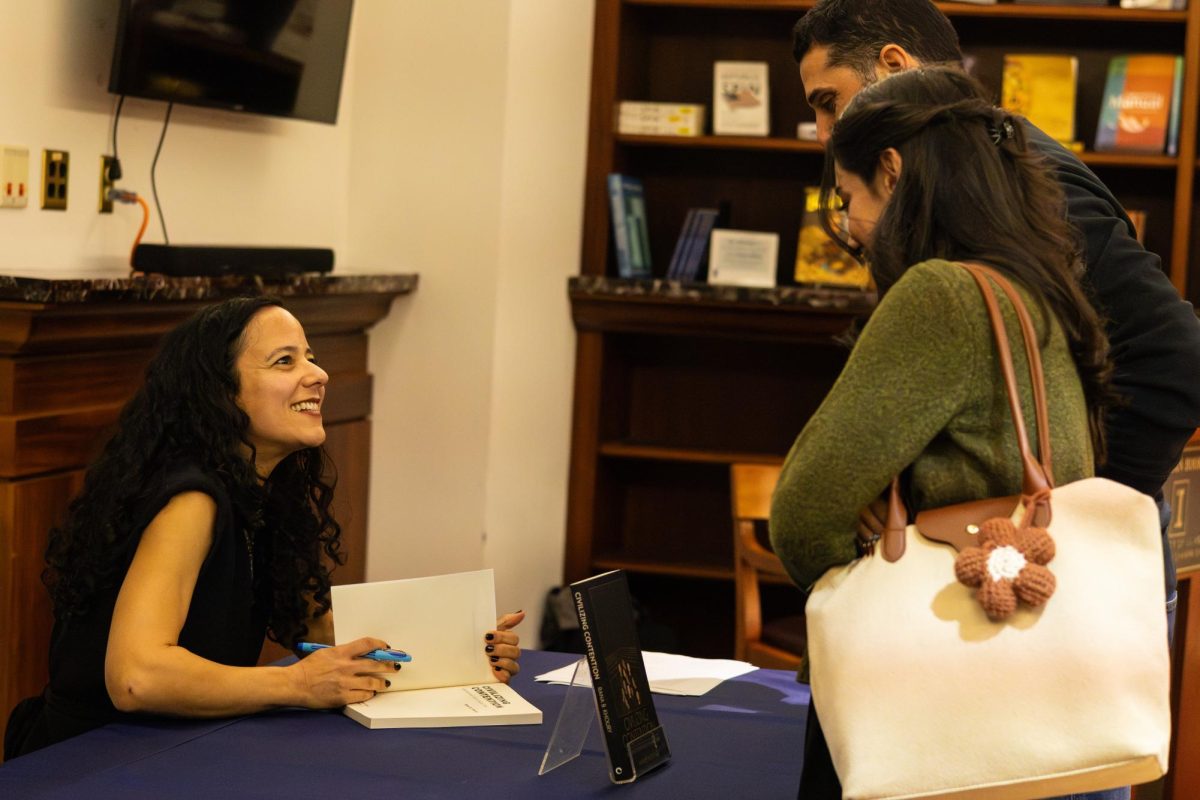
As global conflicts continue to test the limits of humanitarian response, a recent campus event turned attention to how international aid can influence the course of war and the people caught within it.
University professor in LAS, Rana B. Khoury, presented her recently published book, “Civilizing Contention: International Aid in Syria’s War,” at the Illini Union Bookstore this Wednesday.
Khoury’s work studied how international aid influences local activism during war.
She focused on how civilians and refugees found ways to keep organizing and speaking out, even while facing violence and constant danger.
The book is the result of several months of research, including numerous interviews with Syrian activists and international aid workers conducted across Jordan, Turkey and Lebanon.
Get The Daily Illini in your inbox!
The discussion detailed how humanitarian and other international aid organizations turned to local activists to achieve their crisis response goals.
However, Khoury found that, as aid imposed its structures, it left activists unprotected from the violence of the Syrian Civil War and its aftermath.
During her talk, Khoury highlighted the story of an activist who, with international support, was able to run a shelter and an educational organization.
The story illustrated how aid can empower local activists to lead change.
When the Syrian government regained control of the area where the activist worked, he was forced to flee the country. Khoury said his experience shows how people who tried to help their communities during the war were often left unprotected when the government regained power.
She then discussed her use of process tracing in her research, where she gained a profound understanding of the afterlife of the Syrian social movement and the nature of wartime activism.
Reflecting on the difficulty of this methodology, Khoury acknowledged the challenge of studying something recent.
“I don’t know if I would recommend researching things that are ongoing,” Khoury said. “I was able to sort of observe the changes as they were happening and in ways that affected my research, especially as autonomy became more and more restricted for international organizations and activists alike.”
The talk drew a few students who attended as part of HIST 135: History of Islamic Middle East.
Iva Glogovac, senior in LAS, explained that she had to attend an event to write an assignment for the class.
“I specifically came to this (event) because I took Khoury’s class last semester and I love her,” Glogovac said.
Khoury also drew attention to her use of social media in research, analyzing Facebook pages from Syrian organizations to track how they expressed or avoided political views.
The approach offered students a look at how online platforms can reveal new insights into activism during war.
For Amanda Quealy, a junior in LAS, this methodological approach was engaging.
“I love learning about people’s research methods,” Quealy said. “So when (Khoury) talked about using Facebook posts as a source, that just put things into perspective that social media is becoming a historical source. I thought that was very interesting.”
Khoury ended her talk by expressing hope for Syria’s future and for future students’ ability to engage with the country.
“I hope for any students in the room … that Syria will become a place that they can visit,” Khoury said.