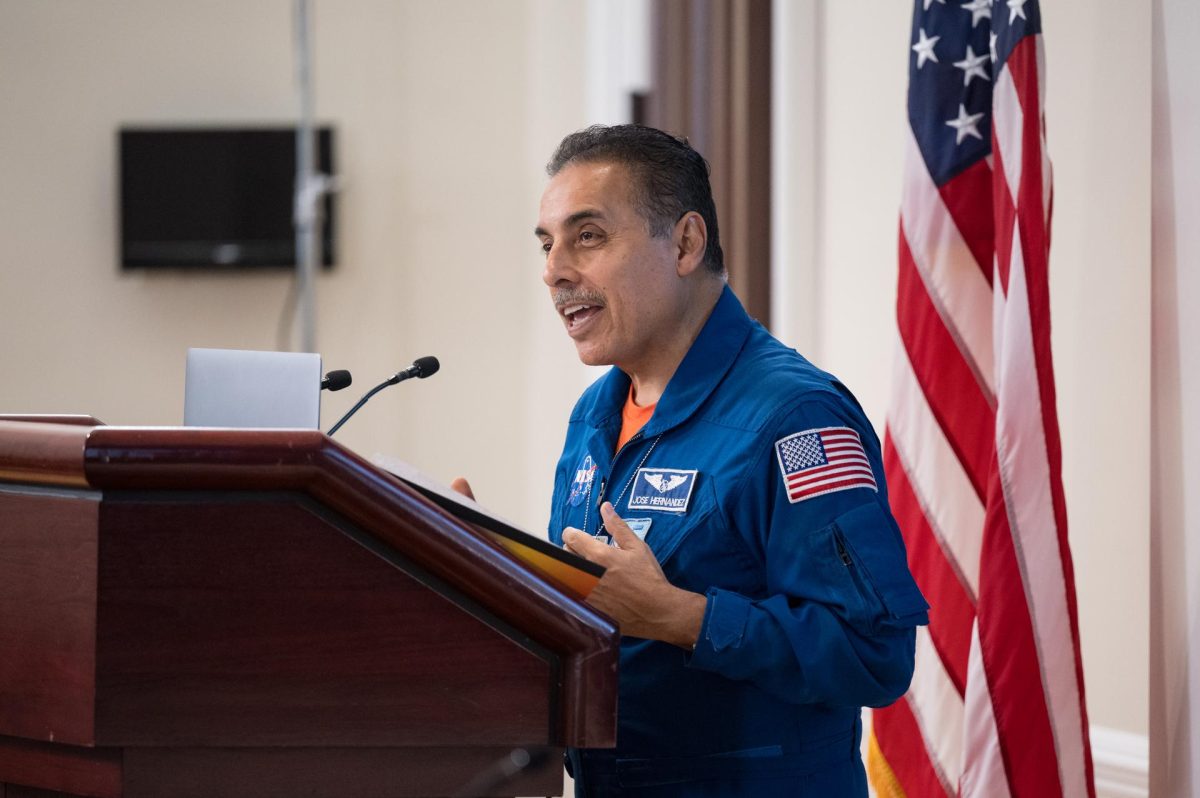
Former NASA astronaut José Hernández stood before more than 100 students, faculty and community members at the Illini Union on Saturday, delivering a story that began in the fields of California and reached the stars.
His visit, hosted by La Casa Cultural Latina and the Illini Union Board, was part of Latine Heritage Month programming.
Magaly Marin, director of enriching programs at the Illini Union, said Hernández was chosen not only to celebrate identity but also to inspire.
“Anything is possible — even a migrant farmer can go into space,” Marin said.
She added that in today’s political climate, it is important to show Latinos as more than stereotypes and highlight the impact of perseverance and opportunity.
Get The Daily Illini in your inbox!
Born to a family of migrant farmworkers from La Piedad, Michoacán, Mexico, Hernández spent his childhood moving across California to harvest crops.
His schooling was often disrupted, with new teachers every few months and stretches of self-study in his grandmother’s kitchen in Mexico.
He first dreamed of space after watching the Apollo 17 mission on television in 1972. But it wasn’t until a second-grade teacher urged his parents to settle in one place that his education gained stability.
This propelled Hernández toward a career in engineering and eventually to NASA, where he became one of the few Latino astronauts in history.
He earned a bachelor’s degree in electrical engineering from the University of the Pacific and a master’s degree in electrical and computer engineering from the University of California, Santa Barbara. He became the first in his family to pursue higher education.
In 2009, he fulfilled the dream he first glimpsed on that flickering television, flying aboard the Space Shuttle Discovery on a 14-day mission to the International Space Station.
“It’s okay to dream big, so long as you’re willing to put the work in converting that into reality,” Hernández told the audience.
NASA rejected Hernández 11 times before finally accepting him. After the sixth rejection, he nearly gave up until his wife reminded him that every letter ended with the words: “Please feel free to reapply at the next selection cycle.” On his 12th attempt, he was selected.
To strengthen his application, Hernández became scuba certified, obtained a civilian pilot’s license, learned Russian and worked with the U.S. Department of State on nuclear cooperation in Russia.
At Lawrence Livermore National Laboratory, he co-invented the first full-field digital mammography imaging system. An achievement he considers equally as meaningful as his journey to space. “I may have gone to space, but saving lives through early detection is what I’m most proud of,” Hernández said.
He went on to describe the exhilarating yet grueling eight-and-a-half-minute launch into orbit, likening it to “the best ride Disney could ever hope for — you go from zero to 17,500 miles an hour.”
Yet the thrill of speed was matched by moments of profound reflection. Looking down at Earth, Hernández recalled seeing no borders.
“From space, we’re just one human race,” Hernández said. “Borders are man-made concepts.”
The view also increased his awareness of Earth’s vulnerability. Watching sunrises from orbit, he realized how thin and fragile the atmosphere truly is.
“I became an instant environmentalist,” Hernández said. “That’s all that’s keeping us alive.”
The event also highlighted the importance of representation. Vanessa Alarcón Ángeles, senior in LAS, said seeing Hernández succeed was powerful.
“It’s important to see people that look like me that made it,” Alarcón Ángeles said. “It’s especially important during these times.”
Hernández’s story, she noted, reinforced the value of persistence and the belief that one can achieve beyond expectations.
Hernández credited his father with a “five-ingredient recipe for success”: define your purpose, recognize how far you are from that goal, create a roadmap, education is key, develop a strong work ethic, persevere and never give up.
For Hernández, the mission came full circle. He recalled landing in California, just 80 miles from where he once picked strawberries. “Poetic justice,” he called it. Today, he tends to his own vineyard, producing what he calls “the best-tasting wine made by an astronaut.”
Berenice Rodriguez, freshman in FAA, reflected on what the talk meant for her future.
“If you keep going for what you want, you’ll eventually get it, no matter how long it takes,” Rodriguez said. “Anyone, regardless of race or origin, can dream big.”
Her takeaway captured the universal message Hernández hoped to leave with the audience: Perseverance and ambition can overcome obstacles.