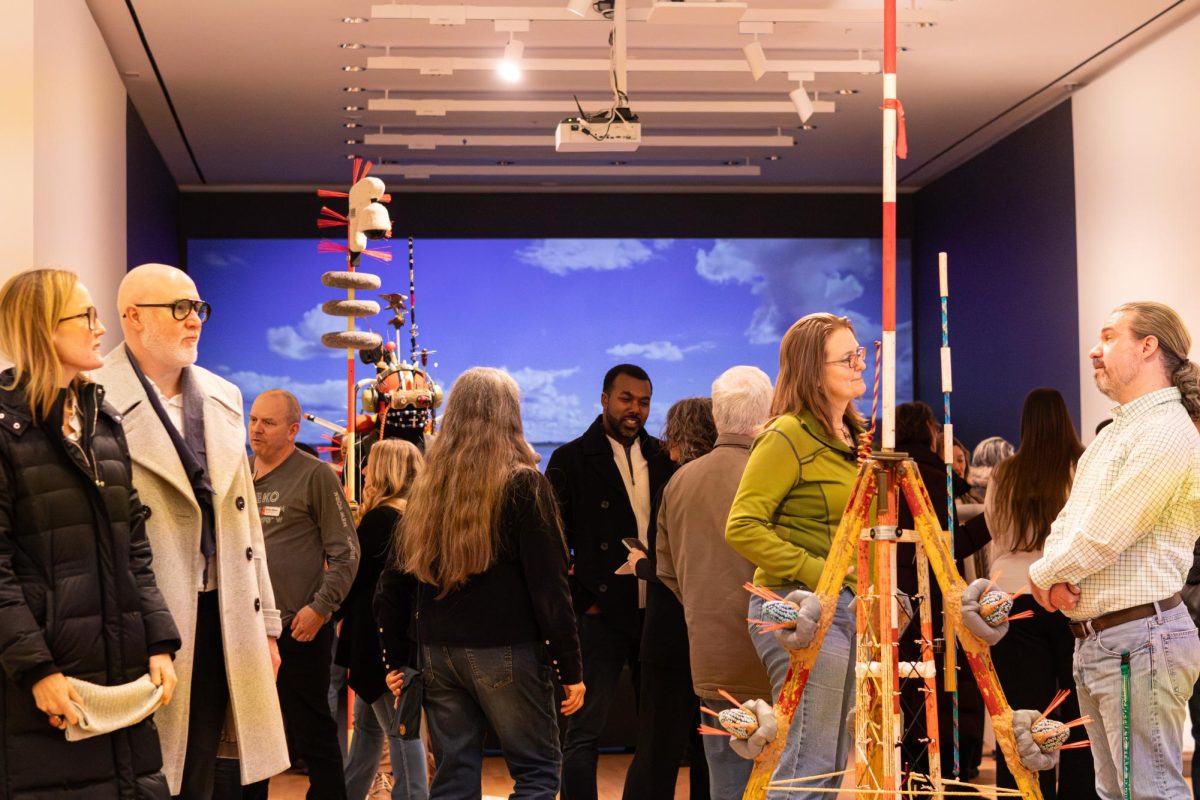
Krannert Art Museum kicked off its newest exhibition, “Another Place: Storymaking the Entangled Prairie,” with an opening-night celebration on Thursday, drawing a crowd of roughly 400 people. The show brings together the new work of 11 University School of Art & Design faculty members.
The exhibit explores the connection between people, history and land. While all of the works are physically situated in the prairie, Chicagoland and central Illinois, they span a broader timeline, covering the past, present and even notions of the future.
Beyond the pieces themselves, the event featured music and a dessert bar. Despite chilly winter weather, the show attracted a large and diverse audience extending past University limits.
“I see so much interaction between people from the greater community and then people on campus as well,” said Evelyn Shapiro, assistant director for marketing and communication at KAM, who noted Champaign-Urbana’s lively art scene.
The artists drew upon lived experience, research and imaginative storytelling. Works in the exhibition span sculpture, installation, photography, printmaking, video and performance, allowing the theme to be explored from multiple angles.
Get The Daily Illini in your inbox!
Stacey Robinson, professor and graduate coordinator in the College of Fine and Applied Arts, whose work was brought to life by animation software, described how he utilized STEM to execute the ideas behind his artwork.
“I would encourage us all to think about art not as the last addition to STEM, but maybe as our entry point to thinking about STEM and STEAM,” Robinson said.
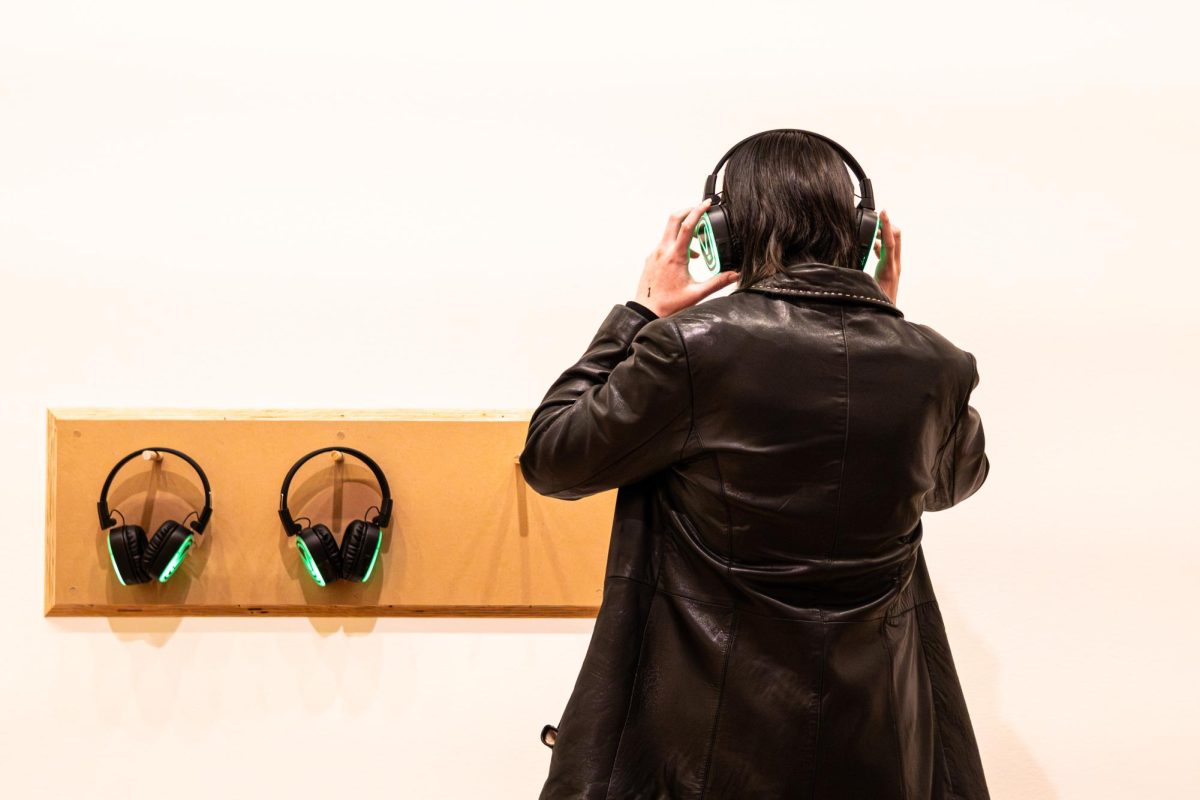
Terri Weissman, professor in FAA and director of graduate studies in the School of Art and Design, curated the exhibit. She drew the theme for this collection from the concurrent focus at the Humanities Research Institute this year.
“There was a wanting to connect with what was already going on with humanities, in terms of a conversation this year with the fellows and all of their conversations and presentations,” Shapiro said. “Certain stories can be told through artwork and interactions with artwork and installation, and all that are not able to be told through words.”
In her opening remarks, Weissman reflected on the exhibition’s timeliness.
“I couldn’t have imagined when planning this show, and when starting to plan it, just how important the ideas in this exhibition would feel at this particular moment,” Weissman said. “I think it can help us reopen the future by thinking about our collective past entanglements and tell different stories.”
Many of these stories centered around underrepresented narratives about land and community resilience in the face of hardships.
“I would encourage us to think about art as our way of protest,” Robinson said.
Since the “Black on Black on Black on Black” exhibit, faculty exhibits have shifted from a more individualized approach to interconnectedness around a central message. However, approaches to this theme varied among the artists.
“I think it’s pretty amazing that there’s bits of ecological history, human history, plant history and imaginative futuristic thinking,” said Lilah Leopold, graduate student studying art history and curatorial assistant to Weissman.
Brooke White, director and professor in FAA, explored physical terrains in her prints.
“All of my work that I’ve made since I’ve been 18 has been about place and about the landscape and our connection to it,” White said.
The prairies in our community carry a long and complex history. Robinson specifically focused on the freedom that three Black towns in Illinois were able to foster predating the Civil War.
“I was challenged to make work that I could show and honor the history,” Robinson said. “This is only the beginning of my dive into this research; there’s so much more to come in the next several years, which I’ve already started.”
As guests work through the exhibit, they are invited to transition from exploring the past to reimagining the future for their communities.
Nekita Thomas, professor and graduate coordinator in FAA, chose to ground her works in her experience growing up living in public housing on the south side of Chicago.
As such, Thomas’ work did not necessarily center around a traditional prairie, instead focusing on a baseball field near where she used to live, which carried a lot of tension from social divides that were happening in her neighborhood.
“What if this place were a little bit different, this field was a little bit different?” Thomas said. “What affordances would it have? What dreams were deferred? Who actually picked up on another type of dream because they weren’t able to play on that field as much as they wanted to?”
Behind the scenes, the curatorial team worked to position the ways in which the artworks interact within the gallery space.
“I’m really interested in that kind of cross-fertilization and conversation that happens with artists that are in the same room,” Shapiro said.
The exhibit will run through July 2. After the exhibition, artworks will be returned to their creators and may be shown in future displays beyond campus.