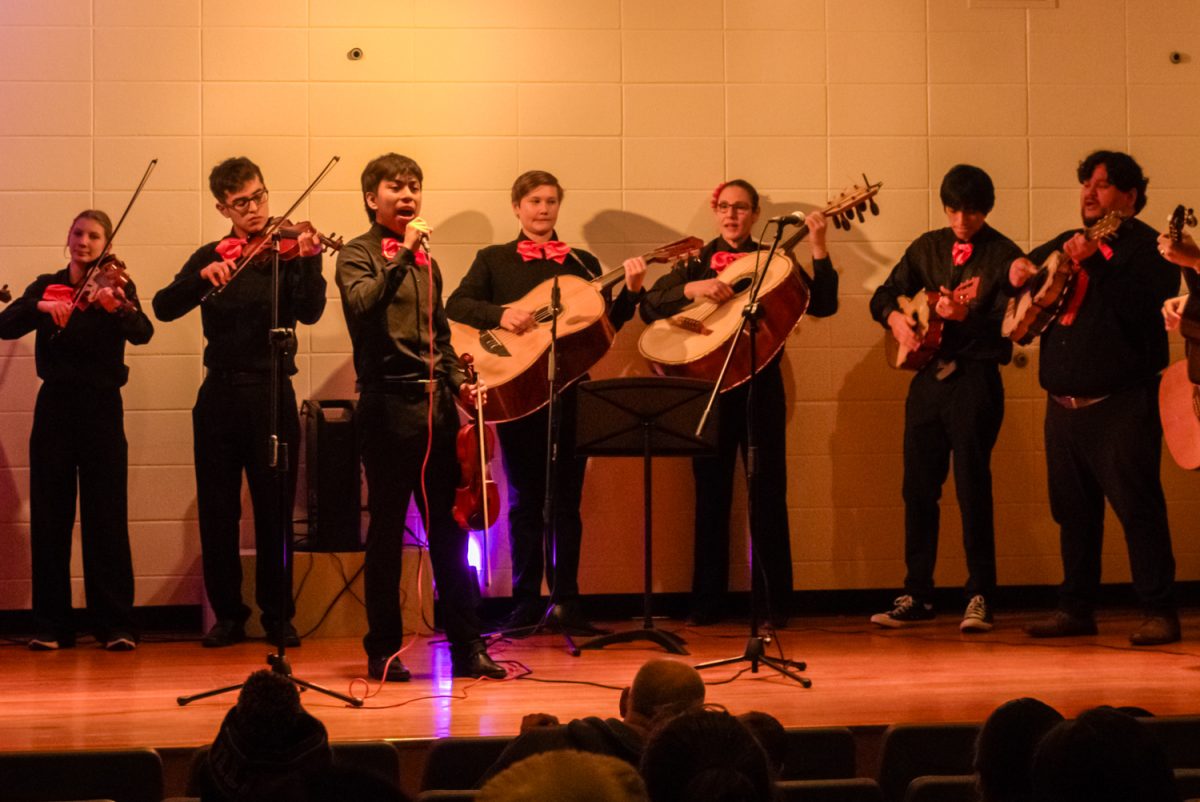
This Saturday, Krannert Art Museum held students, families and community members for Latina Voces, a high school student-led exhibition and live performance celebrating culture, identity and self-expression through art, dance and music.
The exhibition extended across all areas of KAM, transforming the space into a multi-sensory experience that centered Latino youth voices. The event featured student artwork alongside live performances, including folklórico dancing and music from Urbana High School’s mariachi program, the Mariachi Tigres de Urbana.
The exhibition also represents a multi-year collaboration between KAM, University faculty and local educators, supported by grant funding.
Rachel Storm, assistant director of community engagement and learning at KAM, said the exhibition reflects the museum’s commitment to uplifting local student stories.
“We think it’s really important for a museum of this caliber to be showcasing our local students,” Storm said. “For us, it also represents a really important effort to showcase local stories and to make sure local students not only visit the museum and see works of art that inspire them, but also that they are able to share their own stories through creative making on their own.”
Get The Daily Illini in your inbox!
Storm said students participated in field trips, after-school artmaking and a summer program hosted in partnership with La Casa Cultural Latina. These opportunities allowed Urbana High School students to engage with both the museum and the University campus before their exhibition.
Between acts, staff members educated the audience on regional styles of Mexican folklórico, highlighting dances from Jalisco, Sinaloa and Guerrero. They also explained the historical and cultural significance behind each style, speaking in both English and Spanish to ensure accessibility for the wide variety of attendees.
Hannah Velasco, director of Urbana High School’s folklórico program, Ballet Folklórico de los Tigres, worked closely with students to prepare the performances featured at Latina Voces.
Velasco said her approach to working with students goes beyond choreography.
“In addition to teaching them about folklórico, I don’t know if all of them have people in their lives that really fully let them be themselves,” Velasco said. “So I focus on their overall well-being and listen to their feedback, because being a director doesn’t mean anything if you don’t listen to the people that you’re in charge of.”
Velasco said costume choices and performance roles were developed collaboratively, allowing students to feel both comfortable and connected to their heritage. The costumes were hand-beaded with chaquira, requiring hours of detailed manual work.
The folklórico program is currently open only to Urbana High School students, but Velasco said she plans to expand it to the broader community through Phillips Recreation Center.
Faculty facilitators of the University also emphasized the importance of building trust throughout the process.
Idalia Nuñez, professor in Education at the University, said her role was less about directing and more about guiding conversations within Urbana High School students and their families.
“This was very much about building ‘confianza,’” Nuñez said. “Our role was to help them think about what they wanted to share with the community about themselves and to give them the tools to do that.”
As the program concluded, attendees gathered to share food while Latin music played throughout the museum, creating space for students, families and community members to connect beyond the performances and artwork.