In the coziness of The Literary Book Bar, four writers were able to share some of their most personal life experiences with those willing to listen. The Literary hosted Exhibit B: Black History, Present Tense.
Exhibit B was founded by School of the Art Institute of Chicago alums Justin Rosier, Alex Shapiro, James Stewart III and Ian Wojcikiewicz. It aims to expand writers’ platforms and create spaces to express themselves through performance series sponsored by the Guild Literary Complex.
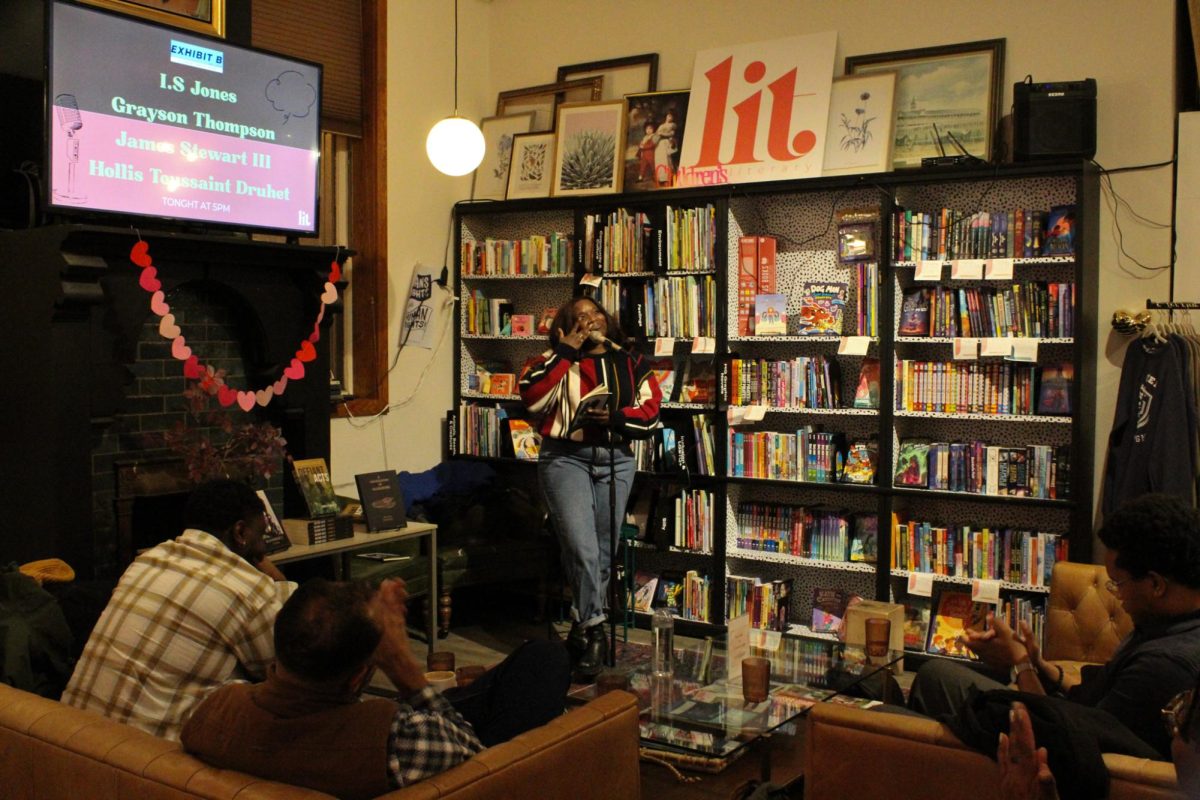
The Literary Book Bar hosted one of those performances last Saturday in honor of Black History Month. The performance featured four Black writers, Itiola Jones, Grayson Thompson, Hollis Druhet and James Stewart III, sharing poems and excerpts from their books. The writers, from Champaign and Chicago, offered storytelling that mirrors Black life across generations and landscapes.
In the corner of the bookstore, the readers sat around a microphone. Surrounding them was an audience eager to hear about their lived experiences through poetry and prose.
Taliah Abduloah, an attendee, went with her sister and mother. She said she was there to indulge in anything Black-related and show support for her community during Black History Month.
Get The Daily Illini in your inbox!
“We were intentional about showing up to support anything Black history and Black authors,” Abduloah said. “It’s just important to be in this space and for the authors to look into the audience and see people who look like them.”
The pieces explored themes that included grief, desire and becoming.
The event started with readings from Druhet, a local writer and recipient of the Lawson Prize for Poetry. Through his poetry, he portrayed his thoughts on police brutality and other injustices the Black community faces.
Then Thompson, a multi-award-winning poet, gave a synopsis of his book, “Defiant Acts.” The piece surrounds his life as a transgender Jamaican-American. He read an excerpt to the audience and gave context for some of the pictures.
Stewart, the organizer and writer, read a chapter from his debut novel, “Defiant Acts,” which was featured in the Chicago Reader and Chicago Magazine’s “Summer’s Required Reading.” The novel follows an interracial working-class family of seven living in Chicago in the 1990s.
The event concluded with the headliner, Jones, a multi-award-winning poet, reading poems from her debut poetry collection, “Bloodmercy.” The collection, named one of the best poetry books of 2025 by the New York Times, reinvents the biblical tale of Cain and Abel as sisters, depicting themes of family, sexuality and faith.
Whether it was because they saw themselves in the writers or because they wanted to show up for their community, the crowd included people from diverse backgrounds.
Veronica Groom, an attendee, was there to show her support for the Black community even though she’s not passionate about poetry and reading.
“I’m really not someone who enjoys poetry very much, but I really enjoyed tonight,” Groom said. “I think it’s wonderful to see examples of Black excellence in our communities.”
Even though the event was for those who love reading and writing, those who didn’t, like Groom, were still able to appreciate the occasion.
Jones said the highlight of the literary arts is that it renders community.
“The thing I love about poetry and literary arts is that it finds a way to bring people together,” Jones said. “I don’t know many of the people in this room, but I know that we all have a love for this long and ancient art.”
The strengthening of community is always crucial. One could argue it’s needed now more than ever.
Stewart said events like these are needed during a time when the political and social climates are causing a lot of turmoil.
“I think it’s important for people to come to events like these out in public with other people during these incredibly complicated times, just to be reminded that they’re not crazy,” Stewart said.
The writers are glad they can offer a safe space to share their understanding.
Jones hopes that more young people will attend events like these; after all, events like these are what inspired her to start writing.
“It’s really urgent that we keep creating and cultivating these third places to keep these opportunities alive,” Jones said. “It makes young people audacious enough to dream.”
After the last reader, the remainder of the time was spent between writers and readers mingling. Multiple audience members stayed to inquire more, and some bought the writers’ book.
As the writers continue their legacy, Jones stressed the importance of what they’re doing.
“We need writing more than ever,” Jones said. “We need art more than ever.”