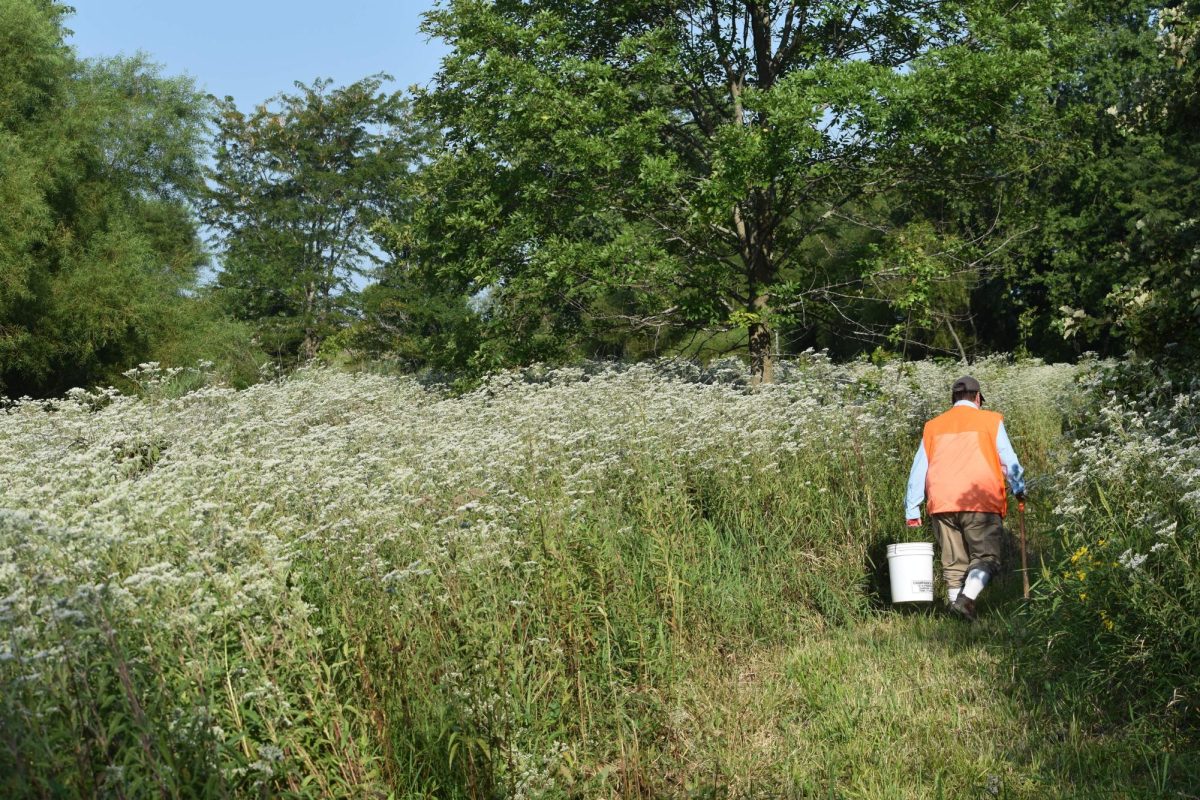
In central Illinois, a vast land known as the Grand Prairie once stretched across the region. It was incredibly diverse, home to hundreds of species of plants, mammals, birds and insects for thousands of years. As settlers arrived, much of the land was lost to plowing and converted into farm fields.
Today, less than 1% of high-quality prairie land remains. Grand Prairie Friends, a not-for-profit conservation land trust, is working to combat that loss by restoring and revitalizing prairies in east-central Illinois. The organization currently oversees over 1,060 acres.
Recently, GPF acquired a new property called Warbler Bend, located in Charleston, Illinois. This property connects preexisting properties along the Embarras River, providing endangered and native species the chance to unify their habitat and interact with more of their kind.
“When we are looking to expand our property along the Embarras River, it’s to focus on helping endangered species and native plants and animals connect their corridor … because no one likes living on an island,” said Taylor McClain, community engagement coordinator for GPF.
One way GPF decides on what land to purchase is by assessing its conservation value, according to Sarah Zoppa, administrative assistant for GPF. A high conservation value is indicated by attributes such as the presence of an endangered species or an area of untouched prairie.
Get The Daily Illini in your inbox!
After acquiring land, GPF then goes through the Illinois Department of Natural Resources to classify the land as a nature preserve or land and water reserve. This ensures the land remains protected, regardless of the future of GPF as an organization.
GPF also works to increase biodiversity and the land’s overall health. Private ownership of the land makes this easier to accomplish. GPF can make physical changes to the property without government approval, as well as keep its properties solely for its own restoration — not public recreation.
“All of our properties are open to the public, but we are able to keep our sole focus in the conservation and preservation of the land,” Zoppa said. “We always keep that as the number one goal. If we are able to provide some sort of outdoor recreation experience that invites people in, we’d love that, but with the caveat that protecting the land comes first.”
With many properties to maintain, GPF relies on volunteers to provide experience, knowledge and manpower. Kenton Macy, a volunteer for GPF, was formerly a United States Department of Agriculture biologist. With his career experience, Macy serves on a stewardship committee that advises GPF on land management.
“All that experience that I got in the USDA, and also through my training, helped me with the volunteer work that I do (at GPF),” Macy said.
In terms of manpower, one practice open to volunteers is removing different invasive species based on the seasons. During spring, volunteers target garlic mustard, a biennial herb that depletes resources such as soil nutrients and water, making it difficult for native species to grow.
GPF volunteers have also assisted in a project working to regrow bat populations. In partnership with the Illinois Natural History Survey’s Illinois Bat Conservation Program, GPF has placed 12 artificial bat roosts — structures that bats use for resting — on Warbler Ridge. Volunteers use ultrasonic recorders to collect acoustic data from the roosts, allowing scientists to identify which bat species are present.
As bats emerge to hunt at sunset, volunteers help with counting the number that emerge from the roosts. This gives scientists a way to track population growth.
“We went out there and we saw like 167 bail out of one bat house,” Macy said. “We were just (like), ‘Wow, this is cool.’”
Laura Jacob, a volunteer for GPF, is involved in a variety of practices such as invasive species removal and bat acoustic monitoring. After moving to Champaign 10 years ago, she began volunteering with GPF, hoping to meet people, get involved and explore her lifelong interest in nature.
She said the organization has now become ingrained in her community, having met many of her friends in Champaign through GPF.
“So many of the people I’ve met, I’m friends with now,” Jacob said. “I can be out somewhere, and it’s like, ‘Oh, I know that person from Grand Prairie Friends.’ It’s a big part of my social life now.”
Working side by side, volunteers foster not only land development but also a sense of community and a deeper understanding of nature. GPF is an organization centered around that mission and ensures the perpetual growth of Illinois’ prairies.