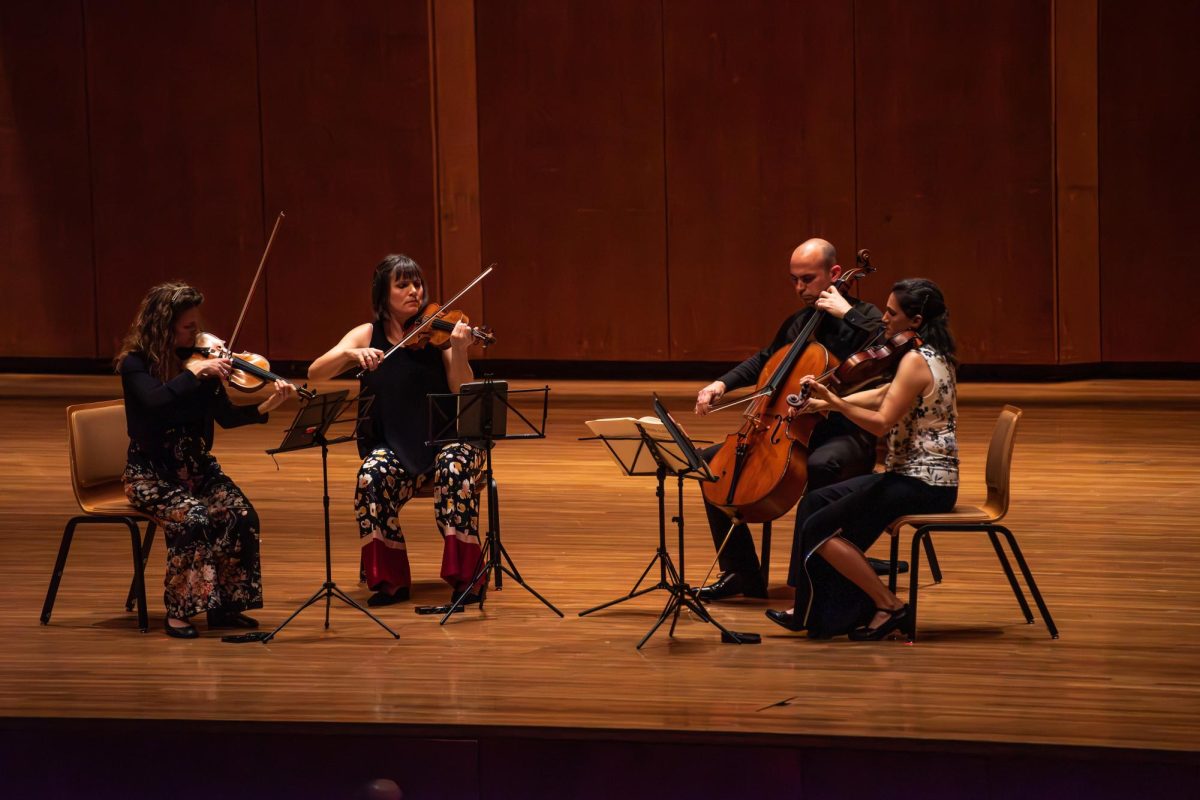
At one moment, slow and soothing — at the next, eerie and intense. The Jupiter String Quartet seemed to enter a private world together while performing at Foellinger Great Hall in the Krannert Center for the Performing Arts on Thursday, telling stories with their bodies as much as their instruments, as if playing momentarily possessed them.
Jupiter String Quartet consists of Liz Freivogel on viola, Meg Freivogel and Mélanie Clapiès on violin and Daniel McDonough on cello.
Formed in 2001 in Cleveland, the Jupiter String Quartet has performed at a myriad of prestigious locations like Carnegie Hall, the Kennedy Center and the Library of Congress.
Resident artists and instructors in the college of Fine and Applied Arts, the Jupiter String Quartet has also worked with Grammy-winning producer Judith Sherman and the Jasper String Quartet on its 2021 album “Mendelssohn/Visconti/Golijov.”
Pablo Nardie, student at Urbana High School and son of Liz Freivogel, was in attendance at the concert in support of his family on stage.
Get The Daily Illini in your inbox!
“I think it’s really cool to be able to see her up there,” Nardie said. “Every summer we get to go places because of their music festivals and performances.”
The performance began with String Quartet, Op. 33 No. 3 in C Major, also known as “The Bird,” by Franz Joseph Haydn. It is a bright, airy piece as suggested by the title.
According to the show’s program, each piece performed had four movements. “The Bird” was generally fast-paced, marked by sharp, frenetic motions by the performers.
McDonough took to the microphone after “The Bird” and made several announcements to the crowd.
McDonough said that the group originally had plans to perform with Australian Concert Pianist Bernadette Harvey at their next concert on April 25, but that she had run into “visa woes,” warning the audience ahead of time of her absence. At the mention of Harvey’s visa troubles, a disappointed murmur rippled through the audience.
McDonough then provided background to their next piece, Quartet No. 1, Op. 20 by Alberto Ginastera, a more aggressive and intense folk-inspired work filled with sharp rhythms.
The piece draws on the culture of the Argentinian gaucho, or South American cowboy, and utilizes pizzicato, a technique to create short percussive sounds, imitating the guitar tones of folk music.
Playing freely and expressively, the group fed off each other’s energy, encapsulating the spirit of the work. After the piece, there was a 20-minute intermission.
During the intermission, Urbana resident and attendee Diane Gottheil joked that the average age of the audience was 105.
When asked why the attendees were an older crowd, Gottheil said that string quartets simultaneously balanced leisure and complexity, making them the kind of activity sought out by that age group.
“You want to chill out, but you don’t want your mind to shut down,” Gottheil said.
Kavinder Patel, friend of Nardie and fellow student at Urbana High School, aspires to play jazz piano in college. Patel offered his praise to the variety of techniques used by the group, especially pizzicato.
“I really liked the second piece, especially when they intoned to the guitar key,” Patel said. “They have new pieces every time, so it’s always very fun to listen to them.”
After the show’s intermission, the group finished the performance with String Quartet No. 7, Op. 59 No. 1 in F Major by Ludwig van Beethoven, “Razumovsky.” The sweeping, dramatic quartet that embodied Russian folk music finished with a standing ovation from the audience.
According to the show’s program, the group chose their name because Jupiter was the most prominent planet in the sky at the time of their formation.
The astrological symbol for Jupiter also closely resembles the number four, denoting the significance of each member in the quartet.
The four shared an intangible, unifying energy on stage that could be seen and heard through their synchronized breathing and sharp, sometimes flowy upper body movements, creating the illusion of them all sharing one mind.
“We root for our string quartets,” Gottheil said. “We get one, we cherish them, right?”