Hidden Gem: ‘Three Billboards Outside Ebbing, Missouri’ (2017)
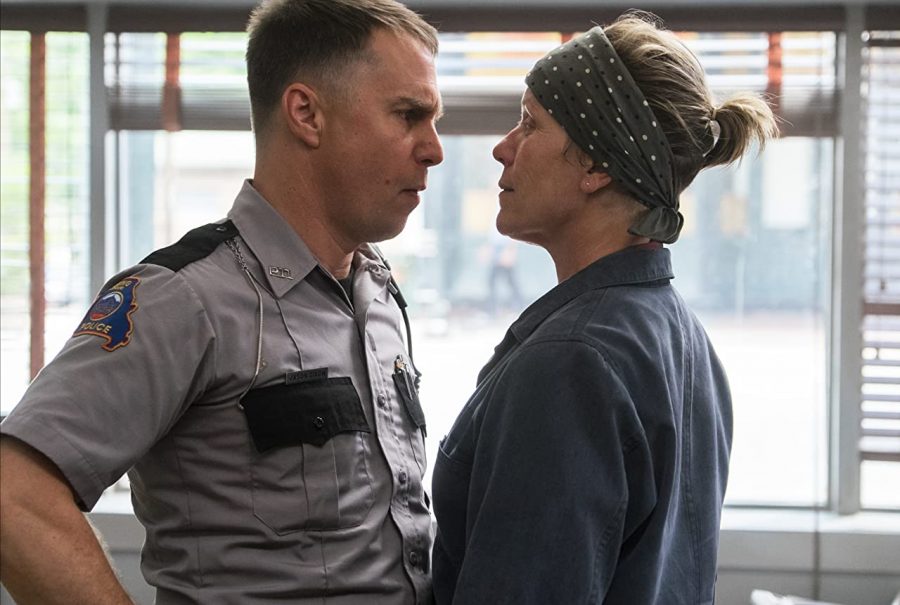
Frances McDormand and Sam Rockwell stare face to face in “Three Billboards Outside Ebbing”. The film was released on Nov. 10, 2017.
Jul 20, 2021
TW: This post contains brief discussion and language regarding sexual assault.
When Francis McDormand won an Oscar this year for “Nomadland,” she joined a unique club of only four actresses who have won three or more Oscars for their outstanding acting. Katharine Hepburn tops the list with four best-actress Oscars. Meryl Streep and Ingrid Bergman each won two best actress Oscars and one for best supporting actress.
McDormand won her second best actress Oscar in British director Martin McDonagh’s unique crime drama “Three Billboards Outside Ebbing, Missouri” (2017). This gem was nominated for seven Academy Awards, including best picture, and Sam Rockwell received the Oscar for best supporting actor.
McDonagh’s original screenplay concerns the middle-aged gift shop owner, Mildred Hayes (McDormand), whose daughter Angela was abducted, raped and murdered seven months prior, and the police have done nothing significant to help. Incredibly frustrated, Mildred lashes out against the local police. She notices there are three dilapidated, abandoned billboards on Drinkwater Road heading into town. She channels her rage by renting the signs and placing the following messages on each: “Raped while dying,” “And Still No Arrests?” and “How Come Chief Willoughby?”
With this, her action attains immediate local media attention and raises the ire of local hotheaded policeman Jason Dixon (Rockwell) and, of course, Chief Bill Willoughby (Woody Harrelson). Even a local priest warns Mildred she should remove the signs and that there should be other methods of seeking the truth about her daughter’s fate. Mildred is not convinced; she wants answers. She explains, “The more you keep a case in the public eye, the better your chances of getting it solved.”
Get The Daily Illini in your inbox!
Where you’d expect the film to become a moral tale of legal justice or even revenge, McDonagh’s screenplay is refreshingly unpredictable, where even the most cold-hearted, ignorant characters achieve understanding and consideration for others and enemies become allies. As we learn, Willoughby is actually a good cop who claims he has done his job trying to pursue leads on the crime without trampling on others’ civil rights. Willoughby also reveals he has inoperable cancer, and his condition brings about several surprising events, affecting many of the story’s characters.
Mildred’s a complex character: divorced, a single mother living not only with the memories of her slain daughter but also sharing her home with her high school-aged son while her ex-husband Charlie is dating a 19-year-old. McDormand’s Mildred is quite possibly the best of her three Oscar-winning performances, more tempered than her mostly one-dimensional comedic Marge Gunderson from “Fargo” and Fern from “Nomadland.” Her determined and strong-willed character balances rage and despair with subtle sarcasm, yet she has deep compassion and understanding for her enemies. With her sandy reddish, pulled-back hair and wrinkled face with minimal makeup, McDormand creates simple, honest and real characters.
In one horrible flashback memory of the night of her daughter’s death, Mildred recalls an argument with Angela, who wanted to borrow her mom’s car for a night out. The spiteful and disappointed Angela shouts back at her, “I hope I get raped on the way.”
The film’s supporting cast is simply outstanding. Harrelson’s Bill Willoughby is a thoughtful, serious cop who faces life-changing decisions while trying to find answers to an unsolved murder case. His performance earned him an Oscar nomination. Rockwell’s much-deserved Oscar performance as the hot-headed, racist Officer Dixon goes beyond the traditional stereotype because after a fiery accident and reading a letter from Willoughby, he reforms and learns to be a good cop. One evening in a local bar, he overhears a creep bragging about having his way with a young woman, and Dixon becomes immediately suspicious that he might be connected to Angela’s murder. He gets into a fight with this bar patron and makes sure he gets a sample of DNA to test, which eventually he’ll share with Mildred.
“Three Billboards Outside Ebbing, Missouri” was shot with rural realism in North Carolina and is a film that defies conventional genre expectations, telling its unique tale compellingly.