Latino liaison helps students adjust to school life
Dec 3, 2004
Francisco Macedo frequently fought with his peers at Central High School, swore at his teachers and walked out on them during conflicts.
The eighteen-year-old youth didn’t speak much English. He didn’t understand the school culture. And school administrators didn’t understand Macedo or his violent behavior.
His parents felt powerless. They didn’t speak English nor did they understand the school’s disciplinary procedures.
That all changed once Lucia Maldonado was hired by the district as the Latino family liaison in 2001.
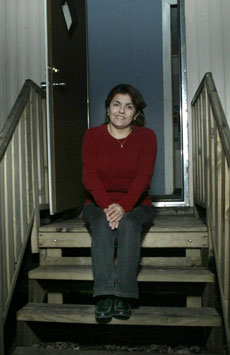
She stands only five-foot-two, is generally quiet and reserved, but she is not one to sit still. As soon as she heard about Macedo’s situation, she got to work. She spoke with Macedo’s school dean, William Freyman, and with Macedo and his parents. Maldonado explained the workings of the school system to the family. She then explained to Freyman how Macedo’s cultural and scholastic background influenced his behavior. In the end, the problem was resolved. Macedo changed his attitude and quit getting into fights at school. He attributes the transformation to the kind-hearted, dark-haired, 36-year-old Lucia Maldonado.
Get The Daily Illini in your inbox!
Maldonado is the first link between Spanish-speaking Latino families and the Champaign Unit #4 School District. She was hired as the Latino family liaison for the district three years ago, and has touched the lives of many Latino students, their families and co-workers.
“It was hard because the people weren’t used to having a process for facilitating communication for the Spanish-speaking parents,” Maldonado said. “The schools wanted me to call the parents, translate at meetings, translate notes and forms into Spanish, be in the classrooms to help the kids,…,all this for not just one, but three schools,” she added.
Those three years were full of rewards and setbacks for Maldonado. Her job demanded more than 40 hours of her time each week, so she had little time to spend with her family.
Maldonado felt the weight of her job every day when she got home from work. As soon as she walked through her house door, her now 6-year-old son would run up to her and give her a big hug.
“My son would…ask me where I had been and tell me all about how bored he had been,” she said.
For three years, Maldonado said it was the rewards that kept her going. Before her arrival, many school administrators assumed Latino parents didn’t value their children’s education.
“Some of the teachers didn’t realize parents weren’t calling you back because, hey, they can’t understand you,” said Stephanie Thomas, former attendance secretary at Central High School.
After Maldonado’s arrival, things began to change.
“Now (parents) called me and I called the school and people began to realize parents weren’t calling because,…,of the language barrier,” Maldonado said.
Maldonado said she feels that many people don’t understand how difficult life can be for new immigrants and she sympathizes with the families because she was in a similar situation nine years ago when she arrived in Champaign after leaving Mexico.
“I didn’t speak any English and I had a very hard time communicating with the schools,” Maldonado said. “I felt powerless.”
But she forced herself to move forward and signed up for English as a Second Language in the Adult Education Center in Urbana.
“It was frustrating because I would study and study, but I wasn’t making any progress in the English language,” she said.
It was not until she got her first job at McDonalds that English began to solidify itself within her – although it cost her many tears.
“I thought I would not need to know English (and) would just be in the back flipping sandwiches,” Maldonado said.
She slowly shook her head sideways as she recalled the fear that fell over her when her supervisor made her a cashier.
“The first few days I would go to work crying because I thought I wouldn’t be able to understand people or they wouldn’t be able to understand me,” she said.
She was right. Maldonado vividly recalls how some people would say, “Why are you working here if you don’t know English?”
“Eventually, I lost my fear of speaking English,” Maldonado said. “It helped me that I had a university education in Mexico, but many of these parents don’t.”
Macedo’s academic struggles, which began five years ago when he enrolled at Edison Middle School, can be partly attributed to the fact that his parents got little or no education in Mexico, Maldonado said. The family is also struggling financially, she added.
“When he was in eighth grade he told me he wanted to work and not go to high school,” Maldonado recalled. “He wanted to have some money to buy (some nice) clothes.”
After that conversation, Maldonado began to work closely with Macedo, but it was not until he spent 36 days in jail last year for driving without a license and missing a court date that his attitude toward school changed.
Although it was not part of her job, Maldonado sought advice from lawyers, police officials and friends and spoke with school officials so Macedo would not be dropped from school.
“Before that moment, I never cared about school, or anything,” Macedo said. He then went from an F average to a C average within a year.
“The fact that you did something and someone’s life improved as a result…that’s very satisfying for me,” Maldonado said.
She felt the many hours she spent outside of school talking to Macedo finally paid off.
“A lot of people would have walked away and given up on the situation, but not Lucia,” Thomas said. “She persisted until she got the results she sought,” she added.
Macedo is glad for Maldonado’s persistence.
“If I am still in school and have stopped getting into trouble it is because of her,” Macedo said.
Maldonado has also impacted her co-workers.
“She opened my eyes to diversity,” said Michelle Brown, one of Maldonado’s former colleagues from the Champaign school’s Family Information Center. “Before, it was just black and white issues. That changed with Lucia’s involvement,” she said.
Brown added that she was impressed by Maldonado’s determination to get kids back in school, of which Alfredo Delgado is another example.
“I would always check with the deans to see if kids weren’t coming to school and that’s how I found out Alfredo had already gone several days without going to school, and nobody knew why,” Maldonado said.
Delgado quit going to school because of a medical problem: His artificial leg was too old and its plastic was cutting into his skin. He said walking had become too painful and his mother could not afford to pay the $900 it would cost to replace his prosthesis. He spent about a month and a half in bed while Maldonado sought aid.
“I gave up many lunch breaks and family time while I sent out e-mails and made phone calls, looking for a way to recruit funds to get Delgado the prosthesis he needed to walk, and get back in school,” Maldonado said.
Delgado does not know what would have become of him if Maldonado had not helped him.
“I am very grateful for all her help,” he said.
Many of her co-workers are impressed by Maldonado’s tenacity.
“She kept hitting walls,” Brown said. “People would say, ‘No we can’t help you,’ but she didn’t stop. She kept her spirits going, got the help and got the kid back in school.”
However, not everyone in the community holds Maldonado in such high regard.
Louisa Sandoval, the district’s new bilingual director, greatly limited Maldonado’s job responsibilities upon her arrival in January.
“She wouldn’t let me know what was going on, so that I could inform parents if they called me,” Maldonado said. “When she would have meetings with the parents she would tell me that I couldn’t be there. I felt that she saw me only as a translator and nothing more,” she said.
Louisa Sandoval could not be reached for comment after many attempts during a three week period.
Maldonado said working with Sandoval was difficult.
“I felt like I was no longer able to do my job well,” Maldonado said. “I also missed my family and wanted to dedicate more time to them,” she added.
This summer she resigned her position as Latino family liaison in Champaign. Her position remains vacant.
Maldonado now works part-time at the Regional Office of Education and is seeking a degree in social work.
“There is a really big need for bilingual social workers. I saw it when I was working in the district,” Maldonado said
Writer’s Note: Lucia Maldonado, Francisco Macedo, Alfredo Delgado were interviewed in Spanish and their quotes translated to the best of my ability.