Students divided on possible cell phone ban
Online Poster
Sep 7, 2005
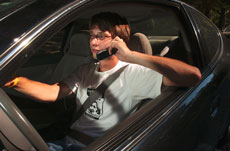
On this campus, students seem to talk on their cell phones more often then they talk to each other, and every day risk getting hit by a bike if they’re too busy text messaging. But for these students a newly proposed law banning the use of their mobiles while driving may not come as a shock.
Currently in Illinois, it is illegal for both bus drivers and people under 18 to talk on a cell phone while behind the wheel. However, legislation is currently being proposed in Congress to make a national law that may prohibit hand-held cell phone use altogether while driving. This law has already been enacted in the city of Chicago, where traffic is heavy and accidents are daily, with a current fine of $50 per infraction.
Surprisingly, the reaction among University students has been somewhat divided as the issue of safety and convenience come into play.
“It, (the law, if passed), would be annoying,” said Dannie Brown, sophomore in LAS. “But it makes sense. I can’t tell you how many times I’ve almost gotten into accidents because I was scrolling through my phone.”
The new law does offer some compromise, as it would allow hands-free cell phone talk with the use of headphones, earpieces and speakerphones in cars.
Get The Daily Illini in your inbox!
“I’ve used my dad’s hands-free cell phone device before and it’s pretty convenient,” said Zach Johnson, freshman in LAS. “You don’t have to worry about driving with one hand or balancing the phone between your head and shoulder.”
The research and statistics behind cell phone use while driving do nothing but help support the passing of this law.
According to the National Highway Traffic Safety Administration, traffic accidents are the No. 1 killer of teens. And research by the Illinois Secretary of State’s Office shows using a cell phone while driving increases the chance of getting into a crash by 400 percent.
However, statistics abundant, there are those students who believe the law won’t make a large impact in preventing accidents but will only inconvenience those who use their time in the car to catch up on conversation.
“Talking in the car is the perfect way to kill two birds with one stone,” said Jenna Bell, junior in Education. “I don’t have time between classes, work and going out to talk on the phone, so I always wait and make my phone calls in the car.”
Other students like Stephanie Souza, junior in Applied Life Studies, feel the law is good in theory but not in practice. She doesn’t mind the thought of using a hands free phone, but believes that it won’t actually prevent accidents.
“Even if we all use cell phone earpieces, it won’t stop people from looking up numbers in their phone or text messaging while driving,” said Souza. “That’s when the majority of accidents seem to happen – when people aren’t paying attention, not when they are just looking at the road and talking. It’s exactly like the radio in a car. Singing to the music doesn’t cause an accident, changing the station does.”
Although University students are split about the possibility of a new law, whatever decision is made by the federal government will override all local legislation and be concurrent nationwide, according to the National HIghway Traffic Safety Administration.
Until then, students may want to invest in a cell phone earpiece if not for driving, then to remain tire-mark free from campus bikers.