Stories of Strength: Libby
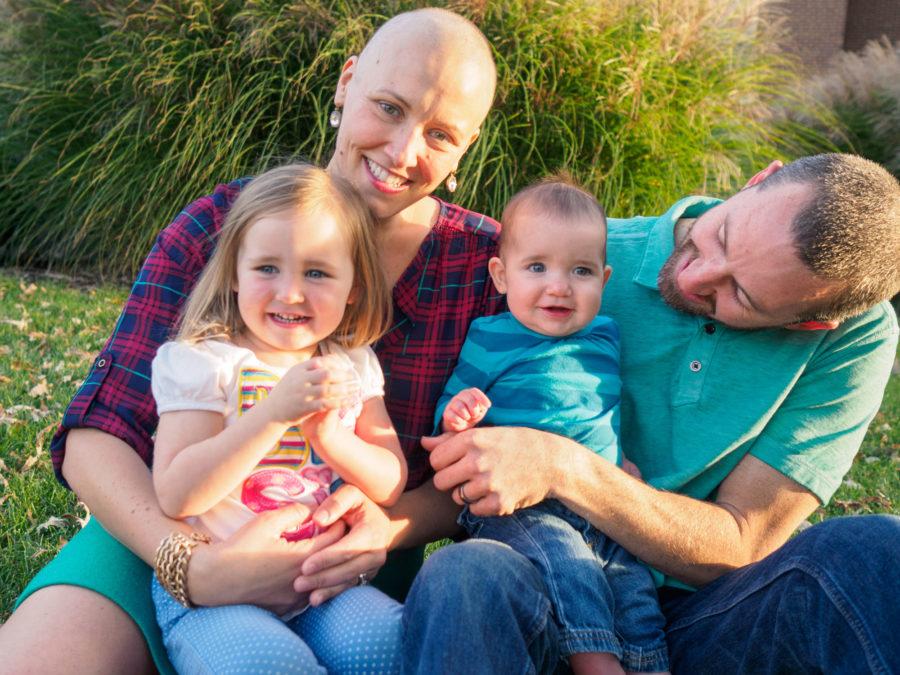
Libby Kacich with her family.
Oct 28, 2015
Libby faced her, explained what was going to happen, then her husband, Bob Kacich, shaved Libby’s hair off with clippers.
“Mommy, Daddy is cutting your hair off!” Caroline laughed.
Caroline continued to watch and laugh, and as Libby saw the moment through her daughter’s eyes, she breathed easier.
On July 9, Libby Kacichch, director of Creative Services for the University’s Public Affairs office and 2003 alumna, was diagnosed with Stage 2 breast cancer.
Get The Daily Illini in your inbox!
A cancer diagnosis never comes at a good time, but hers was particularly ill-timed, Libby said. It was just weeks after she gave birth to her second daughter, Birdy, the day before her husband’s 35th birthday, and less than two weeks before her 34th birthday.
“I just immediately thought of my children and needing to be here for them, and I also felt ready to get answers, and I was ready to dive-in,” she said. “I felt like I immediately knew, my life is changing right now and there will never be a point where I go back to the way that it was before. It’ll always be different.”
Following the diagnosis, Libby’s obstetrician-gynecologist set up an appointment for her at Carle Foundation Hospital’s Mills Breast Cancer Institute. She had no family history of breast cancer and was young and nursing at the time — a practice that can cause lumpy breast tissue.
Her oncologist at Carle admitted that if her doctors met her based off of the latter, they wouldn’t have suspected it was cancer.
Libby was tested for BRCA1 and BRCA2 gene mutationsch — human genes that produce proteins that suppress tumors — and the doctors found a mutation in her BRCA2 gene.
She lost her mother about 11 years ago to stomach cancer and has no living relatives on her mother’s side to test for the gene. However, she is having her father’s side get tested for the BRCA2 gene mutation.
Now, three months later, she is weeks away from Nov. 20 — her final chemotherapy treatment.
Every three weeks, Libby drives three hours southwest with her husband to Barnes-Jewish Hospital in St. Louis on Thursday evenings. They read jokes to each other during their car rides and make it back in time for dinner with their daughters on Friday. Over the course of 18 weeks, she will have received six doses of different drugs, all with various side effects.
“When my doctors described to me the exhaustion, I didn’t really understand it or believe it,” she said. “But they told me that I would be so tired that even when I would sleep, I would wake up feeling just as tired. So I take naps a lot.”
On a chemo day, Libby feels pretty good. But it’s the third and fourth days after an infusion that she starts to feel really bad — though the day varies depending on the drug.
“A lot of people look at me with the puppy dog eyes, and they’re like, ‘I’m so sorry for you.’ And that doesn’t do anything for me,” she said. “It doesn’t make me stronger; it doesn’t help me.
“It makes me feel sadder for people to react like that.”
However, Libby considers herself lucky to have family, friends and co-workers treat her the same as before.
“If I seem like everything’s normal, I think it’ll help her to feel more normal,” Bob said. “And get it off her mind, and keep her mind occupied with the rest of life.”
And for Libby, there’s a lot of good to focus on in life.
“We go to St. Louis for these trips,” she said. “But when we’re home, we’re playing with our kids, we’re eating dinner as a family, we’re taking outings, we’re visiting with our friends, so that I think has helped me tremendously.”
Libby also finds it helpful to be at work and hasn’t missed any workdays except when she leaves for chemotherapy.
Some of her co-workers shaved their heads in solidarity, and they bring her funny signs and Fun Dip — her favorite candy.
“One day she’ll have a pink wig on, and the next day maybe she’ll have a scarf on, and the next day she’ll have nothing,” said Robin Kaler, Libby’s friend and associate chancellor at the University. ch“But she’s made it her own, and she’s made it something that’s not scary … and it allows people to talk to her. She makes it very easy to talk to her.”
Kaler, who works in the same office as Libby and is a breast cancer survivor, accompanied Libby to all of her preliminary appointments, took notes, asked questions and provided support for Libby.
“Lots of times when you’re just learning about something like that, all you hear is ‘Cancer, cancer, cancer,’ no matter what anybody says. And you’ll get home from a doctor’s appointment and you won’t even really remember what the doctor said,” Kaler said.
Despite being a private person, Libby decided early on that she would cast her support net wide, and share her story with others. She started a blog on CaringBridge, a forum for people to share their health journeys, and updates her friends and family on how she’s feeling, her treatments and anything related to the situation.
“I initially started it so I didn’t have to tell my story over and over again and I didn’t have to talk about cancer all the time, because that’s like the least fun thing to talk about,” she said. “But it’s become very therapeutic for me … People post their comments to my post and they lift me up and they make me feel so much better when I’m not feeling good.”
Nevertheless, Libby still considers herself “really bad at receiving attention,” and would rather take the support in and turn it back out in a way that helps others.
A friend of Libby’s introduced her to the Prairie Dragon Paddlers,ch Illinois’ first breast cancer survivor dragon boat team. Not to be confused with a rowing team, dragon boat racing is an old Chinese sport and a typical boat is about 48 feet longch. The paddlers all stroke together in a synchronized motion and the average team’s stroke rate is 70 to 80 strokes per minute.
As a former athlete, Libby is excited about the sport and helped the team with marketing and fundraising efforts.
In December, she will have a bi-lateral mastectomy. Though she only has cancer in one breast, there is an 83 percent chance that she will get it in the other breast later on. Depending on how the surgery goes, Libby may or may not receive radiation treatment.
In the spring, she hopes to join the Prairie Dragon Paddlers and compete in some races.
“This part is shitty. The fact that you have to get chemo, that you have to get surgeries like this, and do all of this stuff is really bad,” she said. “But there’s so much more good, and being able to focus on that is for me what makes it possible.“