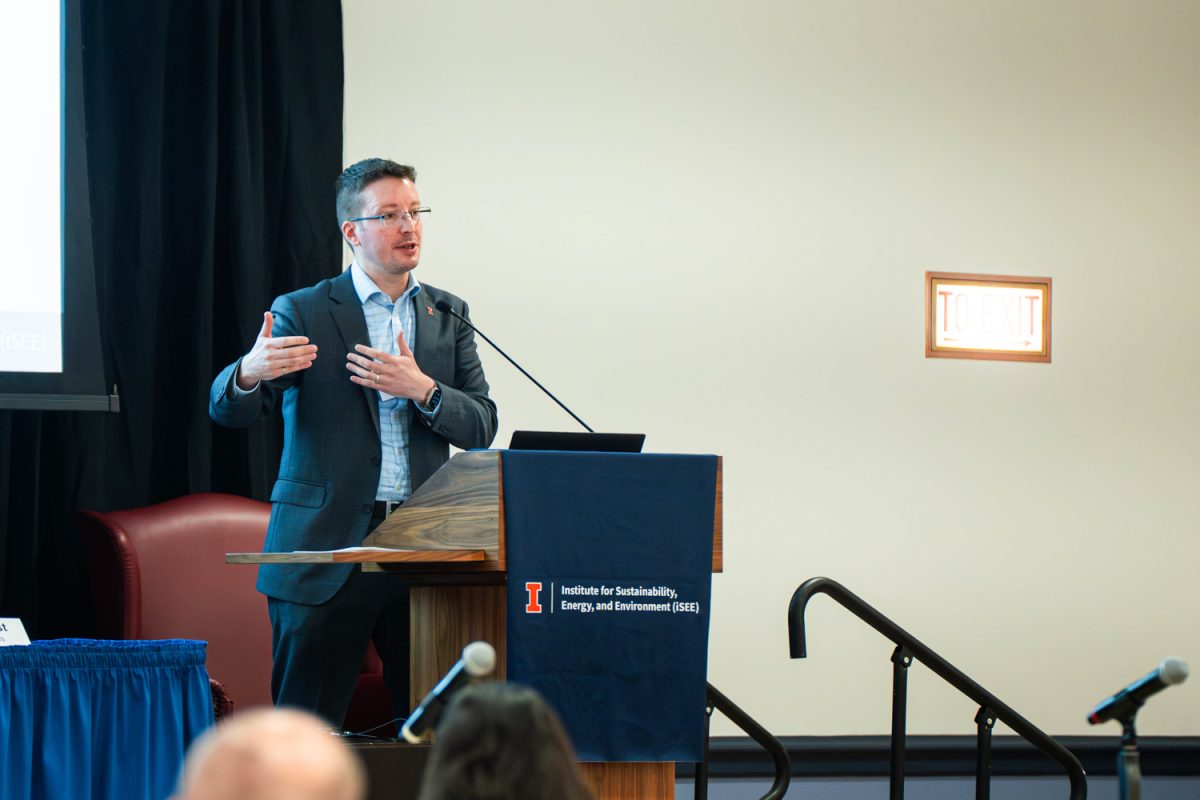
The Institute for Sustainability, Energy, and Environment featured 18 speakers and hosted roughly 250 guests last Thursday and Friday for its annual Congress, addressing the theme of “A Circular Bioeconomy as a Path to Net-Zero.”
Numerous field experts in sustainability and green development attend the congress each year with the aim of pushing solutions to environmental dilemmas in mind.
This year, scientists, professors, corporate executives and journalists spoke at the event at the National Center for Supercomputing Applications on Thursday and at the Illini Union on Friday.
This 11th annual meeting explored zero-waste food systems, decarbonizing energy systems, alternative bioresources to plastic and carbon reduction strategies as key focuses of each discussion. Speakers offered their solutions within each category, in addition to evaluating those of their peers.
“I think sustainability is a topic that a lot of people support and agree with but struggle to implement in day-to-day life,” said Luis Rodriguez, professor in ACES and associate director for education and outreach at iSEE. “So this makes it more tangible.”
Get The Daily Illini in your inbox!
Rodriguez was a key organizer of the event. He helped to form committees, reach out to speakers and decide on themes with a clear interest in making topics as widely applicable as possible.
“iSEE really serves the whole campus,” Rodriguez said. “We have people from at least six or eight different colleges coming, and that’s a really broad audience. For that reason, we’re coaching our presenters to consider that and speak as broadly as they can.”
Each panelist spoke for 15 minutes, with an extra 15 minutes allotted for audience questions. Students stopped by the Union at various times throughout the day for the panels that interested them most.
“So far, I’ve seen a lot that actually connects directly back to things in my own life that I know can, you know, help me make a little more sense of what I’m seeing, so it’s not all academic talk,” said George Taylor, senior in FAA.
Taylor also said he had personally approached Gal Hochman, a speaker and professor in ACES, to follow up on his talk. He said he saw many similar private conversations taking place between presenters and audience members between panels.
Matthew Bastianen, sophomore in FAA, offered his perspective on how food waste, one of the topics covered in the panel, especially applies to the University.
Bastianen raised concerns about food wastage in University dining halls, saying that while University Housing employees make efforts to lessen food waste, many students still tend to leave food on their plates when dropping them off after meals.
“At the end of the day, there’s still so much food being wasted,” Bastianen said. “And so I think that there’s still so much opportunity in the local area to help.”
After the event’s panel on food waste solutions, Brian Roe, professor in Agricultural, Environmental, and Development Economics at The Ohio State University, urged the importance of reducing consumption.
“The very principle of a circular economy is to use less,” Roe said. “Perhaps the most critical and foundational step toward sustainability is just ‘less.’ It doesn’t have to be highly technologically intensive, so less is more, in terms of sustainability.”
Roe also spoke about the importance of this congress and similar ones in terms of their effect on speakers, rather than just audiences.
“As scientists, it’s very easy to focus on your own narrow research interests,” Roe said. “A meeting like this brings together a diversity of disciplines, perspectives, geographical and regional interests, which permits making connections among oftentimes siloed scientists and those connections can oftentimes lead to insights and opportunities that would not otherwise be available.”
The conference aligned with the mission of the Levenick Center for a Climate-Smart Circular Bioeconomy, a new center within iSEE, which was announced about a year ago.