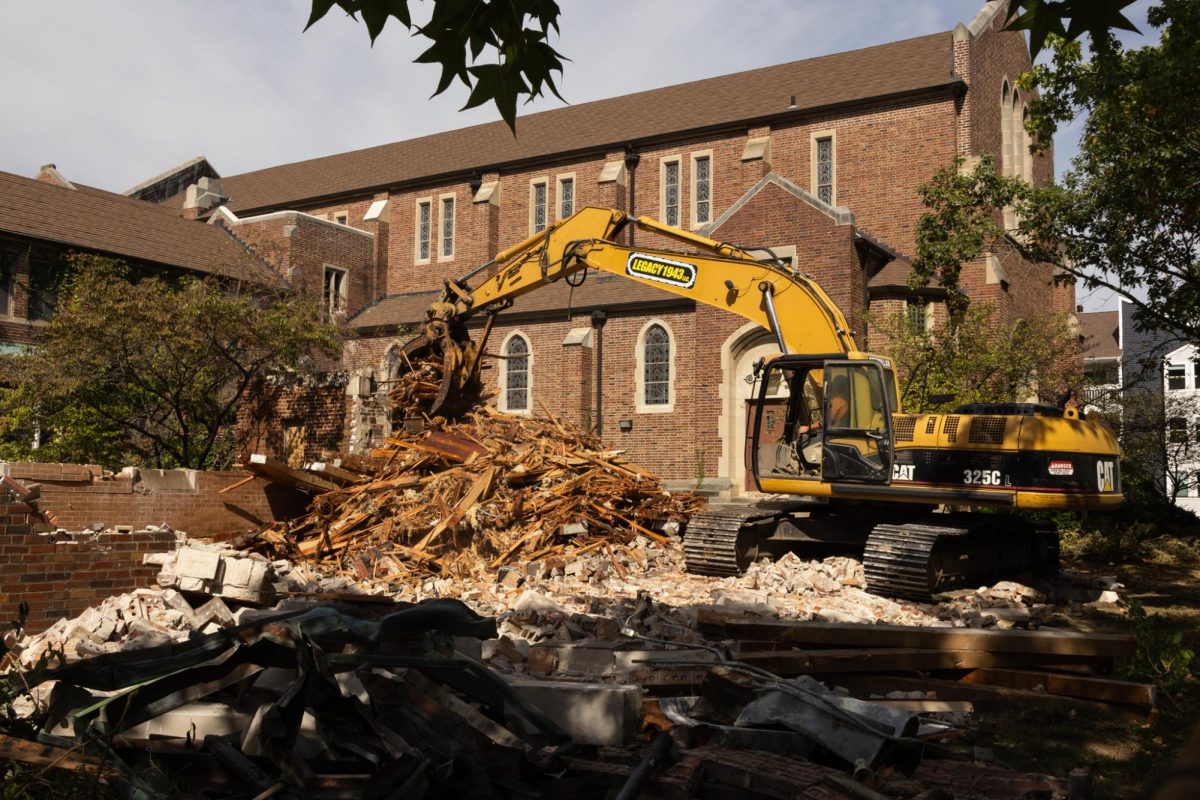
UniPlace Christian Church held its final service last month after standing at 403 S. Wright St. for 89 years. Mounting maintenance costs and a dwindling congregation contributed heavily to its sale to Fairlawn Real Estate, which operates Smile Student Living, in late March. The former church is now fenced off for demolition.
“The congregation, of course, means a lot to us, but we’ve had a strong emotional attachment to the building itself, which really has been a magnificent structure,” said Eric Freyfogle, chair of the UniPlace trustees and member of the church for 40 years.
According to Freyfogle, the congregation was nearly 300 members strong in the ’90s, but has dwindled to roughly 50 people today. The shrinking congregation could no longer support the demands of the aging, ornate structure, which has accumulated millions of dollars in repairs.
Freyfogle feels the church has become less accessible to the wider community amid Champaign’s continuing development, which contrasts with the aging congregation.
“Champaign and Urbana have radically different approaches to development on the fringe of campus,” Freyfogle said. “Champaign has been free to let people just rip everything down and put up student apartments and commercial buildings.”
Get The Daily Illini in your inbox!
When the church was completed in 1936, it was named for the University Place tram stop just outside the building, according to Freyfogle. In the years since, the city implemented buses and bike lanes, and new apartments and a nanotechnology laboratory surround the church lot.
Though UniPlace felt it was best to sell its building, not every campus church has suffered so heavily from new development.
Before pastor Michael Crosby began working at the First Mennonite Church, located five blocks east of UniPlace in Urbana, he said there was a time when the congregation considered moving. They believed leaving the campus area would give the church more room to grow. With a current congregation of roughly 150 members strong, First Mennonite kept its campus location, where the area has remained relatively stable in the 15 years Crosby has been at the church.
“Most of the spaces where developers have put up more high-rise or newer buildings are just far enough away from this little neighborhood that it hasn’t affected it quite as much,” Crosby said.
Though Crosby and Freyfogle testify to relatively lower development in Urbana, developers have shown Crosby interest in buying the First Mennonite property. Still, he believes the value of a stand-alone church on campus exceeds the monetary gain of selling.
“For us, it’s been really significant to have a pretty visible spot here,” Crosby said. “You can see some of the signage around the building that we’ve tried to utilize our visibility to speak some positive and justice-seeking words into the community.”
First Mennonite has incurred maintenance costs of its own, despite being a simpler and younger structure than UniPlace. The sizable congregation has been able to make the repairs and continue operating the church.
For smaller congregations, Freyfogle believes UniPlace may be setting a precedent for selling campus church property. However, another campus church already went through a similar situation just last year.
St. Andrew’s Lutheran Campus Center’s pastor Jon Fry said their 68-year-old building had accumulated a lot of deferred maintenance needs. As a smaller ministry, the church lacked the resources necessary for upkeep.
In early 2024, St. Andrews made an agreement with Fairlawn to demolish its building at 909 S. Wright St. in favor of incorporating a church space in the bottom two floors of the new Smile apartment complex that opened to residents this fall on the original property.
“I think sometimes we put too much emphasis on buildings, especially in the church,” Fry said. “People are really tied to a building or a space as the only place where they can find God, and I think that sometimes that ties us down into what we can do in ministry.”
Though Fry is less concerned with the specific four walls he preaches in, not everyone shares his attitude about physical structures of worship.
“It’s an absolutely extraordinary masterpiece that deserves to be a historical landmark,” said Nancy Hays, Champaign native and 1980 University alum who grew up attending UniPlace.
Hays worked with Leslie Colbert Baker, who led the effort to prevent the destruction of UniPlace. Baker petitioned for the building to be a local landmark and spoke in front of the Historic Preservation Commission and the Champaign City Council. On Oct. 14, the City Council denied the landmark status, and demolition is set to continue.
“It was agonizing for the people,” Freyfogle said of the decision to sell UniPlace to Fairlawn.
Freyfogle opposed the potential landmark designation, ultimately pushing for the church’s destruction to keep the sale from falling through. Even though he believed selling UniPlace was the right thing to do, it didn’t make the decision easy.
“Everybody on the (UniPlace) board was there and it was a unanimous decision (to sell), but it was a decision that brought tears to people’s eyes,” Freyfogle said. “There are people who said, ‘I know we have to do this, but it is so painful for me that I don’t even want to talk about it.’”
For now, UniPlace will continue to follow in the footsteps of St. Andrews by using Latzer Hall at the University YMCA as a temporary worship space until it decides on a new location.
Though Freyfogle was complimentary about their temporary home, he couldn’t deny that the adjustment had a price of its own.
“It’s hard to imagine that people will develop a kind of affection for it that they had for our own place,” Freyfogle said. “And I don’t know what lies ahead.”
CORRECTION Oct. 27, 3:42 p.m.: A previous version of this article did not include Baker’s role in the effort. The article now reflects her submission of the local historic landmark application and continued petitions.