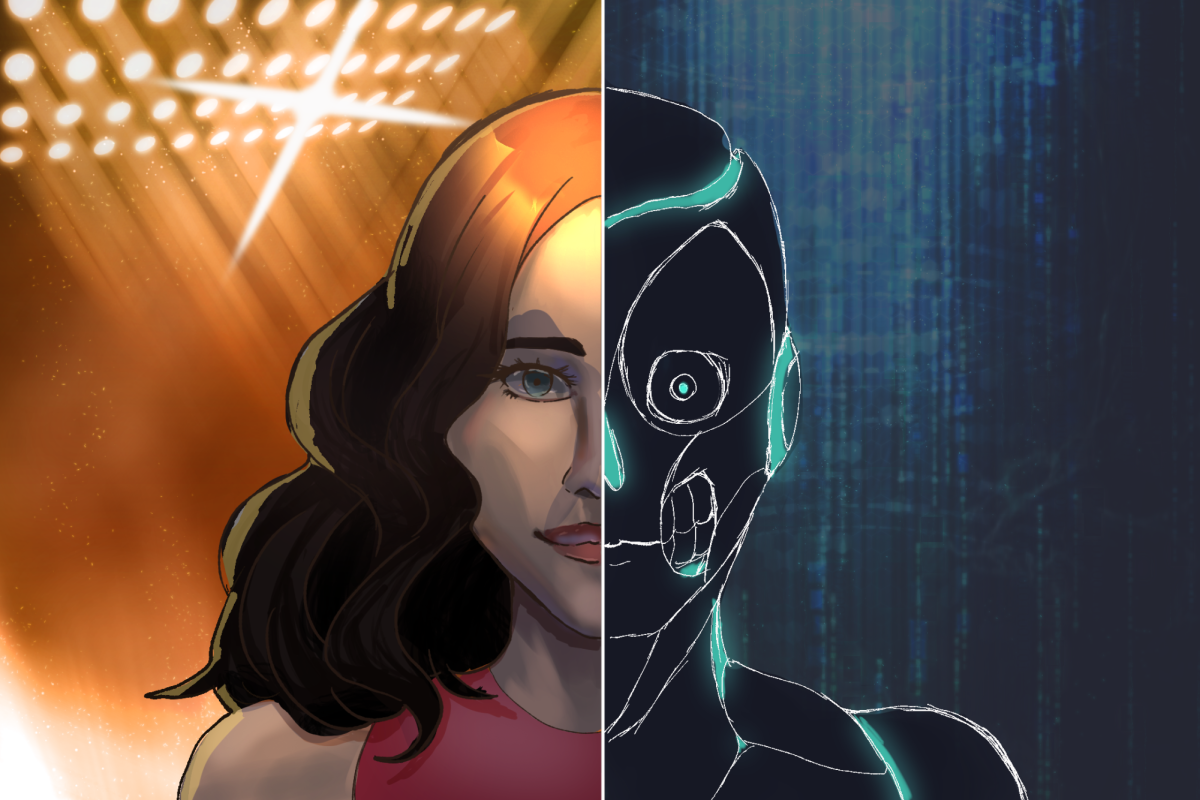
Tilly Norwood has captured Hollywood’s attention — but not as an ordinary debutante. Her screen debut took place in “AI Commissioner,” a short comedy sketch generated entirely by artificial intelligence. Later, at the Zurich Summit held last September, London-based technology and media company Particle6 officially introduced her to the industry, positioning Norwood as a free agent available to sign onto future film projects.
Norwood’s introduction came at a time of growing scrutiny over artificial intelligence in film. In the aftermath of the 2023 SAG-AFTRA strike — which included demands for clearer protections against the unregulated use of AI — the debut of an AI-generated actress prompted widespread media coverage and public debate about the role of synthetic performers in the industry.
Eline Van Der Velden, founder and CEO of Particle6, described Norwood as an artistic experiment.
“I see AI not as a replacement for people, but as a new tool,” Van der Velden wrote in a social media statement. “(Norwood) represents experimentation.”
As AI systems become more common, the film industry faces new questions about creativity, labor and authorship. Supporters of AI-assisted production point to its potential to become a tool for creative storytelling, while others warn that it may affect the job market and complicate issues of ownership and consent. This includes who controls an actor’s likeness and how digital performances are created and stored.
Get The Daily Illini in your inbox!
At the University, these questions have become part of a broader conversation about the relationship between technology and artistic practice. To some, AI-generated performers raise concerns about content protection and the use of creative work in machine-learning data sets.
Levi Petrine, senior in FAA, said they worry about how AI actors are developed and trained.
“AI cannot create something new,” Petrine said. “To go out and produce work and then have it be used to train (an AI model) … it completely takes away from what I’m learning as an actor. Like, why should I even try?”
Beyond artistic concerns, students studying technology also consider the ethics of AI development. Recent technical surveys from the National Institute of Standards and Technology describe synthetic performers as the result of systems that are trained using a mix of text, audio and video to create lifelike characters on screen. As these systems expand, institutional guidelines increasingly emphasize the importance of provenance — the documented origin of training data — and informed consent.
For students like Neev Patel, freshman in Engineering, these technical details translate into concerns about fair use. Patel is a co-runner of Neev.Kavya, an Instagram account meant to educate University students on how to better utilize generative AI tools in their everyday lives.
“I think that using AI to generate someone, with the current way that AI works, is something that could very well be unethical,” Patel said. “Creating AI to be based off of other people is in some way using their creative identity or creative persona … without necessarily compensating them for that.”
But Patel also sees room for creative growth. He compared the rise of AI tools to earlier innovations like CGI, which began as technical aids but eventually became art forms in their own right.
“AI as a creative medium isn’t something that can be disregarded,” Patel said.
Discussions about AI in film have increasingly turned toward its potential as a creative medium. A 2022 article in the Harvard Business Review argued that when used thoughtfully, AI tools can support ideation, accelerate production and offer new modes of content creation.
Josh Heuman, professor in Media, echoed that view. He said that public reactions to AI performers often reflect narrow assumptions about creativity, and that synthetic actors can expand the conversation by offering new ways to explore imagination and performance.
“I think AI is a tool, and when used effectively, tools can be powerful ways to tell stories,” Heuman said. “I think … a lot of what (AI) does and what we do are maybe less dissimilar than we think.”
As synthetic performers like Norwood move from concept to screen, they bring with them a set of questions the industry can no longer ignore. For some, they signal a shift in how stories are told and who gets to tell them, while for others, they raise concerns about the boundaries of creative identity.
Whether viewed as a threat, a tool, or something in between, AI-generated actors are no longer speculative. They’re here, and the conversation about their place in film is just beginning.