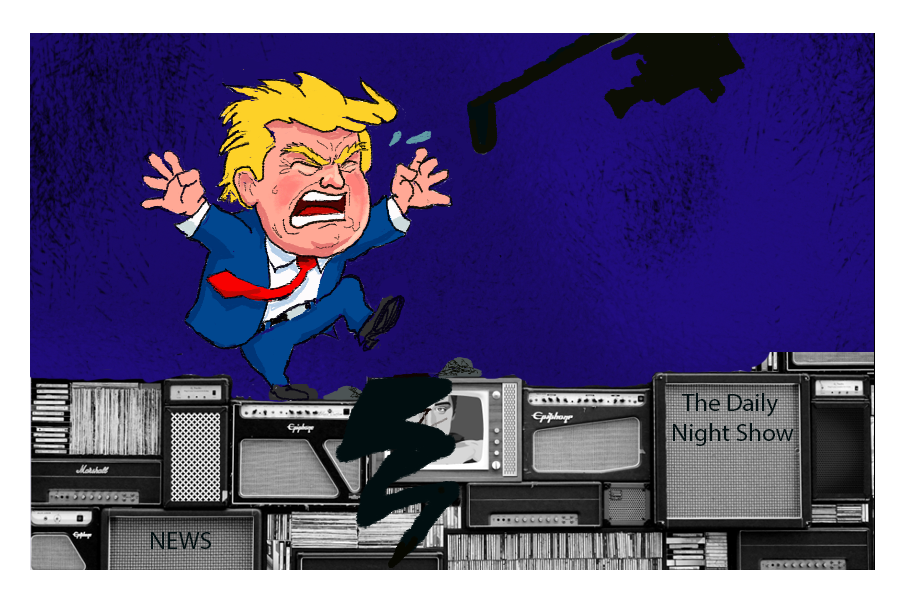
When the Federal Communications Commission pulled Jimmy Kimmel’s self-titled late-night show from broadcast over his comments on the assassination of Charlie Kirk, viewers and peers of Kimmel voiced concerns for the future of entertainment under President Donald Trump and the increasing reach of his administration.
While the broadcast of “Jimmy Kimmel Live!” is officially in the hands of ABC, Trump and FCC Chairman Brendan Carr played a part in its delay. Trump has been an outspoken critic of the media ever since his first term, and Carr — appointed to the FCC by Trump in November — spearheaded the movement to punish Kimmel for his remarks.
With this kind of change in the political landscape, the media has felt the impact. Josh Heuman, a professor in Media, shared his insight into the current climate of entertainment and the sweeping changes it’s experiencing.
“What’s interesting about where we are right now is (the change in the media landscape is) happening on so many different levels, all in play at the same time,” Heuman said.
Kimmel’s suspension might have come as a shock to viewers, but the reworking or outright cancellation of entertainment for real-world reasons isn’t without precedent.
Get The Daily Illini in your inbox!
There’s a long history of movies and TV shows seeing abrupt cancellations for their ties to current events, whether intentional or not. In a recent example, Universal Studios pushed gun violence thriller “The Hunt” back from its intended 2019 release date as a result of the El Paso, Texas, Dayton, Ohio, and Gilroy, California, shootings.
This delay is an example of the precedent Hollywood has set to evaluate the ramifications of a project’s wide release. Trump has indicated that he’s willing to tighten his grip on any number of detracting voices in the field of entertainment.
“I think programmers are always on the lookout for correspondence, but I think that they’re also making potentially safer decisions,” Heuman said. “You can’t help but second-guess (yourself) in an environment where that climate is so charged.”
With Trump’s expanding influence on entertainment and broadcast news, the social media landscape has also changed. Riya Nath, a sophomore in LAS, explained how her use of social media has changed since the 2024 election.
“It’s like we’re in a panopticon,” Nath said. “I feel like we’re self-policing … because we don’t know who’s watching or even if they’re watching.”
In the aftermath of events like the Kirk assassination, taking a political stance on social media can seem like an incredibly precarious personal choice. In one of the more direct moves from Kirk’s former cohort, Turning Point USA launched the Professor Watchlist, a public record of college professors who TPUSA believes “advance leftist propaganda.”
“Especially with DEI cuts, these stories about people of color, being LGBTQ, even being a woman, people are scared to write them,” Nath said.
One relevant example is that of Apple TV’s “The Savant,” delayed indefinitely three days before its planned release date of Sept. 26. Based on a 2019 article by Andrea Stanley, “The Savant” was set to follow a member of the Anti-Defamation League who infiltrates online hate groups to thwart domestic terrorist threats before they can strike.
“The Savant’s” delay sparked immediate speculation, with a consensus across many outlets that the series was either too relevant or too expository to be released without serious backlash. Some speculated that the decision was also connected to Kirk’s assassination.
This abrupt and indefinite halt is new for streaming giant Apple TV, a platform with fewer ties to the older and more institutional studio system. With this kind of practice in mind, the streaming economy presents a contrast to the more traditional system of network television.
“I’m not sure that we’re in the position to cancel Netflix in the way we are to boycott a specific product … they’re getting a lot of their funding directly from the consumer,” Heuman said.
Disney+ saw its subscriber losses almost double in the weeks following Kimmel’s suspension, a blow that illustrates where some consumers draw the line for the streaming conglomerate.
These decisions aren’t unanimous among their distributors — there’s been vocal disagreement from some involved. “The Savant” star and executive producer Jessica Chastain has voiced her frustrations with the dubious delay.
“I value my partnership with Apple,” Chastain wrote in a social media post. “That said, we’re not aligned on the decision to pause the release of ‘The Savant.’”
There’s still no news concerning “The Savant’s” release, and the Apple TV app has changed the description from “coming soon” to just “2025.” In the month following the show’s delay, Apple has given no official reasoning.
Despite pushback, Hollywood’s swing to appeasement hasn’t slowed down yet, and it’s unclear how much the average consumer can really vote with their wallet.
“I’m not sure that we’re going to be shaping the bottom line of these huge companies … I’m skeptical about how much influence we have at that exit consumer level,” Heuman said.
Even for those who engage with the media cautiously, it can still be a challenge to sift through the torrent of unchecked and decentralized information, according to Minjin Khuchitbaatar, senior in LAS.
“It’s so important to be politically active, but it can affect you negatively, and you can never foresee what someone will think of it,” Khuchitbaatar said. “They could interpret it way differently.”
With programs like the Professor Watchlist and the right’s crackdown on perceived “celebration” of Kirk’s death, political speech online has become a real, tangible threat to the professional lives of many.
“It’s scary,” Khuchitbaatar said. “I’m a little more nervous about free speech nowadays. I don’t know about you, but I am.”