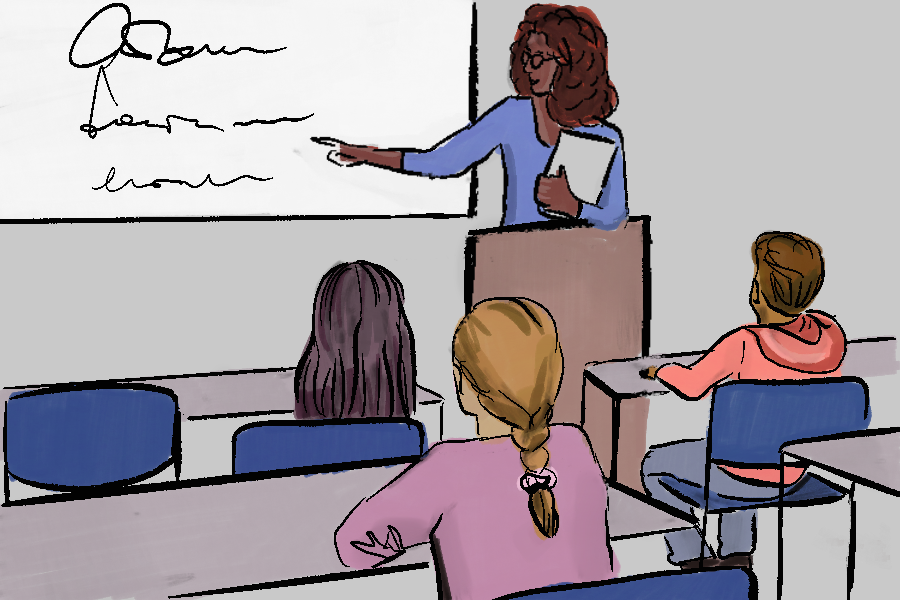
A professor’s teaching style can be pivotal in how a student learns and thinks about learning. How a professor instructs can have a lasting impact on a student that can stick with the student for years.
“I stay in touch with a lot of former students,” said Andrea Stevens, professor in LAS and the director of undergraduate studies for the Department of English. “I’ve written letters for them … I see them still at conferences and things like that.”
Stevens specializes in Shakespeare and his contemporaries and has taught Shakespeare and early British literature courses. Currently, Stevens teaches ENGL 209: Early British Language and Culture.
Stevens’ first impactful teaching experience was when she got her doctorate at the University of Virginia. She taught nonfiction writing and Shakespeare to talented students from ages 11-17 during the summer at the Johns Hopkins Center for Talented Youth.
“If you can keep gifted 11-year-olds occupied for seven hours of a day in the summer, I think that it can help fine-tune your teaching skills for sure,” Stevens said.
Get The Daily Illini in your inbox!
While teaching Shakespeare, Stevens focuses on the play performances and gets people from the Department of Theater to do workshops, like a stage combat workshop. Her class ENGL 209 covers a lot of time and has many texts that can be used. When teaching a course like it, she focuses on texts that made her an English major, such as poems and plays.
Stevens also tries to help students connect the literature to the present. In ENGL 209, she and her students made a Spotify soundtrack. She incorporates multimedia and gets students to visit places on campus to see objects related to the courses, such as at the Rare Book and Manuscript Library.
Over time, Stevens has seen students connect with the literature, and consequently, they come back and ask for advice or supervision over an honors thesis. Stevens finds it crucial to help students work through various possibilities after graduation.
“The mentoring that you do and the advising you do outside of the classroom matters as much as what you do inside the classroom,” Stevens said.
She views being an “ongoing resource mentor” as part of her job as a professor and as the director of undergraduate studies. By being a faculty member, Stevens finds that a large part of her role is supporting students and their research.
“(The English department) can really deliver the small liberal arts elite education to our English majors because of the faculty-student ratio,” said Stevens.
As a professor in Business, Mike Szymanski teaches BUS 201: Business Dynamics and BUS 301: Business in Action and does research in international business and management. According to Szymanski, most of his recent work concentrates on the role of language in management.
Both of his courses focus on experiential learning. Within hands-on learning, students try to do things, fail, reflect on what went wrong and try again. In his courses, Szymanski concentrates on the crucial concepts, such as foundations and theories, that can help students the most.
In his courses, Szymanski typically introduces a topic, talks for a bit and then does an exercise. At the end of the class, he and the students reflect on the exercise.
In addition, Szymanski focuses on one thing he wants students to remember from each week and keeps the messages simple.
“One of the principles is simplicity,” Szymanski said. “Do not overcomplicate things that are relatively simple, but make sure the main message gets across.”
A large part of Szymanski’s teaching style is connecting with students. He focuses on getting to know them, what they want to learn and their expectations for the courses he teaches. At the end of each semester, students also write a reflection paper about their experiences throughout the semester.
“A lot of them say the same thing, that this was a class that was very different from everything else they have taken so far,” Szymanski said.
Christopher Ball, professor in Media, specializes in virtual and augmented reality. He teaches JOUR 101: Interactive Media and You and JOUR 430: Augmented and Virtual Reality.
In his courses, he finds ways to use immersive and interactive media within storytelling. Ball uses lectures and hands-on experiences. He said that, by combining them, lectures and experiential learning can be the most long-lasting, such as remembering a 3-D model a student has made.
A phrase Ball incorporates into his courses is “We’re looking where the ball is going, not where it is.” To adapt his courses accordingly, he ensures that he stays updated with the latest media and technology.
“I have to keep up with what’s changed since the last time I taught that class,” Ball said. “If it was a year ago, then probably a lot’s changed, and a lot’s gonna need to be updated.”
He uses the easiest and cheapest software since it will be the most realistic in the field for students. Ball also tries to make his class as entertaining as he can. For example, one of the first things students do in his class is play virtual and augmented reality games.
In his courses, he finds it important to have positive, low-pressure experiences with the technology used. The tone for his course is to have fun, even with the challenges and things that do not go right.
Ball teaches for a future that is unknown and focuses on student self-efficacy, meaning that one is more likely to do something if they believe they are capable, in the present and the future.
“The reason why I’m a professor today is because a professor believed in me in undergraduate,” Ball said. “That’s all it took, one professor saying, ‘You’re really good at this, and I think you could do more with this.’”
While all professors’ teaching styles differ, there is one thing that brings them together: supporting students. Whether it is through advising, mentoring or asking for feedback, they ensure to place importance on helping students in and outside of the classroom.