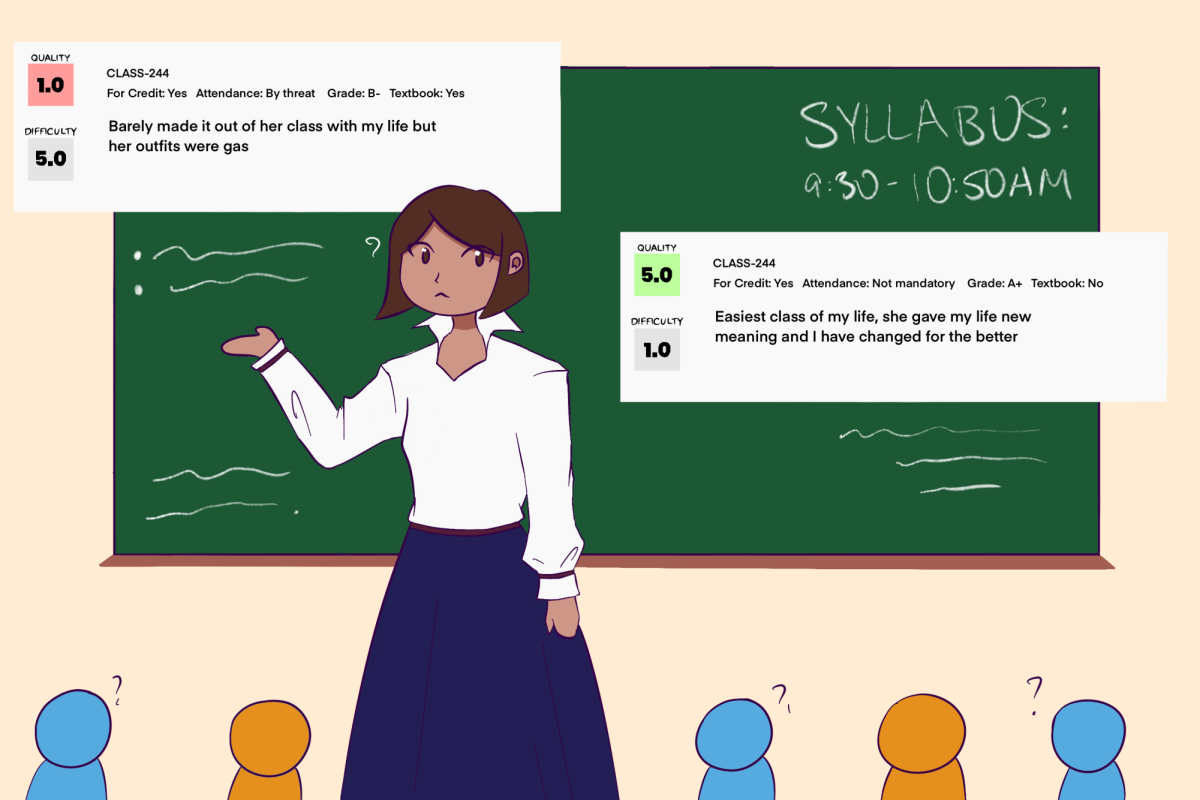
Whether hunting for course tips or researching an instructor before registering, many students have likely encountered Rate My Professors, yet University faculty say the site has been losing traction for years.
Wade Fagen-Ulmschneider, professor in Engineering, said the website was more popular 10 years ago, receiving significantly more traffic then than it does today.
Lawrence Angrave, professor in Engineering, recalled a controversial feature — that has since been removed — that allowed users to rate the attractiveness of professors, denoted by a chili pepper. As a result of backlash on social media from professors and students alike, the website’s developers removed the chili pepper in late June 2018.
“I think a long time ago they had like a ‘hot or not’ thing, which I found incredibly sexist,” Angrave said. “It’s just icky and inappropriate.”
Angrave acknowledged the emotional impact courses can have on students, leading them to write negative reviews about a professor. Angrave said reviews attacking a professor may have been written as an outlet for frustration.
Get The Daily Illini in your inbox!
However, Angrave also expressed concern for the emotional well-being of professors in the face of bitter criticism.
“You may not realize the emotional harm that you might be doing someone when they read personal attacks,” Angrave said.
Fagen-Ulmschneider estimated that the low number of recent reviews on Rate My Professors accounts for about 1% of students in a typical course, saying the typical enrollment numbers for any course he teaches range from 200 to 400 students per class.
Angrave echoed the sentiment that the sample of student reviews on Rate My Professors poorly reflects the experience of an entire population of students in a given class, and mentioned the negative perceptions popular gen ed STEM courses often have projected onto them.
“Just because a course is rated extremely difficult, doesn’t necessarily mean it’s a bad course; statistics and math courses often have that reputation, especially if they’re required courses,” Angrave said. “So I think comparing courses is very dangerous, right?”
When asked about the FLEX survey, Angrave expressed that he was looking forward to receiving the results due to the timeliness and relevance to course feedback that the survey provides professors with.
“I think it’s important that students have a voice, and I think it’s important that faculty have a way to hear about problems early on,” Angrave said. “I’m excited to see that feedback.”
Seeking a more tailored way to measure an educator’s accomplishments, Fagen-Ulmschneider created his own website.
The website offers metrics driven by data like grade disparities between course sections and grade disparities by professor, along with any accolades the professor they are searching for has won.
“As a student, I know that I would probably lock in for a really, really hard course knowing I’m learning from someone who won the Nobel Prize,” Fagen-Ulmschneider said.
In other departments, professors’ reputations hinge more on the quality of the relationship between student and professor as opposed to quantitative measurements and data.
Sam Nixon, a graduate student studying flute performance, said reviews of professors for the School of Music travel through in-person conversations rather than online.
“It’s very word-of-mouth based,” Nixon said. “Studying with a teacher is so personal.”
Nixon said some students may respond better to one-on-one instruction in smaller courses as opposed to the lecture format of larger classes due to the number of different learning styles among each student and level of attention professors are able to give to students at a time.
One-on-one or smaller instruction groups are typical of departments with a smaller number of students, like those within the School of Music.
Advocating for connection, Angrave said that students should simply speak with their professors, saying many are more open to hearing concerns than students might expect.
“Many professors are more approachable than they might appear, and you don’t have to wait for these surveys to actually reach out to your professor and to give them feedback,” Angrave said.