Election: Long lines at polling places, no unusual problems reported
Associated Press
Nov 3, 2004
Last updated on May 11, 2016 at 04:52 p.m.
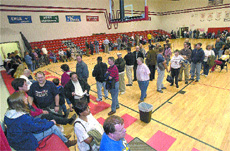
CHICAGO (AP) – A handful of precincts ran out of ballots and some would-be voters were still in line more than two hours after polls closed Tuesday in Illinois, reflecting record registration and heavy turnout across the state.
Despite scattered problems, including University of Illinois students being forced to cast provisional ballots because they lacked proper identification, election officials said things went smoothly overall.
“There were lots of calls and questions, but most of them were routine and most of that was because of the large number of people who turned out to vote,” said Dan White, executive director of the State Board of Elections.
Sangamon County Clerk Joseph Aiello said voters weren’t just more plentiful, they also were more committed to making sure their votes counted.
Get The Daily Illini in your inbox!
“The mood of the voter in this election is different than any election I’ve ever seen,” said Aiello, who has served as clerk for almost 12 years. “There’s more passion. They seem to be very emotional. They’re asking lots of questions, double-checking things.”
Polling places were required to allow voters to cast ballots if they were in line when polls closed at 7 p.m. In Normal, Ill., some students were just getting to vote two hours later. All students had voted by 9:50 p.m.
In Bloomington, Ill., some precincts ran out of ballots and had voters use ones that were similar to sample ballots but could not be read by voting machines. Election officials planned to transfer those votes to regular ballots later, after more were printed.
“I’m really pleased the voters are turning out. It just caught us a little off guard,” said Charlene Stanford, executive director of the Bloomington Board of Election Commissioners.
A record 7.5 million Illinois residents were registered to vote. White said he expected turnout to be stronger than the 69 percent in the 2000 presidential election.
Long lines were common throughout the day at polling places in Cook, DuPage, Rock Island and Winnebago counties. “It’s gangbusters,” said Winnebago County clerk David Johnson, who predicted an 80 percent turnout in his county.
In Chicago, turnout was expected to be 77 percent, which would be the highest in 20 years. That kind of turnout is “unheard of,” said Tom Leach, spokesman for the Chicago Board of Election Commissioners.
At the University of Illinois at Urbana-Champaign, some students cast provisional ballots because they had registered through the mail and did not realize they were required to show identification with their address when they voted, White said.
No major problems were reported with provisional ballots, a backup required after the 2000 election when thousands of voters nationwide were mistakenly turned away from the polls.
A recent interpretation of election law on provisional ballots could cause problems after Election Day.
State law requires provisional ballots to be cast in the proper precinct to count, but the State Board of Elections has recommended that provisional ballots cast in the wrong precinct count for some federal offices if the voter is later found to be eligible.
Since the state’s 110 election jurisdictions are autonomous, each can decide whether to follow the state board’s recommendations.
Voters in about half of Illinois’ election jurisdictions were using optical scan machines that read paper ballots with the voter’s choices shaded in, while the rest were using punch-card ballots.