Clerical, graduate groups protest while Board meets
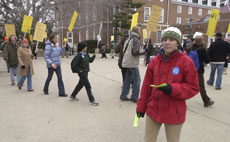
Graduate student Natalie Havlin hands out flyers to passersby Thursday in front of a circling group of GEO members outside the Union before the Board of Trustees meeting. Online Poster
Mar 11, 2005
Last updated on May 11, 2016 at 07:39 p.m.
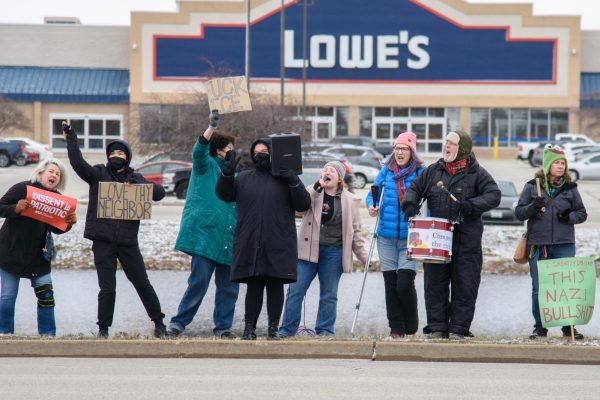
The Board of Trustees gathered for a conference Thursday but was overshadowed by protests throughout the day directly outside the window of the room they were gathered in.
In the morning, chants of “help me teach, keep me well!” from the Graduate Employees Organization (GEO), and during their break, members of American Federation of State, County, and Municipal Employees (AFSCME) shouted “No contract, no peace!”
About 40 members of the GEO gathered in chilling weather to protest the health care plan being considered by the BOT.
“The rally is to represent the concerns of a large amount of grads. We’re urging the BOT to vote ‘No’ on a certain health care proposal,” said Michael Simeone, graduate student and rally organizer. “From what the University has told us, it doesn’t meet the needs of graduate students.”
Get The Daily Illini in your inbox!
Simeone said the new proposed healthcare plan was lacking in three areas: affordable coverage for spouses and children, chronic illness coverage, and catastrophic coverage including trips to the emergency room.
“If you look at other Big Ten schools, Illinois doesn’t match up,” Simeone said.
Kate Roark, GEO member and a mother, brought her son to the rally to help protest.
“My husband and I are both GEO members and grad students and we have to get health care for our son through state aid,” said Roark. “That seems like a bad statement for the University.”
Gene Barton, vice chancellor of student affairs, agreed the plan was inadequate, but he said the University is trying to resolve it.
“We’ve spent a lot of time working on it,” Barton said.
Barton said the University has sent bids out to insurance companies throughout the country, but the offers made by the insurance companies have all been higher than what the University will pay. He said one of the problems is the costs are tripled when factoring in a spouse and a child. Compared to the undergraduate plan, the graduate plan is more comprehensive, but the plan would not protect students while traveling abroad.
“(The plan) is perfectly good if you are a typical student without a spouse and without a child,” Barton said.
After the GEO cleared out and lunchtime rolled around, the AFSCME gathered and began to amp up their voice in protest of failing contract negotiations between the union and the University. The negotiations began almost a year ago, but expired last August. The AFSCME ranks 14th on Fortune’s 1997 Washington Power 25 most powerful national lobby groups – placing it ahead of the International Brotherhood of Teamsters trucking union.
The lobby group represents clerks, secretaries, personal assistants, cahiers, and other logistic based jobs.
“The University looks at clerical staff as second class citizens. They are paid less than people who mow grass,” said Jerry Right, a staff representative for the union. “This is about the standard of living for members (of the union).”
Right said the biggest issue in contention for contract renewal is the “Step” program. Under the Step program, members of the employee’s union would receive an annual salary increase over a 21-year period. Right also said some of his members have had to take on a second job in order to make up for the lack of income.
Right said 1,600 members of the union are represented at the University, which would bring the total cost of the plan to an estimated $30 million. Right said the University’s new Banner computer system – a network responsible for controlling nearly all information based issues – has demanded the employees learn more and work harder. Right cites the system as a failure.
“Banner controls the payroll system and it won’t even generate a payroll report for employees,” Right said.
Delinda Swanson, a clerk in the political science department, said her office had five full-time employees and one-part time employee – now they have four.
“Our jobs are getting more difficult and we’re getting paid the same,” Swanson said. “(There is) money for Banner but not for people who work banner.”
Not all the protesters at the rally were union members affected by the contract. Belden Fields, professor emeritus in political science, said he joined the group to show his solidarity with the secretaries.
“I think the University has an obligation to negotiate with them,” Fields said.
Robin Kaler, University spokeswoman, said, “The majority of people across campus have gotten a 6 percent raise. AMCSE has gotten a 12-15 percent increase.”
Kaler said the problem with resolving the issue isn’t about creativity – it’s about money that isn’t there.
“These are valued employees. They work very hard. They are the face of the University,” Kaler said.
Kaler said the University got a federal mediator to help. The University is continuing to work on resolving the problem. In one incident, Kaler said, the union and the University were having a mediation session and the union had already scheduled a protest to take place after the talks.
In regards to striking, Kaler said, “We hope they are focusing their efforts on negotiating a contract.”
When the protesters’ lunch break was over and the crowd began to disperse, one woman in the group said striking is a long way down the road, but they would strike during the regular school year so it would make an impression. Another woman said, “We should just leave for a few days … the campus would shut down.”