Ryan convicted of scandal
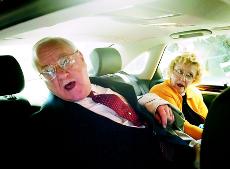
Former Illinois Gov. George Ryan sits in a car with his wife Lura Lynn Ryan after he was convicted of racketeering and fraud charges at the federal courthouse in Chicago, Monday. Ryan faces up to 20 years in prison for racketeering conspiracy charge alone The Associated Press
Apr 18, 2006
Last updated on May 12, 2016 at 02:37 a.m.
CHICAGO – Former Gov. George Ryan was convicted Monday of steering millions of dollars in state leases and contracts to political insiders, lying to federal agents and tax fraud, becoming the third former Illinois governor in as many decades to be convicted of federal felony charges.
Ryan, 72, sat stone-faced as U.S. District Judge Rebecca R. Pallmeyer read the verdict convicting him of racketeering conspiracy, mail fraud, tax fraud and lying to the FBI.
Co-defendant Larry Warner, 67, a Ryan friend and Chicago lobbyist, was also convicted of all charges in a six-month trial that was the climax of the state’s biggest political corruption scandal in decades.
“I hope this case begins the end of political prostitution that seems to have been evident in the state of Illinois and begins a resurrection of honest government and services in this state that so many people have demanded,” said Robert Grant, head of the FBI’s Chicago office.
Get The Daily Illini in your inbox!
The verdict came on the 11th day of deliberation by a jury of six men and six women whose work had to be restarted after two jurors were dropped and two alternates added in their place.
Ryan, long the most powerful Republican in Illinois, faces a maximum of 20 years in federal prison and a $250,000 fine on the racketeering conspiracy count alone but most likely will receive a much lighter sentence. Sentencing for both men is scheduled for Aug. 4.
Prosecutors want Ryan and Warner to forfeit a total of $3 million, the amount prosecutors estimate Warner received through state leases and contracts Ryan steered to him.
Pallmeyer will rule on the forfeiture portion of the case later.
Ryan’s lead attorney, former federal prosecutor Dan K. Webb, said the defense team would “begin working immediately on post-trial motions to try to get this verdict overturned.”
Webb zeroed in on Pallmeyer’s decision to replace two jurors with alternates eight days into deliberations as an “unusual situation” that could undermine the conviction on appeal.
Ryan, flanked by his wife, Lura Lynn, and other family members, was grim as he left court.
“I believe this decision today is not in accordance with the kind of public service that I provided to the people of Illinois over 40 years, and needless to say I am disappointed in the outcome,” Ryan said, declining to comment further. Warner declined to comment.
The corruption scandal ended Ryan’s political career even as he was becoming prominent as one of the nation’s most outspoken critics of the death penalty. Just before he left office in January 2003, Ryan commuted the death sentences of 167 inmates to life in prison and pardoned four others, declaring the state’s capital justice system “haunted by the demon of error.”
The defense had condemned prosecutors for using circumstantial evidence to suggest Ryan was corrupt. Assistant U.S. Attorney Patrick M. Collins, who headed the eight-year investigation that led to Ryan’s indictment, acknowledged that “there was no smoking gun in this case.”
“This case was tried witness by witness, piece of evidence by piece of evidence,” Collins said. “It was only looking at the totality of the case that the true picture could be shown to this jury, and that was a picture of corruption at the highest levels of government.”
Seventy-nine former state officials, lobbyists and others have been charged in the government’s Operation Safe Road investigation. Seventy-five, including Ryan and Warner, have been convicted. None have been acquitted.
Ryan’s former chief of staff, Scott Fawell, now serving his own 6 1/2-year racketeering sentence, told the jury how Ryan had helped Warner rent buildings he owned to the state. And other witnesses told how Ryan helped Warner land lucrative deals for his lobbying clients, including a $25 million IBM computer contract. The company was accused of no wrongdoing.
Gifts to Ryan for helping Warner and other friends with contracts and leases ranged from $145,000 in loans to his brother’s floundering business to a free golf bag, witnesses testified.
Another businessman, Harry Klein, testified that he entertained Ryan and his family at a luxurious estate in Jamaica every year for a decade. Klein said Ryan always paid him $1,000 a week with checks but then accepted the $1,000 back in cash.
Juror Kevin Rein of suburban Glen Ellyn, a self-employed carpenter, told reporters after the verdict that no one piece of evidence was crucial in leading to Ryan’s conviction. He said the prosecutors presented “a pretty good pile of evidence” of corruption on Ryan’s part.
Ryan never took the witness stand. Rein said he would like to have heard from him and discounted the defense contention that what prosecutors were presenting was just normal politics, saying the testimony of former Ryan employees, including Fawell, convinced him crimes were committed.
“They painted a different picture of what was going on,” Rein said.
Jurors said they had numerous arguments over the meaning of the evidence but that it wasn’t all that difficult to reach a verdict. They said Ryan had no partisans in the jury room.
“When I walked into the deliberations I had a pretty good feeling of my vote,” said juror James Cwick, 22, of Glen Ellyn, a supervisor at a shipping company loading dock.
None of the jurors said they were disillusioned with Illinois politics, despite a far-reaching tapestry of corruption that emerged from the testimony concerning Ryan.
“I think he’s just one bad egg in the whole basket,” Cwick said. “There are many people who are doing a great job out there.”
The two original jurors who were dropped were found to have omitted mention of their arrest records on questionnaires that the jury filled out last September.
Two other Illinois governors have been convicted of federal felonies in recent decades. Otto Kerner, who was a sitting federal appeals judge at the time of his indictment, was convicted of taking part in a racing stock scandal. And Dan Walker was convicted of corruption involving bank loans that took place after he left the governor’s office and went into business.
U.S. Attorney Patrick J. Fitzgerald told reporters after the verdict that he hoped it would discourage public officials from engaging in corrupt practices.
“If they keep stealing, we’ll keep chasing them,” he said. “I think people now know if you’re part of a corrupt conduct where one hand is taking care of the other and contracts are going to people, you don’t need to say the word ‘bribed’ out loud. I think people need to understand that we won’t be afraid to bring strong circumstantial cases into court.”