Disaster drill proves successful
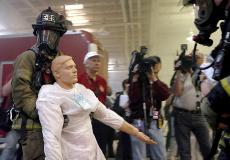
A firefighter removes a “victim” as part of a large-scale training exercise Wednesday, in Glenview, Ill. In a program coordinated by local state and federal agencies under the guidance of the U.S. Department of Homeland Security, first responders, firefig The Associated Press
May 8, 2006
Last updated on May 12, 2016 at 03:11 a.m.
SPRINGFIELD, Ill. – Illinois officials say their emergency disaster drill this week was so successful, they almost got no practice.
Part of the three-day exercise included a fake terrorist attack on a suburban Chicago manufacturer. Participants didn’t know where or when, but they used tips, rumors and other “intelligence” to correctly pick the site, evacuate the building and secured it from invaders, Jill Morgenthaler, the state’s homeland security director, said Friday.
“They pre-empted the terrorist strike,” Morgenthaler said. “It actually would not have happened.”
Wanting the practice of a terrorist “takedown,” faux interlopers were allowed to take over the building later.
Get The Daily Illini in your inbox!
And while the drill showed strengths in Illinois’ response plan, it revealed weak spots that need tightening, officials said at a news conference at the statewide emergency operations center.
The practice session also included a mock pandemic of the type that health authorities say is inevitable with the worldwide spread of the avian flu. Such an outbreak could sicken as much as 40 percent of the work force.
State officials at the emergency operations center here communicated with local authorities in Chicago and other areas to respond to the mock problems. They discovered several drawbacks, including a shortage of people.
“We were able to do this three days, cut off the exercise at 6 p.m. But something like a pandemic flu, which could go on for weeks … I have to come up with some solutions,” Morgenthaler said. “It’s not necessarily hiring more people but maybe training more people within more agencies.”
The drill showed that the public health department’s emergency response center should not be in a separate building across town from the agency’s main complex, director Dr. Eric Whitaker said. With a weekslong problem such as a pandemic, emergency center staff would be needed to help with day-to-day operations.
Mike Chamness, director of the state’s terrorism task force, said the exercise also raised questions that officials must answer. For one, the final day was spent on problems that will exist months after a disaster, such as dealing with quarantined flu-sufferers.
The team decided that a voluntary quarantine, if necessary, would be the best approach because it would be difficult to patrol a forced one, Chamness said.
“If we get timely, good information to the public, Americans will behave responsibly and will react in a way that helps alleviate the situation as opposed to cause another disaster,” Chamness said.