Students discuss Palestine
Nov 30, 2006
Last updated on May 12, 2016 at 06:36 a.m.
Taking the mic for the first time in front of a large group of people, Haneen Sulieman, senior at Bogan High School in Chicago, began to read a poem she wrote about the ways that Sept. 11 affected Muslims.
“I wanted to speak for Muslims,” Sulieman said. “The conflict over there (in Palestine) really hurts me.”
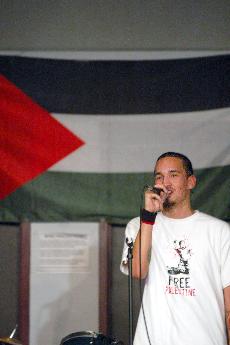
Sulieman is part of The Creative Writing Program, a program through the Arab American Action Network, which helps high school students use hip hop and spoken word to “strengthen writing, creativity and performance.” The group, along with University students, performed at Cafe Intifada last night.
Students for Justice in Palestine hosted the event, which used hip hop and poetry to discuss the status of the conflict between Palestine and Israel and its effects on the Muslim community last night at Allen Hall.
Get The Daily Illini in your inbox!
Khalid Mashal, senior in Engineering and president of Students for Justice in Palestine, said that the goal of the event was to give students alternative sources of information concerning the conflict so that they can form a just and fair solution rather than working for “one side or another.”
“Basically, it gives a chance for everyone to use art and expression as a means of resistance, to spread awareness of the Palestinian cause through means other than politics,” said Nader Abusumayah, University alumnus and former vice president of Students for Justice in Palestine.
Abusumayah also said that night was important because it serves as a good way to network with people that are politically savvy and in tune with poetry and hip hop.
Mashal said that many of the performers had visited Israel and Palestine, either with their families or with delegations, and were writing about their experiences. Mashal, who was born and raised in Jerusalem, recited a poem in Arabic about prisoners in Palestine.
“It was definitely eye opening,” Abusumayah said about his visit to Palestine with his family in 1999. “We hear about the occupation and we see the checkpoints, the soldiers carrying guns.”
Issues discussed through performances ranged from the problems with associating the Muslim religion with terrorism and the discrimination that has occurred because of that association to violence in Palestine and stereotypes of the Muslim community.
“(Cafe Intifada) is important because it gives a chance for the different ethnicities and races to talk about conflicts, racism,” Sulieman said. “People need to see that.”