Race Relations 101
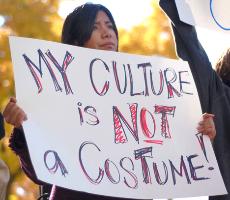
Senior in LAS Marlyn Rodriguez holds up a sign in support of the anti-racism rally organized by S.T.O.P. (Students Transforming Oppression and Privilege) on the Quad at noon on Oct. 31. The rally, which later moved to protest the Zeta Beta Tau fraternity Dan Hollander The Daily Illini
Dec 8, 2006
Last updated on May 12, 2016 at 06:52 a.m.
While planning their Oct. 5 exchange, the University of Illinois’ Delta Delta Delta sorority and Zeta Beta Tau fraternity did what almost every campus Greek house does: They picked a theme (“Fiesta”) and chose a location (Station 211 in Champaign). What they didn’t do was consider how chapter members might interpret the “Fiesta” theme, or that there might be a problem with the nickname, “Tacos and Tequila.”
It is little surprise then that they were unprepared for the controversy that would erupt in response to the event. Nor did they expect that it would take its place in the weeks that followed alongside a “Ghetto Fabulous” party at the University of Texas School of Law and a “Halloween in the Hood” party at Johns Hopkins University as bitter examples of racism on university campuses. Rather, the Tri Delts and ZBTs expected a night of drinking, dancing and fun.
In the two months since the exchange, the question of responsibility has fueled the debate over the appropriate response to what is being identified as a larger problem than simply one party. Nonetheless, the latest round of race-themed social events on college campuses across the country has served as a lightening rod, prompting calls for change, with campus activists looking to university administrations to hold students and organizations accountable for their conduct and take responsibility for the racial climate at their schools.
“I think the most important thing we can do at the University is to encourage students to be very self reflective about their own backgrounds and encourage them to grow and develop as human beings and help them find ways to open up to other people and interact with other people,” said Adele Lozano, director of La Casa Cultural Latina.
Get The Daily Illini in your inbox!
By 10:30 p.m. on Oct. 5, Station 211 was packed. About 100 Tri Delts and ZBTs, most of them dressed for the “Fiesta,” had crowded into the side bar. Tri Delt attire ranged from black cocktail dresses to one sorority member wrapped in the Mexican flag as a dress and another with her shirt stuffed to appear pregnant. Some fraternity members donned sombreros and “farmer” clothes. Still, as far as the party planners were concerned, everyone seemed to be having a good time.
“I thought that some girls were dressed inappropriately, especially because they were on campus,” said Sara Colombo, sophomore in LAS, who is unaffiliated with either organization and witnessed the exchange. “But I didn’t think the theme was anything out of the ordinary.”
Colombo said, however, that it didn’t take long for people to realize – either on their own or from complaints – that there was a problem. Many on campus who heard about the party, like Brian Montes, graduate student, thought the costumes mocked Latinos, in particular Mexicans.
“The stereotype of what it is to be Mexican is embodied in these parties,” Montes said. “In these parties, to be Mexican means to be a gang member, pregnant or a farm worker.”
News of the event reached Dean of Students William Riley from the Office of Fraternity and Sorority Affairs the Tuesday following the Thursday night party. He responded by asking the Office of Student Conflict Resolution and the Office of Fraternity and Sorority Affairs to investigate what happened.
The Wednesday after the event, Emma Miller, Tri Delta president, received permission to present a formal apology to the United Greek Council, the student governing body for culturally-based organizations on campus.
ZBT president, Brandon Keene, who initially had planned to submit a written apology, joined Miller in speaking at the regularly scheduled meeting.
Too little, too late some students argued.
“From seeing Emma speak, you could tell she was very genuine,” United Greek Council President Patty Garcia said, adding that many were unsatisfied with ZBT’s response. “But I know people didn’t take the apology very seriously.”
Miller declined an interview request, and Keene could not be reached.
On Oct. 31, several hundred students rallied outside the Illini Union before moving to the Tri Delta and ZBT chapter houses, ultimately gathering at the Swanlund Administration Building to voice their objection to the party and the University leadership’s response.
The administration, they insisted, needed to address the racist theme as a product of “institutional racism.” They argued that the University has condoned racism on campus not only by refusing to take prompt, decisive action against the chapters, but by retaining Chief Illiniwek as its symbol. Some speakers at the rally insisted the University could not hold its students to a higher standard of behavior than it does itself.
“I was not surprised because individuals can only operate within a context, and that context is this racist administration,” Treva Ellison, senior in LAS and former Illini Media Company employee, said during the open-mic portion of the rally.
When the crowd was gathered at Swanlund, Vice Chancellor of Student Affairs Renee Romano read a letter from Chancellor Richard Herman, which said, in part, that the “Fiesta” exchange was “juvenile” and “insensitive.” Herman’s letter also noted that the controversy had “spurred a great deal of conversation about treating one another with common decency,” which would result in “a deeper appreciation of our cultural diversity.”
Are sanctions enough?
On Nov. 28, the University’s Board of Fraternity Affairs and Board of Sorority Affairs announced sanctions against Zeta Beta Tau and Tri Delta for violations of the student code as well as fraternity and sorority rules regarding alcohol.
The chapters will not be allowed to recruit new members during Spring 2007 and were placed on social probation through Fall 2007, with events where alcohol is present including exchanges and formals prohibited. Both organizations were also placed on conduct probation until the end of Fall 2008 and will be monitored by oversight committees appointed by the Board of Fraternity Affairs and the Board of Sorority Affairs.
But most who have spoken out against the exchange, including English Professor Carol Spindel, say the Tri Delta and ZBT chapters are not solely responsible; in fact, they do not see the chapters’ conduct as out of step with the campus as a whole.
“We have the lowest bar in the country when it comes to how much sensitivity to other cultures you have to learn to graduate,” Spindel wrote in an “open letter” in response to Herman’s letter.
Many students and faculty members, such as Karen Kelsky, head of the Department of East Asian Languages and Cultures, say that there can be no thorough discussion of the racial climate on campus without adequately acknowledging the presence and effects of the Chief.
“How can you expect white students to display respect toward people of color when you have a white student dressed up in a fake Indian costume and dancing around our sporting events every week as an official University mascot?” she said.
Brian Glickman, senior in Business, disagrees with those who claim a connection between the Chief and racism on campus.
“‘Tacos and Tequila’ is intended to be a mockery, while Chief Illiniwek intends to honor the heritage of our state,” he said, pointing to incidents on other campuses as evidence that the presence of the Chief does not cause racist behavior. “Attempting to connect the two is an injustice towards the ongoing Chief debate.”
Transforming the campus climate begs first for a re-evaluation and change of campus values, race scholars say, and colleges and universities nationwide are implementing diversity initiatives to do just that. For example, two days following the Oct. 28, “Halloween in the Hood” party hosted by the Kappa Upsilon chapter of Sigma Chi fraternity at Johns Hopkins University in Baltimore, William R. Brody, the university’s president, wrote, “Events of last weekend, triggered by an offensive and repugnant invitation to a fraternity party, have underscored that racism is still an issue. It’s still an issue in our society. As much as we wish it were otherwise, it is still an issue in our university community.” In the message, Brody also listed five new or existing Johns Hopkins diversity initiatives and suspended the chapter.
When John D. Wiley, chancellor of the University of Wisconsin-Madison welcomed first-year students to the university last fall, he posed the challenge to seek out someone different as a step to understanding how diversity shapes the world.
As part of the “Creating Community” program, the university is working to institute change at the individual level, with Wiley calling these interactions “critically important.”
It is this type of institution-wide approach that many students on the University of Illinois campus, including Genevieve Tenoso, Lakota and Ojibwe American Indian and graduate student, would like to see.
“It seems when students of color point to an issue, the administration’s response is slow,” she said. “It’s hard to retain students, faculty and staff of color in a racially hostile environment.”
Herman said that the University is limited by the student code and the U.S. Constitution in what kind of action it can take in response to events such as the “Fiesta” exchange, adding that his Oct. 31 statement was an exercise of his own First Amendment rights. But he sees the necessary response as larger than his office.
“I can speak out as to what kind of atmosphere I want on campus,” Herman said. “It’s one thing to issue an edict, but it’s another thing to have all students, faculty and staff working together to ensure a welcoming atmosphere.”
Is the University behind?
Universities nationwide are struggling with how best to address diversity education. Because a lack of understanding of people from different cultural backgrounds is an identified cause of racial tension on campuses, most universities offer several avenues for students to learn more about other cultures.
The University’s general education requirements include a non-western or U.S. minority culture course, and administrators are also looking to integrate diversity into the freshmen orientation program. In the long term, they say, students may be required to take a class that relates to diversity.
But Seema Kamath, junior in AHS and Illinois Student Senate cultural and minority affairs committee chair, said students must express an interest in these opportunities in order to take advantage of them.
“The University doesn’t take an active stance in diversity training per se,” she said.”I really think the University should promote multiculturalism more.”
Still, students and administrators agree that education can only go so far.
“I don’t think that taking a class is enough,” said Ariel Avila, senior in LAS and vice president-internal of the Illinois Student Senate. “I think the University should play a more proactive role in exposing students to other cultures.”
Beyond the classroom, the University’s Strategic Plan for 2006-2011 identifies the institution’s principal challenges and how to address them and calls for the University to “foster an inclusive campus community.”
Associate Dean of Students Cathy Acevedo said that, while the Plan will ultimately increase accountability for diversity initiatives, the University is still “in the beginning stages of identifying what it is we need to do to make this a more inclusive environment.”
Alex Ring, a Caucasian senior in Business, who grew up in a small, 99 percent white town, said he finds the diversity initiatives in the Plan to be narrow-minded. Like Avila, Ring does not think a class will overcome the backgrounds or characters of students.
“They need to understand the value of racial integration,” he said. “I think you stand to gain a lot by interacting with different races because it brings different perspective, and you learn about different cultures and different values. And that leads to understanding, and understanding leads to acceptance.”
The University has not conducted a campus climate assessment incorporating race for students or staff, a survey that has been either conducted or announced by all of the public universities in the Big Ten.
However, a 2003 study by University Professor Kimberly Shinew on interracial interaction among students during leisure time offers the best measure of the University’s racial campus climate. The study found that 56.5 percent of students surveyed said that they felt that there was a race-relations problem on campus, but most students said they had not seen evidence of active efforts on the part of the University to promote positive race relations.
Those who study these occurrences on campuses across the country are calling for that trend to change.
Robert Jensen, a University of Texas professor and author of “The Heart of Whiteness: Confronting Race, Racism and White Privilege,” responding to the “Ghetto Fabulous” party at the University of Texas law school, wrote: “The problem with a racist ‘Ghetto Fabulous’ party isn’t that it offends some people or tarnishes the image of UT or may hurt careers. The problem is that it’s racist, and when you engage in such behavior you are deepening the racism of a white-supremacist culture, and that’s wrong.”
Members of the University’s Board of Sorority Affairs and Board of Fraternity Affairs agree:
In their letters to ZBT and Tri Delta, following the organizations’ disciplinary hearing, the boards wrote: “To say that members of the board are disappointed in the actions of your members does not do justice to the harm done to our fraternal community and to the larger university community of students, staff and faculty. The blatant insensitivity and stereotyping behavior exhibited is in direct conflict with the values of your chapters, the UIUC Greek community and the university community more broadly.”
The key, says Walter Kimbrough, president of Philander Smith College in Little Rock, Ark., and author of “Black Greek 101: the Culture, Customs and Challenges of Black Fraternities and Sororities,” is reclaiming the core values of Greek life.
“The question has to be for the Greek system, why the hell can’t we learn that this is not good?” he said. “Having parties where we dress up like people of other ethnicities and call it fun is not in line with those core values.”
On Nov. 16 more than 100 faculty, staff and graduate students sent a letter to Chancellor Herman, President B. Joseph White and Provost Linda Katehi requesting that they organize two public meetings – one to be held before the end of this semester in order to hear student concerns and suggestions, as well as a follow-up forum at the beginning of spring semester to develop plans, strategies and programs.
The University community is invited to Foellinger Auditorium on Feb. 1 from 4-6 p.m. where administrators will discuss their diversity initiatives and provide an opportunity for students to voice their concerns, said University spokeswoman Robin Kaler.
“I’m hopeful, and I understand that it won’t happen overnight,” said Cris Mayo, interim director of the Gender and Women’s Studies Program. “But there needs to be a consistent commitment to dealing with these issues.”