Duke prosecutor testifies in own ethics trial; former lacrosse player takes stand in tears
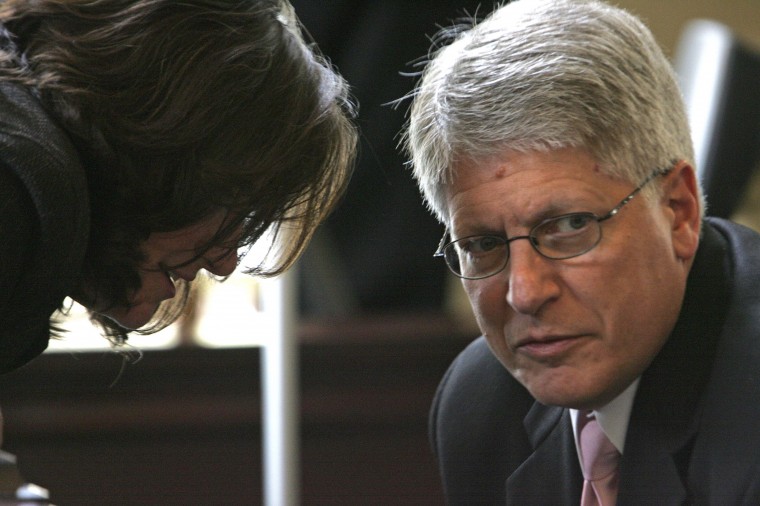
Durham County District Attorney Mike Nifong, right, speaks with an unidentified member of the audience during a break in his North Carolina State Bar trial in Raleigh, N.C., Thursday, June 14, 2007. The North Carolina State Bar has charged Nifong with bre The Associated Press
Jun 15, 2007
Last updated on May 12, 2016 at 12:29 p.m.
RALEIGH, N.C. – District Attorney Mike Nifong acknowledged Friday that he “maybe got carried away a little bit” in talking about the three Duke University lacrosse players who were once charged with raping a stripper, and he said he expected to be punished.
“I think clearly some of the statements I made were improper,” Nifong testified Friday at his ethics trial.
The North Carolina State Bar charged Nifong with violating several rules governing professional conduct, including making misleading and inflammatory comments about the three indicted athletes. Those statements included calling the players a “bunch of hooligans” and confidently proclaiming he wouldn’t allow Durham to become known for “a bunch of lacrosse players from Duke raping a black girl.”
The three lacrosse players were later cleared of all charges by the state attorney general, who concluded they were “innocent” victims of a rogue prosecutor’s “tragic rush to accuse.”
Get The Daily Illini in your inbox!
On the stand Friday, Nifong said, “The comment about race was not a comment that should have been made.”
Nifong also faces much more serious charges from the bar of lying to both the court and bar investigators and withholding critical DNA test results from the players’ attorneys. If convicted, he could be stripped of his license to practice law in the state. He said of the DNA evidence Friday, “Whether we feel it is exculpatory or not, I’m not denying they were entitled to have that evidence.”
If convicted by the bar’s disciplinary committee, Nifong could be stripped of his license to practice law in the state.
One of the accused players testified earlier Friday that he and his teammates had been confident that DNA testing would quickly clear them.
The DNA tests indeed failed to show any physical contact between the accuser and the members of the lacrosse team, but Nifong still pressed ahead with the case and won indictments against Reade Seligmann, Dave Evans and Collin Finnerty.
“We went from being viewed as athletes to being viewed as rapists,” Seligmann testified Friday.
Seligmann broke into tears as he described how his attorney got a call from Nifong notifying him of the indictment last year. He said the attorney glanced his way and said, “She picked you.”
“My dad just fell to the floor, and I just sat on the ground,” Seligmann said. “And I said, ‘My life is over.’ … The first thing I thought about was, ‘How am I going to tell my Mom.”
His attorneys pulled together ATM receipts, cell phone records, time-stamped photos and the testimony of the cab driver who took Seligmann home the night of the off-campus party where the woman, hired to perform as a stripper, said she had been attacked.
“I don’t know much about the law,” Seligmann said, “but you hear the word alibi, and you think that’s one of the first things a prosecutor would want to have. You don’t charge an innocent person. I could never understand it.”
Since opening its case on Tuesday, the state bar has largely focused on the DNA testing, specifically when Nifong learned about the results and when he shared that information with the defense.
The team party was in March 2006. Nifong released an initial report on the DNA testing in May 2006, and defense attorneys quickly trumpeted that private lab DNA Security Inc. had been unable to find a conclusive match between the accuser and any lacrosse players.
However, lab director Brian Meehan testified Wednesday that he had told Nifong about the full extent of the test results – including that the lab had found matches to other men – as early as April 10, 2006, a week before the first indictments.
Meehan said he and Nifong never conspired to keep the results from defense attorneys. He said that the initial DNA report was never intended to be all-inclusive and that Nifong never asked for a final and complete report on his lab’s findings.
Evans’ defense lawyer Brad Bannon testified Thursday that Nifong had said in court documents and hearings in May, June and September that he had no more evidence that could be considered helpful to the defense, yet it wasn’t until Oct. 27 that Nifong gave the defense the raw test data from DNA Security.
“It just kept getting worse,” Bannon recalled. “I would find another one of the items that had male DNA that excluded our clients, and their teammates, and then another, and then another, and then another. …
“We were all bewildered at the fact that it hadn’t been provided to us before.”
Nifong’s attorneys hoped to finish presenting their defense by Friday evening. The three-member panel hearing the case is expected to deliver a verdict not long after the trial concludes, perhaps as early as Saturday.
Nifong has declined several requests for interviews in recent months. His last public comment on the case before the ethics trial was a one-page statement released the day the case collapsed. In it, he apologized, but only “to the extent that I made judgments that ultimately proved to be incorrect.”