A Tale of Two Cities – close on map, distant on immigration
Jul 25, 2007
Last updated on May 12, 2016 at 01:56 p.m.
NEW HAVEN, Conn. – New Haven and Hazleton, Pa., two Northeastern cities led by descendants of Italian immigrants, are just 200 miles from each other on a map. But they are worlds apart when it comes to dealing with illegal immigration.
Hazleton Mayor Lou Barletta, a Republican, has said that illegal immigration is “destroying” his working-class city of 30,000 and driving up crime. He pushed through an ordinance adopted by towns and cities around the nation that would penalize landlords who rent to illegal immigrants and businesses that hire them. A federal judge could rule as early as this week on its constitutionality.
New Haven’s John DeStefano, a Democrat, has embraced illegal immigrants as an important part of New Haven’s economic and social fabric. The city of 125,000 already prohibits police from asking about their immigration status.
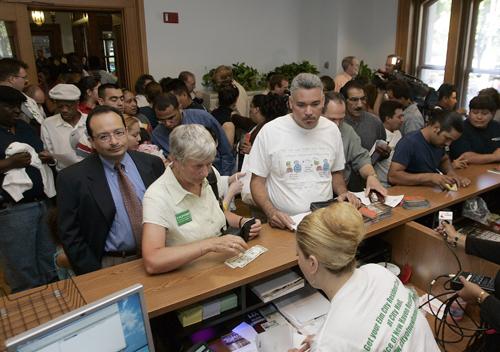
On Tuesday, DeStefano launched a program to provide illegals with ID cards that will enable them to open bank accounts and give them access to many city services.
Get The Daily Illini in your inbox!
How did two Northeastern cities wind up on opposite sides of the issue? One main reason given is that New Haven, the home of Yale University, has a long and rich history of liberal politics, unlike Hazleton, a conservative city in the mountains of northeastern Pennsylvania, 95 miles from Philadelphia.
New Haven “does have a tradition of championing the causes of outsiders,” said Scott McLean, a political science professor at Quinnipiac University who lives in New Haven. “New Haven sees itself as a leader in these kinds of policies.”
This port city is about one-third white, one third black and one-third Hispanic, with an estimated 10,000 to 12,000 illegal immigrants, according to New Haven officials.
“I think New Haven is doing something that makes sense for New Haven,” the mayor said Tuesday. “Service to one another in community, more than waving an American flag, defines the spirit of our soul.”
Hazleton is a blue-collar town in a region whose fortunes rose, then fell, with the anthracite coal industry that once provided jobs to many of its residents – immigrants from Italy, Ireland and Eastern Europe. When the mines closed a half-century ago, Hazleton’s economy struggled.
By 2000, household income was a third lower than the national average, empty storefronts were commonplace and the population stood at just over 23,000, down from its 1940 peak of 38,000.
Then, quite unexpectedly, Hispanic immigrants started arriving via New York and New Jersey.
By 2006, perhaps 10,000 Hispanics had settled in Hazleton, comprising 30 percent of the population. Dozens of Hispanic-owned businesses opened.
At a recent court hearing, an immigration expert called by the city testified that 1,500 to 3,400 illegal immigrants live in Hazleton.
The influx caused growing pains. The school system bulged and the city struggled to keep up with increased demand for services. Tensions flared between Hispanics and whites.
Barletta announced the crackdown shortly after a slaying for which two illegal immigrants were eventually charged.
Though Hazleton’s ordinance has never been enforced because of the legal challenge, many Hispanics, illegal or otherwise, have already left.
Rudy Espinal, a real estate agent, said Barletta held illegal immigrants responsible for the city’s ills without any data to back it up.
“It’s time for the city to come up with a new strategy,” he said. “We are seeing the same amount of crime as we were before. “