Iraqis mandate removal of U.S. security firm
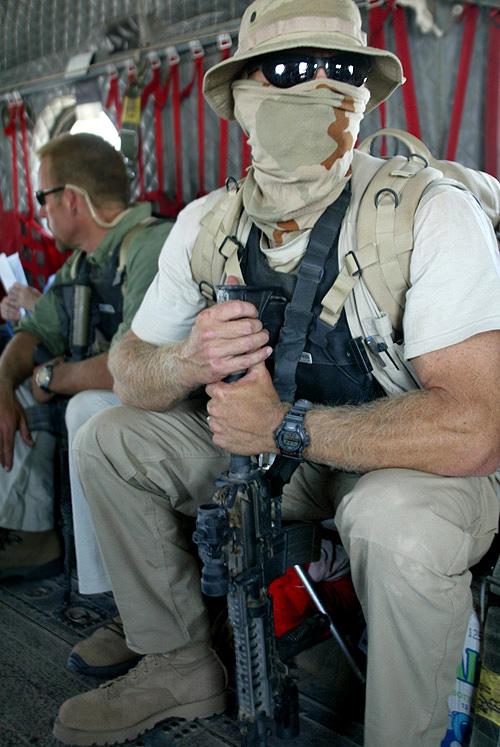
A U.S. private security officer sits in a Chinook helicopter in this Sept 18, 2003 file photo near the southern Iraqi city of Basra. THE ASSOCIATED PRESS, KAREL PRINSLOO
Sep 18, 2007
Last updated on May 12, 2016 at 03:59 p.m.
BAGHDAD – The Iraqi government announced Monday it was ordering Blackwater USA, the security firm that protects U.S. diplomats, to leave the country after what it said was the fatal shooting of eight Iraqi civilians following a car bomb attack against a State Department convoy.
The order by the Interior Ministry, if carried out, would deal a severe blow to U.S. government operations in Iraq by stripping diplomats, engineers, reconstruction officials and others of their security protection.
The presence of so many visible, aggressive Western security contractors has angered many Iraqis, who consider them a mercenary force that runs roughshod over people in their own country.
Sunday’s shooting was the latest in a series of incidents in which Blackwater and other foreign contractors have been accused of shooting to death Iraqi citizens. None have faced charges or prosecution.
Get The Daily Illini in your inbox!
Secretary of State Condoleezza Rice telephoned Prime Minister Nouri al-Maliki late Monday and the two agreed to conduct a “fair and transparent investigation” and hold any wrongdoers accountable, said Yassin Majid, an adviser to the prime minister. Rice was expected to visit the Mideast on Tuesday.
Deputy State Department spokesman Tom Casey said Rice “told the prime minister that we were investigating this incident and wanted to gain a full understanding of what happened.”
“She reiterated that the United States does everything it can to avoid such loss of life, in contrast to the enemies of the Iraqi people who deliberately target civilians,” Casey said.
Majid made no mention of the order to expel Blackwater, and it was unlikely the United States would agree to abandon a security company that plays such a critical role in American operations in Iraq.
The U.S. clearly hoped the Iraqis would be satisfied with an investigation, a finding of responsibility and compensation to the victims’ families – and not insist on expelling a company that the Americans cannot operate here without.
Details of Sunday’s incident were unclear.
Interior Ministry spokesman Abdul-Karim Khalaf said eight civilians were killed and 13 were wounded when contractors believed to be working for Blackwater USA opened fire on civilians in the predominantly Sunni neighborhood of Mansour in western Baghdad.
“We have canceled the license of Blackwater and prevented them from working all over Iraqi territory. We will also refer those involved to Iraqi judicial authorities,” Khalaf said.
He said witness reports pointed to Blackwater involvement but added that the shooting was still under investigation. One witness, Hussein Abdul-Abbas, said the explosion was followed by about 20 minutes of heavy gunfire and “everybody in the street started to flee immediately.”
U.S. officials said the motorcade was traveling through Nisoor Square on the way back to the Green Zone when the car bomb exploded, followed by volleys of small-arms fire that disabled one of the vehicles but caused no American casualties.
Blackwater said the company had not been formally notified of any expulsion.
“Blackwater’s independent contractors acted lawfully and appropriately in response to a hostile attack in Baghdad on Sunday,” spokeswoman Anne E. Tyrrell said in a statement late Monday.
“The ‘civilians’ reportedly fired upon by Blackwater professionals were in fact armed enemies and Blackwater personnel returned defensive fire,” she said. “Blackwater regrets any loss of life but this convoy was violently attacked by armed insurgents, not civilians, and our people did their job to defend human life.”
American officials refused to explain the legal authority under which Blackwater operates in Iraq or say whether the company was complying with the order.
The Illinois-Blackwater connection
The University cancelled a partnership between its Police Training Institute and Blackwater USA in late August after a possible conflict of interest was revealed. The institute’s director Tom Dempsey had made a personal agreement with the company and did not reveal it even though he was entrusted with negotiating the contract between the institute and Blackwater. Dempsey resigned in early September. University spokesperson Robin Kaler told The Chicago Tribune Dempsey agreed to resign “in light of the controversy surrounding his affiliation with Blackwater.”