Attacks in Pakistan spreading to capital
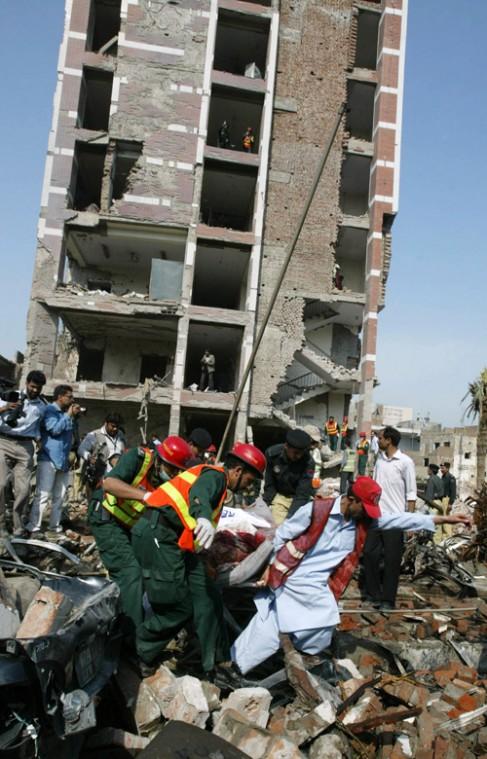
Pakistani rescue workers remove a dead body from the site of a suicide bombing at the office of the Federal Investigation Agency, Tuesday, March 11, 2008, in Lahore, Pakistan. Massive suicide bombs ripped through the seven-story police headquarters and a K.M. Chaudary, The Associated Press
Mar 12, 2008
Last updated on May 12, 2016 at 10:54 p.m.
LAHORE, Pakistan – Pakistan’s crisis deepened after two suicide bombings killed 24 people and wounded more than 200 in this normally peaceful city Tuesday, and pressure grew for more dialogue with militants as a new government prepares to take office.
It was the first major act of terrorism since former Prime Minister Nawaz Sharif and slain opposition leader Benazir Bhutto’s Pakistan People’s Party announced over the weekend that they would form a coalition government aimed at reducing the powers of President Pervez Musharraf, a U.S. ally.
With such attacks now spreading from unruly tribal regions to the eastern cultural capital of Lahore, an increasing number of Pakistanis are questioning Musharraf’s approach to countering al-Qaida and the Taliban. Musharraf’s opponents say punitive military action has only fueled the violence.
Musharraf quickly condemned the “savage” bombings, which ripped through a police headquarters and a business located near a house belonging to Bhutto’s widower. The president said in a statement that the government would continue to fight terrorism “with full force.”
Get The Daily Illini in your inbox!
But some enraged Lahore residents blamed Musharraf. They gathered in small groups Tuesday on the city’s main Mall Road, chanting “Musharraf is a dog! Musharraf is a pimp!”
The winners of last month’s elections accused the former army strongman of destabilizing the country with military operations against militants near the Afghan border and even suggested that rogue forces were trying to undermine Pakistan’s return to democracy.
“He has carried out indiscriminate operations in the tribal areas that have opened up new fault lines in Pakistani society,” said Ahsan Iqbal, a spokesman for the party set to partner with Bhutto’s in the new government. “Unless he resigns, there will always be a cause for all these groups to carry on these activities.”
Tuesday’s blasts happened about 15 minutes apart in different districts of Lahore. The first tore the facade from the seven-story Federal Investigation Agency building as staff were beginning their work day.
The explosives-packed vehicle managed to penetrate security, drive into a parking lot and detonate close to the building – which houses part of the federal police’s anti-terrorism unit – devastating offices on the lower floors and blowing out the walls around a stairwell, city police chief Malik Mohammed Iqbal said.
Grainy footage from a surveillance camera shown on the private Aaj television channel showed the small truck running over a guard and barreling through the gate seconds before the blast.
While al-Qaida-linked militants in Iraq have regularly used vehicles to launch massive attacks on buildings, such damage has rarely been inflicted on a government building in Pakistan.
Officials said 21 people were killed, including 16 police, and more than 200 people were wounded. Doctors at Lahore hospitals said the dead included a 3-year-old girl, while 32 girls were injured by flying debris at a nearby Roman Catholic elementary school.
Associated Press writers Munir Ahmad, Sadaqat Jan, Zarar Khan and Stephen Graham in Islamabad contributed to this report.