Army policy changed to preserve marriages
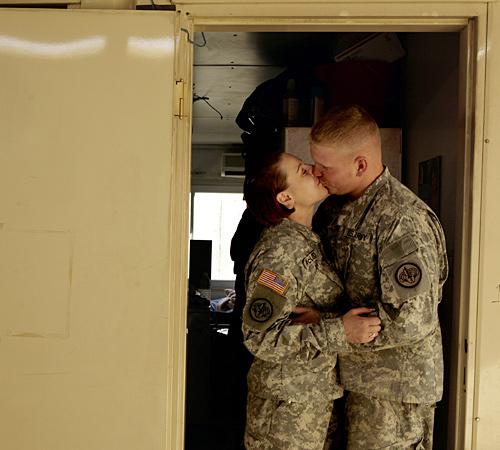
U.S. Army Sgt. Jacqueline McCloud, 29, left, and her husband, Sgt. Jason McCloud, 24, kiss in the doorway of the small cargo container they share at Forward Operating Base Marez in Mosul, Iraq, 225 miles northwest of Baghdad, on Thursday. The two, who hav Maya Alleruzzo, The Associated Press
Apr 1, 2008
Last updated on May 12, 2016 at 11:27 p.m.
BAGHDAD – When American soldiers get off duty in Iraq, the men usually return to their quarters, the women to theirs. But Staff Sgt. Marvin Frazier gets to go back to a small trailer with two pushed-together single beds that he shares with his wife.
In a historic but little-noticed change in policy, the Army is allowing scores of husband-and-wife soldiers to live and sleep together in the war zone – a move aimed at preserving marriages, boosting morale and perhaps bolstering re-enlistment rates at a time when the military is struggling to fill its ranks five years into the fighting.
“It makes a lot of things easier,” said Frazier, 33, a helicopter maintenance supervisor in the 3rd Infantry Division. “It really adds a lot of stress, being separated. Now you can sit face-to-face and try to work out things and comfort each other.”
Long-standing Army rules barred soldiers of the opposite sex from sharing sleeping quarters in war zones. Even married troops lived only in all-male or all-female quarters and had no private living space.
Get The Daily Illini in your inbox!
But in May 2006, Army commanders in Iraq, with little fanfare, decided that it is in the military’s interest to promote wedded bliss.
“It’s better for the soldiers, which means overall it’s better for the Army,” said Command Maj. Mark Thornton of the 3rd Infantry.
Military analysts said this is the first war in which the Army even gave the idea any serious consideration – a reflection not only of the large number of couples sent to war this time, but also of the way the fighting has dragged on and strained marriages with repeated 12- and 15-month tours of duty.
While some couples were also sent into the 1991 Gulf War, the fighting was over before their living arrangements became an issue, said Lory Manning, a retired Navy captain who studies how military policies affect women for the Women’s Research and Education Institute.
More than 10,000 couples are in the Army. Exactly how many are serving in the war zone, and how many of those are living together, are not clear.