NASA’s latest robot to explore ice reservoir beneath surface of Mars
May 20, 2008
Last updated on May 13, 2016 at 11:00 a.m.
LOS ANGELES – Like a miner prospecting for gold, NASA hopes its latest robot to Mars hits pay dirt when it lands Sunday near the red planet’s north pole to conduct a 90-day digging mission.
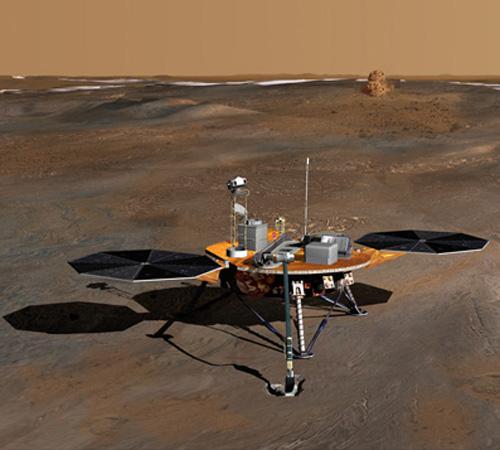
The three-legged Phoenix Mars lander fitted with a backhoe arm is zeroing in on the unexplored arctic region where a reservoir of ice is believed to lie beneath the Martian surface.
Phoenix lacks the tools to detect signs of alien life – either now or in the past. However, it will study whether the ice ever melted and look for traces of organic compounds in the permafrost to determine if life could have emerged at the site.
Before this robotic geologist can excavate the soil, it must first survive a nail-biting plunge through the Martian atmosphere. Despite the rousing success of NASA’s twin Mars rovers, which landed in 2004, more than half of the world’s attempts to land on the planet have failed.
Get The Daily Illini in your inbox!
“It’s kind of like first-day jitters,” said Ed Sedivy, program manager at Lockheed Martin Corp., which built Phoenix. “There’s a lot of excitement, but there’s also some nervousness.”
Launched last summer from Cape Canaveral, Fla., Phoenix has traveled 422 million miles for Sunday’s touchdown.
The spacecraft’s main tool is an 8-foot aluminum-and-titanium robotic arm capable of digging trenches 2 feet deep. Once ice is exposed – believed to be anywhere from a few inches to a foot deep – the lander will use a powered drill bit at the end of the arm to break it up.
“It’ll be a construction zone,” said mission co-leader Ray Arvidson of Washington University in St. Louis . He predicts the ice will be “as hard as a sidewalk.”
The excavated soil and ice bits will then be brought aboard Phoenix’s science lab. It will be baked in miniature ovens and the vapors analyzed for organic compounds, the chemical building blocks of life.
The last time NASA did tests for organics it was on a hunt for extraterrestrial life in 1976 with the twin Viking spacecraft. No conclusive signs of life were found.
Phoenix’s landing target – a broad shallow valley in the high northern latitudes comparable to Greenland or northern Alaska on Earth – was chosen because if organic compounds existed, they’re more likely to have been preserved in ice. Researchers do not expect to find water in its liquid form at the site because it’s too cold.
The last time NASA tried a soft landing on Mars, it ended in disaster. In 1999, the Mars Polar Lander was angling for the south pole when it prematurely shut off its engine and tumbled to its death.
The cost of the mission is $420 million, excluding the $100 million NASA sunk into the canceled predecessor. Phoenix will communicate with Earth through the two NASA orbiters circling the planet.
Once on the ground, the 772-pound Phoenix will wait 15 minutes for the dust to settle before unfurling its solar panels. Then it will hoist its weather mast and beam back the first images of its surroundings. Over the next several sols, as days are known on Mars, it will check its instruments and stretch its robotic arm to scoop up the first soil sample.
By around sol 10, Phoenix will dive into the digging phase that is expected to dominate the rest of the mission, excavating about two hours a day.
While scientists say there’s a chance Phoenix could live a month or so beyond its 90-day mission to see late summer or fall, it won’t survive as long as the rovers. That’s because its solar panels won’t produce enough power to keep it alive during the Martian winter.
Said Arvidson: “Its feet will be embedded with dry ice and the sun will be below the horizon.”