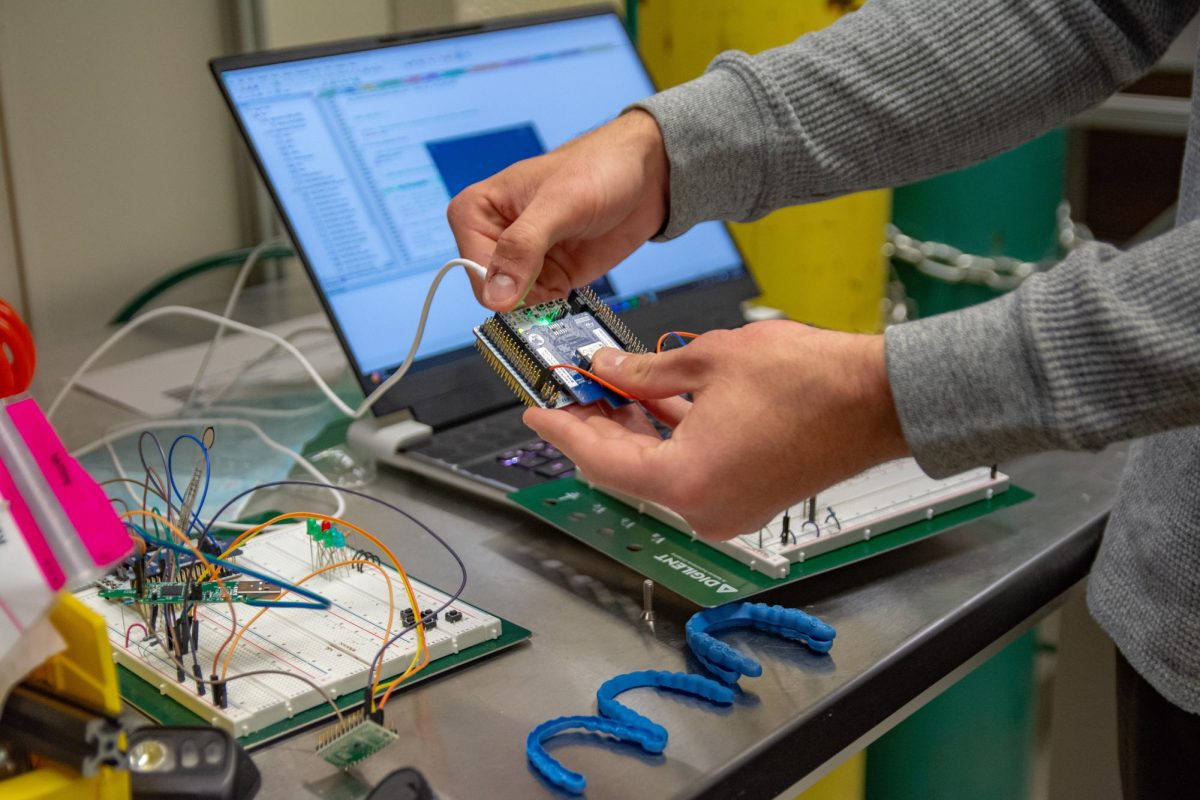
As his thesis deadline approaches, Angel Aquino, graduate student in Engineering, looks forward to ditching his printer with the help of the University’s new Electronic Thesis Dissertation (ETD) system.
First started in 2009, the system, allows graduate students to electronically submit their dissertations on the Graduate College’s website. With the adaptation of this new software, students no longer have to print out entire dissertations and submit them physically or through post, said Rebecca Bryant, assistant dean at the Graduate College.
Aquino, who is pursuing his doctorate in electrical and computer engineering, has a thesis deadline around October or November, and is excited about the proposed benefits of the new system.
“It’s easier for us,” Aquino said. “I don’t have to print out my entire thesis.”
Bryant said a majority of students have shown support for the system. Although ETD will not become mandatory until December of this year, about 95 percent of last year’s graduate students (roughly 800 total) have already utilized it, Bryant said.
Get The Daily Illini in your inbox!
In addition to saving time, Bryant said the ETD system will keep a student’s wallet slightly heavier not only by reducing printing costs, but eliminating the need to mail dissertations to different locations.
“It can get very expensive if you have a 300 page-long dissertation,” Bryant said.
Other benefits of the system include reduced use of paper and shelving needs at the University library. While all printed dissertations eventually make their way to the Main Library, electronic submissions will now be stored at a thesis repository called IDEALS, run by library staff.
Bryant added that students are now able to control how easily their work is available to the public — the system allows students to withhold their work for two years if desired.
Not only do students find ETD helpful, thesis reviewers have also found the new system to be better, like Mark Zulauf, thesis coordinator at the Graduate College.
“It’s been like night and day. It’s allowed us to provide a much more thorough review, just because we don’t have to flip through pages,” Zulauf said.
He said reviewers can now simply search for a particular keyword and immediately find related articles because of the use of a computer.
With so many benefits, some may wonder why the system has only recently made its way to the University. Aquino said he used a similar system at another school, and is “surprised” ETD is just being introduced. Some institutions have had a similar system for up to 10 years, and Bryant said the birth of the system has been requested by students for a while.
“It has taken some time to know what format to use, or to know what is easiest for students,” Bryant said. “There were challenges before. In the past couple years, we had the personnel and the potential, really, to do it.”
The Graduate College received the software for free from the Texas Digital Library, Bryant said. Because the software is new, she said the University Library and the Graduate College are continually working out any kinks that show up in the software.
Although the system has improved, Bryant said the reviewing process will remain just as diligent.
“As far as faculty, reviewing masters and doctoral dissertations is rigourous as ever. I don’t think that will change,” Bryant said.