UI lacks in resources for transgender students, trans equality RSO president says
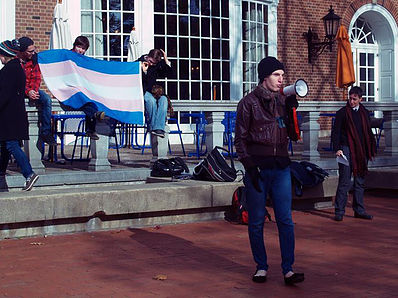
Stephanie Skora, president of the Campus Union for Trans Equality, CUT*ES, speaks on the Quad during a rally for Trans* Day of Remembrance on Nov. 20, a day to memorialize those who have been killed due to trans*phobia.
Dec 5, 2013
Last updated on Oct. 24, 2016 at 05:22 p.m.
The University lags behind in resources available to the transgender community in comparison to other schools within the Big Ten, specifically in regard to health care, gender-neutral housing and gender-neutral bathrooms, said Stephanie Skora, president of the Campus Union* for Trans Equality and Support.
“It’s very concerning because the University of Illinois holds itself up as this bask of inclusion when we really don’t have the right to do that because we are not doing everything that we can right now for such an endangered population,” said Skora, a transgender junior in LAS.
To help counter this, Illinois student senator Justin Ostrowski, senior in LAS, submitted a resolution to the senate asking for its support to create a more trans-inclusive campus.
“We would essentially use this as a sort of leverage tool in scheduling meetings with administrators, chairs of committees and other people with power,” Ostrowski said. “We can use (the resolution) to say this is something that the student body supports and cares about. It’s much more impactful to have a statement like this than to just come in with three or four people.”
Get The Daily Illini in your inbox!
At the senate’s Wednesday meeting, Skora called upon the senators to pass the resolution unanimously.
“Our mission right now, as stated by Chancellor (Phyllis) Wise numerous times, is to make this campus a diverse and inclusive place,” she said. “This statement would be an excellent first step in doing that.”
After Ostrowski told senators, “We’ve been morally beaten down by a bureaucratic hammer,” the resolution passed, 22-3 with four abstentions.
B A Davis-Howe, a senior library specialist, said this statement moves toward creating a climate that is not only beneficial to students, but to all of the University’s employees.
“It is historically known that Champaign and Urbana are two of the longest standing communities in the country for trans-inclusion,” Davis-Howe said.
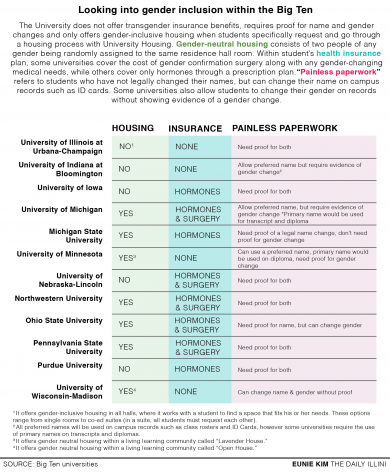
Last summer, the University of Illinois at Chicago, the University’s sister school, passed a trans-inclusive health measure, which covers gender confirmation surgery within its student health insurance plan. And several other Big Ten universities offer these resources as well.
“We find that when we look across all of these sorts of resources, the University of Michigan is very, very far ahead of everybody,” said Ostrowski, who is also a member of CUT*ES.
He also cites the option for students to change their legal name — “painless paperwork” — without having to prove a legal name change for issues of security, safety and convenience.
Although the University already has diversity and inclusion statements with references to gender identity, gender expression and sexual orientation, “it’s fairly ignored and is something that is almost everywhere now and not trailblazing,” Ostrowski said.
Ostrowski is concerned that once the resolution is published, the administration will not take action, instead falling back on its previously published inclusion statement.
“But we’re hoping they look at this as a real narrative of the student body and we can see more changes,” he said.
Chip Austin, a transgender graduate student, believes all faculty members should be educated on trans issues through trans ally training, along with LGBT ally training.
“Everyone is potentially going to interact with a trans student, so they should be able to know what to do about it if there are any problems that come up,” Austin said.
CUT*ES, a new registered student organization specifically dedicated to the trans-community, serves to create a safe, friendly and welcoming community for trans-identified members.
“My ultimate hope for transgender people on campus is that they are treated as equal students and that they have the opportunity to participate and learn in this educational system as productively and freely as any other student,” Ostrowski said.
Gender-inclusive housing is available in all halls, when specifically requested, and students need to work with University Housing to find spaces that “fit their needs,” said Kirsten Ruby, associate director of housing for communications and marketing, in an email.
A call for gender-neutral bathrooms
One of the main goals CUT*ES has is to push administration to pay attention to the lack of gender-neutral bathrooms on campus, as many buildings don’t have them, Ostrowski said.
Skora hopes to submit a ballot for the spring semester’s student referenda requesting more inclusive bathrooms. If it passes, she said the student body will show administrators that this is an issue they support.
“There is a safety issue, there is a comfortability issue, which then all comes down to ‘how can you learn in this environment?’” Ostrowski said. “There is a large narrative around safety issues in bathrooms in terms of someone who looks like a woman that is going into a men’s restroom. That’s not safe for a lot of people because a lot of people are sort of fearful of these kinds of things.”
CUT*ES plans to push the administration this year to establish policy requiring gender-neutral bathrooms to be built when any building undergoes significant construction, Skora said.
“We are trying to make it so that any construction on a building, even if you are just changing a tile, would require you to ensure that there is a single stall,” Ostrowski said.
McKinley Health Center currently hosts a map on its website displaying the locations of the campus’ 37 gender-neutral bathrooms, but it has not been updated in six years, Ostrowski said. McKinley itself has 20 gender-neutral bathrooms in the building, which is not a part of the list, Skora said.
“Say you are a trans-student in Engineering, you would potentially have to walk across the Engineering Quad to find a safe bathroom to use,” she said. “By the time you get back, you’ll have either missed lecture, or half of your lecture.”
She said many buildings have gender-neutral bathrooms in the basement, making it difficult for trans-students who have classes on the top floors.
“You better hope you can get downstairs and back fast enough or you’ll be missing some important information,” Skora said. “It would be nice to have one on every floor, but we know that’s not feasible right now.”
CUT*ES recently created a bathroom committee to help try and get access to blueprints and construction documents to make an overall list of where bathrooms are and where they are lacking.
Skora said there are more than 100 bathrooms on campus that are single-stalled locking bathrooms with a gender needlessly assigned to them.
“Only one person can use that bathroom at a time, so it doesn’t matter what gender the person is,” Skora said. “It’s such a simple, small change that has not been made and unfortunately we have to go to these lengths to make sure it happens.”
Looking into health insurance plans
Skora attests that health care for transgender people is very expensive, whether it be hormones or a gender confirmation surgery. The expense prohibits a lot of trans-people from receiving appropriate medical care, making it a class-based issue in the community, she said.
She also added that many health care professionals are not necessarily trained in trans issues.
“When you have to educate your own doctor, it’s very awkward and it makes you feel very uncomfortable because if you know more about how to treat yourself medically than they do and they have the medical degree, it doesn’t make you feel very confident,” Skora said.
Both Ostrowski and Skora serve as members of the University’s student insurance advisory committee and are investigating the possibility of securing trans-inclusive healthcare for the Fall 2014 semester.
“We were both delighted to find out that it was on their agenda before we were even on the committee,” Skora said. “That’s a major priority for us as a University that claims inclusion and diversity. One of our subsidiaries has beat us to that, and we cannot let ourselves be outside that field for so long.”
She said surgeries are important needs because they could save lives. Many within the trans community have gender dysphoria, or extreme discontent with their born sex, and other mental health issues stemming from this disorder. Without having access to surgeries or hormones, those affected could become extremely depressed or commit suicide, she said.
“The trans community has an alarmingly high suicide rate upwards of 30 to 35 percent, and obviously … where suicide is already a problem in higher education overall, that is an atrocious figure, and we need to have our needs catered to so that tragedies don’t occur more frequently,” Skora said.
‘Painless paperwork’
Austin has personally run into problems with trans-inclusion, as he cannot write his preferred name on University records or prescriptions at McKinley.
“One of the things we’re pushing is more painless paperwork, so I don’t have to feel like I’m lying every time I write down my name and my gender,” Austin said.
Other universities within the Big Ten allow students to change their names on records without showing proof of a legal name change, along with changing his or her gender without showing evidence of a gender confirmation surgery.
Austin added that trans-inclusion is also important to create a culture of gender diversity.
“The traditional trans-person identifies across the binary, but there is a lot of people in the community who do not identify as male or female or they identify as both, so part of trans-inclusion is to make people more open-minded about gender in the same way they’ve recently become more open minded about sexual orientation,” he said.
@MeganAsh_Jones