Police recruits train for certification at academy with new structure
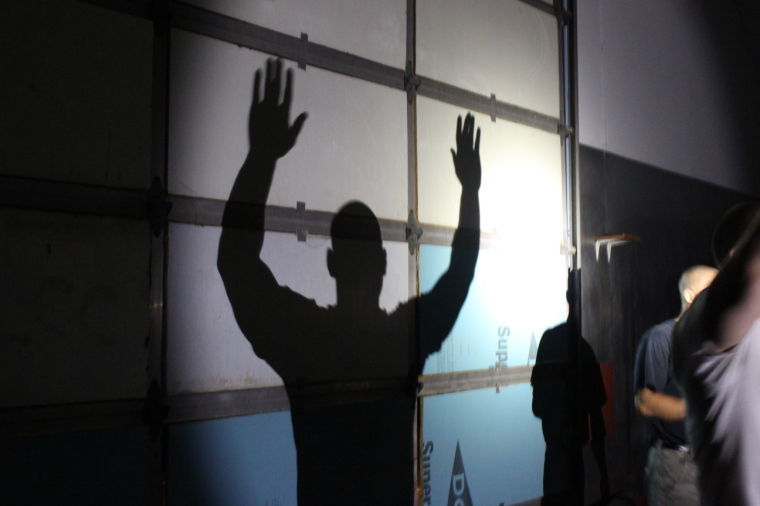
Cody Hammond, a deputy sheriff from Coles County, pretends to be a criminal during a control tactics lesson at the Willard Training Center. Recruits took turns acting as both police and criminals to practice all of the tactics they learned during their training.
Apr 1, 2014
Last updated on May 11, 2016 at 05:47 a.m.
Editor’s note: This is part two of a two-part article series. Read part one here.
Deputy Brad Atkinson of the Champaign County Sheriff’s Office can bench press 98 percent of his body weight without flinching. He can run a mile and a half in less than 12 minutes. He can crank through 40 sit-ups in 45 seconds.
But Brad’s physical fitness is not the key to enforcing the law. His ability to pass the Police Officer Wellness Evaluation Report, or POWER test, is not what will make Brad, or any of his classmates in Basic Law Enforcement Class No. 3017 at the Police Training Institute, a good police officer.
Dr. Mike Schlosser, director of PTI, says the key lays in two skills.
Get The Daily Illini in your inbox!
“The two most important things I think to be a cop are common sense and, does anyone remember?” he asks his students. “Knowing how to talk to people.”
After meeting the physical fitness standards set by the Illinois Law Enforcement Training and Standards Board, it was time for the staff to show the recruits how to protect and serve their communities as sensible officers who know how to treat people — a job in which they’ll be held to a higher standard.
In their first two weeks of classes, the recruits adjusted to their basic schedule of at least eight hours of class per day and started to cover the basics: a tactical mindset and principles to apply to their work, personal wellness, “Verbal Judo,” or communications skills, and community-oriented policing.
In the second week, the recruits made their first visits to the Willard Training Center — where they began learning control tactics — and the shooting range called the Tactical Training Center, where they began firearms lessons.
They also added daily physical training, activities that would range from running circuits with resistance bands to running up ramps at Memorial Stadium. Once, the training even included an exercise for the vocal chords: singing the Star Spangled Banner outside the Armory.
The recruits had to arrive for PT by 5:45 a.m., line up in an array of three or four rows facing their squad leaders — four recruits selected by PTI’s administration to help with day-to-day operations during the 12 weeks of training. During PT, the squad leaders led daily stretching and warm-up exercises.
***
Week three was the time for the recruits to test their knowledge in the first integrated scenario. PTI considers its scenario-based training a point of pride because it gives the recruits several opportunities during their training to apply their classroom knowledge to mock crimes.
The recruits arrived in their department uniforms and lined up for a uniform inspection with Mr. Chuck Deakin, the operations manager.
“If you look sharp, you command respect,” Mr. Deakin told them.
Mr. Ed Ogle, who’s retired from Brad’s department, then broke the recruits into five groups and sent the students down the back stairwell of the building into the basement to find their assigned rooms.
His parting advice to the students prior to taking their first police reports was to remember they’re in a training environment.
“Mistakes are good,” he said. “You are going to learn quicker from your mistakes than if you ace everything.”
One by one, they were called to stand before the ceiling-mounted camera and practice interviewing techniques on an assigned dispatch — either property damage or stolen property. To successfully take the report, the recruits would have to draw on their recent instruction and establish the elements of the offense — the circumstances that have to be satisfied for a crime to be prosecuted.
When Brad’s turn came, nervous and not knowing what to expect, he wrote a stolen bike report for Steve Malloch, who also retired from the Champaign County Sheriff’s Office. But Malloch was agitated — at least his character was.
Malloch, a facilitator for the session, portrayed a man whose bike, his only means of transportation, had been stolen. He complained he had called the police a half hour before Brad arrived. Brad, drawing from his classes, had to combine communication skills and legal knowledge. He also had to practice officer safety tactics by keeping his gun-side back and his hands available in case Malloch tried to grab his weapon — a plastic weapon used for training purposes.
The instructors don’t expect the recruits to properly assess the scenarios on the first attempt — especially whoever volunteers to go first.
“By the end of the four hours, they’re like ‘Oh, now I understand what it means to have reasonable suspicion, and I understand what I need in order to do a pat down,’” Dr. Schlosser said.
The scenarios are set up to simulate more than common calls for police, though. With an audience of classmates and a video camera taping the experience to send back to the recruits’ departments, it’s supposed to put them under stress.
***
The fourth week brought more classroom sessions and practice at the off-campus training facilities on firearms and control tactics.
It brought the second scenario — a domestic violence call and the recruits’ first experience with PTI’s role players — and an hours-long burning sensation like Brad had never before experienced — O.C. Spray Day. The day was meant to educate recruits about how to use the defensive spray, the effects it might cause on any given person and a day to teach them what it feels like to take a hit of it themselves.
With a line of spray across their cheeks, each recruit was to drop down on the concrete to do 30 push-ups, run the length of the Tactical Training Center, crawl through a padded tunnel created by an overhead door, and grab a mat for an instructor to hold while the recruit kneed him until he was given the go-ahead. Then he had to practice the proper handcuffing procedures on a fellow recruit, and, finally, shoot a target with a laser gun.
Brad felt the burn on his skin but managed to keep the spray out of his eyes until he reached the laser beam, having done the push-ups with his head held back.
“It feels like you have rocks in your eyes,” Brad said.
With a Dawn-soap remedy Brad found online, he managed to clear the pain after a few hours.
One recruit was not so lucky. Unable to open his eyes, he was sent to the hospital.
***
Five weeks in, the class began training on the Standardized Field Sobriety Test and were ready to practice conducting vehicle stops in the dark.
It was cold. Bitter cold. Cold enough that not even long underwear, layered socks and toe warmers could prevent numbness from taking over in a matter of minutes during the class. But police officers don’t get to choose the weather in which they work.
Brad practiced his first stop of the night in front of Sgt. Jeff Vercler of the Champaign County Sheriff’s Office — a sergeant whose shift he might eventually work on. Brad had the opportunity to get tips from his colleague, and Sgt. Vercler got to see what his department’s recruit can do.
***
Six weeks in, the recruits completed their third scenario, this time on Terry Stops — stops conducted when police think a crime has been, or will be, committed by a person who matches the suspect’s description.
On Wednesday morning that week, they learned the part of the job that would make up 80 percent of the calls they take: service.
“No matter where it is, when it is, you guys come,” said instructor Dallas Jackson, a retired state trooper.
They wouldn’t just take criminals to jail. There’d be welfare checks. There’d be citizens locked out of their homes. There’d be motorists to assist, downed wires to address and missing persons to look for.
“Why do we do this stuff?” Jackson asked the recruits. “It’s our job.”
At week’s end, Brad and his classmates were half-way through their training at the academy.
“It’s going pretty quick,” Brad said. “It’s flying by.”
***
The weeks wore on. The recruits trained on drug identification and searches involving drugs. They continued their certification training for Standardized Field Sobriety Tests. They trained for eight hours on HAZMAT. Night building searches. Child and elder abuse. Ethics. Juvenile law and processing. CPR. They did their fourth and fifth integrated scenarios, again practicing domestic violence calls and terry stops.
The 10th week arrived, 75 percent of the recruits’ time at the academy behind them. They had their second round of practicing patrol operations, in which Brad got to practice a welfare check. Dispatched to a mock apartment inside building Q-8 at the Willard Training Center, the two recruits, Brad and Josh Carrigan of the East Peoria Police Department, knocked on the door of a man whose aunt called and said he might be off his medication.
Inside the apartment, behind the door, was Tim Arie, a substitute teacher in the Unit 4 school district who has been a role player at PTI for eight years. Tim draws on his experience as an actor, who used to do commercials in Los Angeles, to give the recruits the most realistic experience they can get in training.
As the recruits tried to enter Tim’s home, he threw a rope in Carrigan’s face and began frantically switching between topics as he talked non-stop.
“I love, love, L-O-V-E the granny panties,” Tim exclaimed as he showed the recruits an advertisement, just before asking, “Do you guys got any candy? I would love a Snickers.”
Tim threw a jersey over his face and sat quietly.
“Would this be a good time to do something?” asked Malloch, who was facilitating the lesson.
Brad and Carrigan approached Tim to put him in handcuffs, Brad reaching up to Tim’s head to remove the jersey. The action was met with a quick, staccato scream.
Before the week of training was over, the recruits also finished the third module of a three-part class on policing in diverse communities, a pilot study being conducted by University professors in conjunction with Dr. Schlosser and PTI. Training of this nature was relatively new to PTI — a result of the academy’s continued existence despite years of pressure to shut its doors.
***
By June 2012, ILETSB director Kevin McClain was prepared to tell the board its initial start-up of a new training academy at Western Illinois University was not making as much progress as planned. Training demands were slowly increasing and other academies had to pick up the extra cadets in the absence of basic training courses available at PTI. Three months earlier, the board had decertified PTI from being able to teach basic law enforcement.
But the University had a new president, Robert Easter, who saw that the University’s mission was to serve all parts of the state. And he was willing to negotiate with the board to get PTI’s certification back.
Before the board meeting, Easter and McClain had drafted a “Memorandum of Understanding,” which McClain distributed to the board. He informed the board that the University would be willing to enter an intergovernmental agreement if the board approved the memorandum. The document was accepted and all the board members passed a motion to re-approve basic training at PTI.
***
With only 10 days left to train before graduation, Brad was ready to wrap things up and get on the streets.
“It’s been enjoyable,” he said. “But it’s nice to actually get out there and actually put some of the things to use.”
His final full week at PTI would include his state qualification firearms test, three exams and two days of training on patrol rifles, an extra training course his department signed him up to take.
In his last three days, Brad and his classmates finished their certification on Field Sobriety Testing, trained in rapid response to address active shooters and completed their final test: the state qualification test.
At the completion of this exam, Brad’s training at PTI concluded. All that was left was walking across the stage of The Vineyard Church that afternoon to receive his certificate of completion.
***
Graduation day might never have been possible if the contending entities had not come together on July 9, 2012. That day, the state and University signed an agreement to establish PTI as not only a training academy, but also as a research institute.
In accordance with the agreement, the board would work with the University to find alternative sources of funding to support PTI and ensure it would not need the University’s subsidy. PTI was to complete special research projects — one being an update to the mandated curriculum for all police officers in the state, to be completed by two University professors.
With that tenet of the agreement in mind, Dr. Schlosser is looking to change another aspect of PTI. He’s working on changing the academy’s name to the Police Training and Research Institute.
“Our number one goal will always be to train competent, safe officers. But with the changes that we’re making and the growth that we want and the goals that we have, it kind of fits into where we’re headed,” he said.
***
With certificates in hand, the 56 recruits of BLE No. 3017 turned 180 degrees on Mr. Deakin’s call from the stage for an “about face,” and the class was congratulated by their friends, families and departments.
One last time, Mr. Deakin called, “Class, about face.”
The recruits turned to face the stage and received their final command from the operations manager.
“Dismissed.”
Sari can be reached at [email protected] and @Sari_Lesk.