U-C Senate encourages Board of Trustees to establish supplemental retirement system
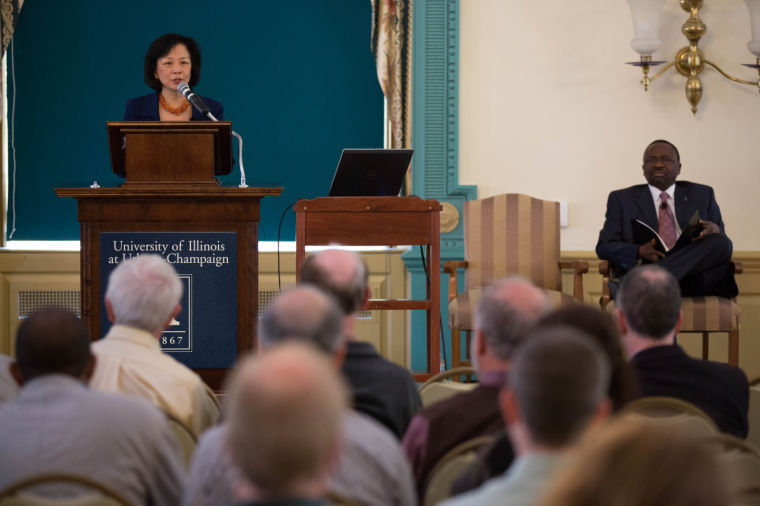
Chancellor Phyllis Wise speaks to the audience during a town hall meeting held at the Union, on Wednesday, April 9, 2014. Wise and Provost Ilesanmi Adesida were included in several documents of emails released Friday.
Apr 15, 2014
Last updated on May 11, 2016 at 05:17 a.m.
The Urbana-Champaign Senate took an early step Monday in providing financially competitive retirement compensation to University of Illinois faculty.
The resolution, which the senate passed unanimously, encourages the Board of Trustees to establish a supplemental retirement system that is flexible enough to be adjusted as needed for all State Universities Retirement System-eligible University employees.
Since 2004, SURS liabilities have incrementally outweighed its assets. In 2004, SURS was 66 percent funded, but this had fallen to 41.5 percent in 2013. Mike Sandretto, senate budget committee chair, said the state has not been contributing enough money to catch up to its liabilities.
Additionally, Sandretto added that the recession particularly hurt funding, as SURS saw its percent funding decrease 22 percentage points from 2007 to 2010.
Get The Daily Illini in your inbox!
“The recession brought them down a lot. The change in the pension fund will reduce underfunded by we don’t know how much, maybe enough,” Sandretto said. “As long as there’s not another recession, the state can probably catch up — we don’t know.”
The package under consideration would include a University contribution to employee 403(b) plans and additional matching contributions for every employee who contributes to their own 403(b) plan.
Finance professor Jeff Brown, who chairs the ad hoc compensation review committee, said each employee would receive a modest contribution as a percent of pay under the plan’s draft.
The plan could also include additional University pension contributions for employees who earn more than the salary cap imposed by the state’s recent pension reform, Senate Bill 1. However, Brown said this has not been decided on.
Brown estimated that, for each percent of pay that the University would direct into this supplemental retirement system, it would cost a total of $7.5 million to the Urbana campus.
“We just have to do this,” Brown said. “Either we pay for it now, or we are going to pay for it later as we watch key staff and faculty exit.”
According to a 2012 study by Buck Consultants, University of Illinois’ plan lags behind the average Big Ten contribution rate of 26.39 percent of salary to pension funds. In contrast, University of Illinois Tier I faculty receive a total of 15.5 percent, Tier II receives 14.5 percent and faculty with a self-managed plan receive 15.6 percent.
“No matter how you slice it, we are at a competitive disadvantage,” Brown said.
Additionally, senators stood with their students “past and present in dire need of (their) support” in passing a resolution urging Congress to pass HR3892, a bill that would restore full bankruptcy protection to all student loans.
“The situation is actually far worse than I imagined a month ago,” said bill sponsor George Ordal, professor emeritus of biochemistry. “The reason for that is that the federal government is really acting as a predator on (student loan debtors).”
The Illinois House of Representatives and Senate have already passed bills similar to the Urbana-Champaign Senate’s, and HR3892 has last been referred to the subcommittee on Regulatory Reform, Commercial and Antitrust Law.
“People who are still teenagers and completely naive about the ways of the world are signing these fateful documents,” Ordal said.
Bill sponsor Tony Fiorentino, law student and Illinois student senator, said the resolution calls on Congress to restore basic consumer protections to individuals with consumer debt. He said legitimate debt should be treated equally, adding that student loans are the only loans without bankruptcy protection and a statute of limitations.
Prior to the vote, Fiorentino read an excerpt from the 1977 House of Representatives judiciary committee report when bankruptcy protections for student loans were initially removed.
“The proposal in this bill visits a special discrimination upon student debtors,” he read. “It treats educational loans precisely as the law now treats loans incurred by fraud, felony and alimony dodging.”
Also, senators forwarded four faculty member candidates to fill two faculty positions on the Athletic Board for four-year terms in 2018. These faculty member candidates will be forwarded to Chancellor Phyllis Wise, who will make the final selection: Kent Choquette, professor in electrical and computer engineering; Kathryn Clancy, assistant professor in anthropology; Michael LeRoy, professor in labor and employment relations; and Robert Olshansky, professor in urban and regional planning.
Tyler can be reached at [email protected] and @TylerAllynDavis.