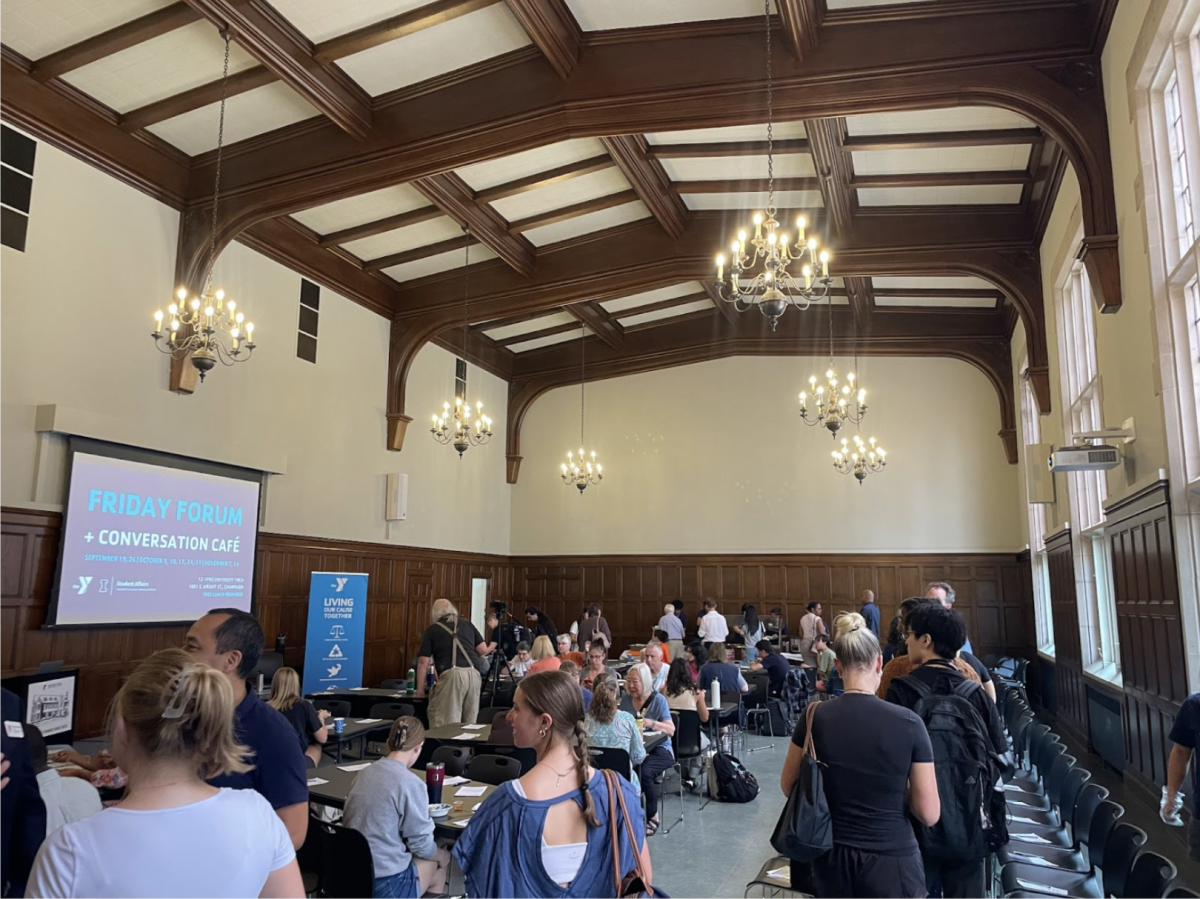
Representatives from the New American Welcome Center led a conversation about immigration at the Friday Forum and Conversation Café, resuming the weekly lecture series where community members discuss community concerns over free lunch catered by Y-Thai Eatery.
The events are hosted by the University YMCA in collaboration with the University’s Diversity & Social Justice Education program.
Jim Hinterlong, executive director of the YMCA, gave the forum’s opening remarks. Hinterlong told the crowd the YMCA has hosted Friday Forum since 1927 and emphasized the importance of continuing the tradition.
“Human inclusion and belonging have been central to the identity of our organization throughout history,” Hinterlong said. “I would argue it has never been more important to have a space that says everyone belongs, and should be heard.”
NAWC was founded in March 2017 and offers resources to help immigrants with transitional housing, citizenship education, legal processes and healthcare.
Get The Daily Illini in your inbox!
“(The) program was established largely because a group of students on this campus … said that we should listen to what the immigrant community said was needed, and create structures and programs that bring resources … that would address the real and persistent needs of immigrants,” Hinterlong said.
Hinterlong then introduced the speakers from NAWC, Associate Director and Legal Services Director Daniela Vergara and director Francisco Baires. The pair talked about what motivated them to join the cause and spoke on a variety of issues impacting immigrant communities.
Vergara began by talking about her work at NAWC and the center’s immigrant relief fund. Vergara said since its inception, the fund has mobilized over a million dollars to support new arrivals from around the world.
Vergara also shared a recent experience from one of her clients, who was able to benefit from NAWC despite facing a language barrier.
“The case worker that was working with them, Sadia, does not speak Spanish, but she moves heaven and earth to be able to help the clients,” Vergara said. “The client told me that they felt like she was an angel, (and) even though they didn’t understand each other linguistically, she was able to help.”
At one staff meeting, Baires asked the group what languages they spoke to best match representatives with clients. He said among the staff members present, they spoke over 13 languages.
In addition to matching representatives with clients based on language, NAWC tries to pair staff from a client’s particular country to aid them with the transition process. Vergara and Baires said finding staff with a similar background to the client helps them feel less alone.
Vergara recounted an instance when someone shared they were unable to return to their home country for a parent’s funeral. The person told Vergara they felt “heartbroken and alone.”
“As they’re telling me this story, they began tearing (up),” Vergara said. “I said, you know, we have people here as part of our staff that are actually from your home country. Would you like to meet them?”
After introducing clients to staff from the same country, Vergara explained, the clients often feel more comfortable. From there, NAWC representatives recommend other resources and events available through the center and in the surrounding community.
“If you feel lonely out there and you feel like everything is unbearable, come to our office, come volunteer,” Vergara said in an interview with The Daily Illini. “We are a community, and we are here to help you. We are here to walk with you, and we are here to support you in whatever way we can.”
“If you don’t know where you come from, you don’t know where you’re going,” Baires said, with some audience members joining in to finish the famous Maya Angelou quote.
Questions from the audience
At around 12:45 p.m., the duo opened up the floor to questions from the crowd.
One audience member shared that they immigrated to the U.S. from South Korea, and their husband is from Guatemala. The audience member said that in their experience, there is a disconnect between immigrant communities from different parts of the world.
The audience member asked the pair if they had advice on how to bridge the disconnect between different immigrant communities who may have differing experiences with the American immigration system.
Vergara and Baires responded, saying NAWC promotes a basis of understanding between cultures by community-building through events like the piñata party and Lunar New Year. They emphasized that everyone is welcome to attend to learn about the different cultures.
“No matter what group we’re with, we’re all headed in the same direction,” Baires said. “We’re all going to get there together, but we want to learn how. So it’s best that we build as strong a bridge as we can, and we keep planting those seeds.”
Another audience member asked the speakers how the community can remain both informed and hopeful at the same time.
“So my personal answer is that it is true, this moment in time is very dark,” Vergara said.
She continued by stressing the importance of community members knowing their rights, keeping others updated about immigration enforcement in the area and having a family preparedness plan.
Baires explained that people should be intentional with how they interact with the greater community.
“That’s why the work of community navigators and our staff is so important,” Baires said. “Dani (Vergara) can get up here and say all we want to any audience, but if the community doesn’t trust us, they’re not taking anything we say as valid.”
Final thoughts
The next forum will be on Friday at Latzer Hall in the YMCA, where Robert Case will share his experience as a photographer in the ’70s during campus protests against the Vietnam War.
“It’s a program we’ve been doing for 99 years, and we think (it’s) super important,” said Ann Rasmus, associate director of the YMCA. “We contribute a lot of staff time and organizational energy to keep it going, because people really find a lot of value in the Friday Forum. It’s something that we’re really proud of.”