The McKinley Health Center has launched its annual flu shot outreach campaign, aiming to vaccinate as many students across the Champaign-Urbana area as possible.
Amy Carroll, an administrative nurse at McKinley, noted the uncertainty of flu seasons. Carroll said the flu virus changes every year, making it difficult to keep up.
“(Flu season) can get pretty bad,” Carroll said. “And unfortunately, it’s different every year, so sometimes we’re playing catch up with previous years.”
Carroll highlights the system McKinley runs for flu shots.
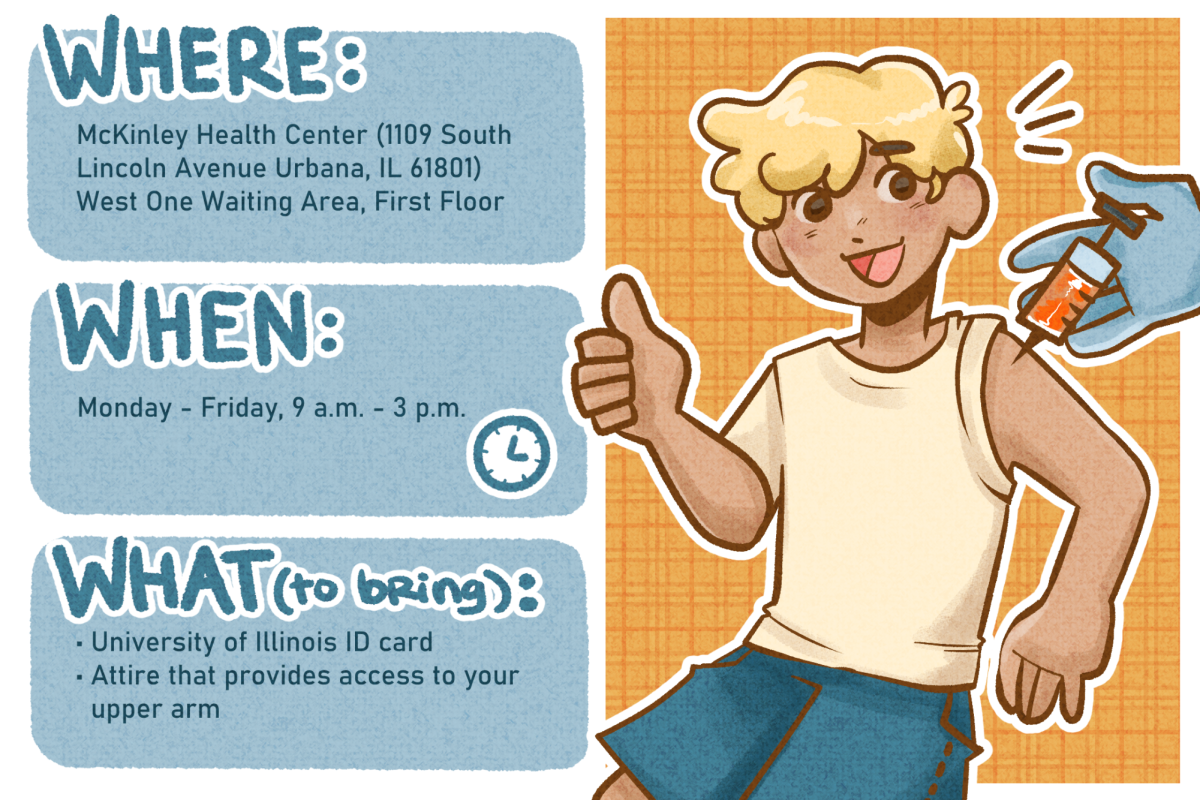
“We run this every fall here in the building,” Carroll said. “We have a specific clinic set up just for flu vaccines, 9 (a.m.) to 3 (p.m.), Monday through Friday. Walk in, come and get your flu shot. We bring the flu shot to where the students are, where the faculty staff are and make it as convenient as possible to get your flu vaccine.”
Get The Daily Illini in your inbox!
Health officials on and off campus are encouraging college students to receive their flu shots annually to decrease the spread of the flu. Due to the high population of students in shared living, recreational and academic facilities, the flu can be more detrimental to college students than most realize.
Influenza, known as the flu, is a contagious viral infection. It can cause symptoms like fevers, sore throats, body aches and, in some cases, can cause deadly complications like pneumonia or sepsis.
According to the CDC, flu shots are the most effective way to prevent the flu and potential complications.
Cases of the flu in the United States begin to increase drastically between October and May. More than 90% of these cases are children and young adults, making college campuses hot spots for the flu.
Health professionals at McKinley say they are available to answer any questions or concerns about the flu vaccine. They are offering 14 locations for people to receive the flu shot on campus.
Although flu shots may only be seen as a preventative measure by some, there are broader protective benefits of the shot, according to Stephanie Hensch, associate director of clinical support services at McKinley.
“It’s important to protect themselves from getting influenza, but also it protects other people around them from getting it.” Hensch said. “Infants, elderly and immunocompromised individuals … they can have significant symptoms when they’re exposed to somebody who has it … so we encourage people to get it.”
Autumn Owens, freshman in ACES, also noted how simple it was to receive a flu shot.
“All you had to do was walk in and swipe your card in,” Owens said. “They asked you a couple questions, mainly if I had the flu shot before. It feels like a pinch. It might hurt for the first couple seconds, but close your eyes, and it’s over.”
Despite these recommendations and encouragement for the shot by healthcare providers, a growing number of individuals are experiencing vaccine hesitancy. For more reasons than one, individuals often question the effectiveness of vaccines, including the seasonal flu shot.
Dr. Carla Rafferty, family medicine physician at Carle Foundation Hospital, explained that the flu shot recommendations are based on scientific and medical evidence.
“We base our recommendations on medical data, on studies that have been done, on the knowledge that doctors and scientists have gathered over decades of research,” Rafferty said.
Vaccines work by mimicking an infection. All vaccines contain antigens, which provoke the immune system to release antibodies. This allows the body to recognize and fight a real infection if exposed in the future.
Rafferty compared vaccines to football practice.
“Your body is going through the motions when it gets the vaccine to figure out how to fight this thing off,” Rafferty said. “When you’re exposed to influenza, you already got the other team’s playbook and your body already knows what to do.”