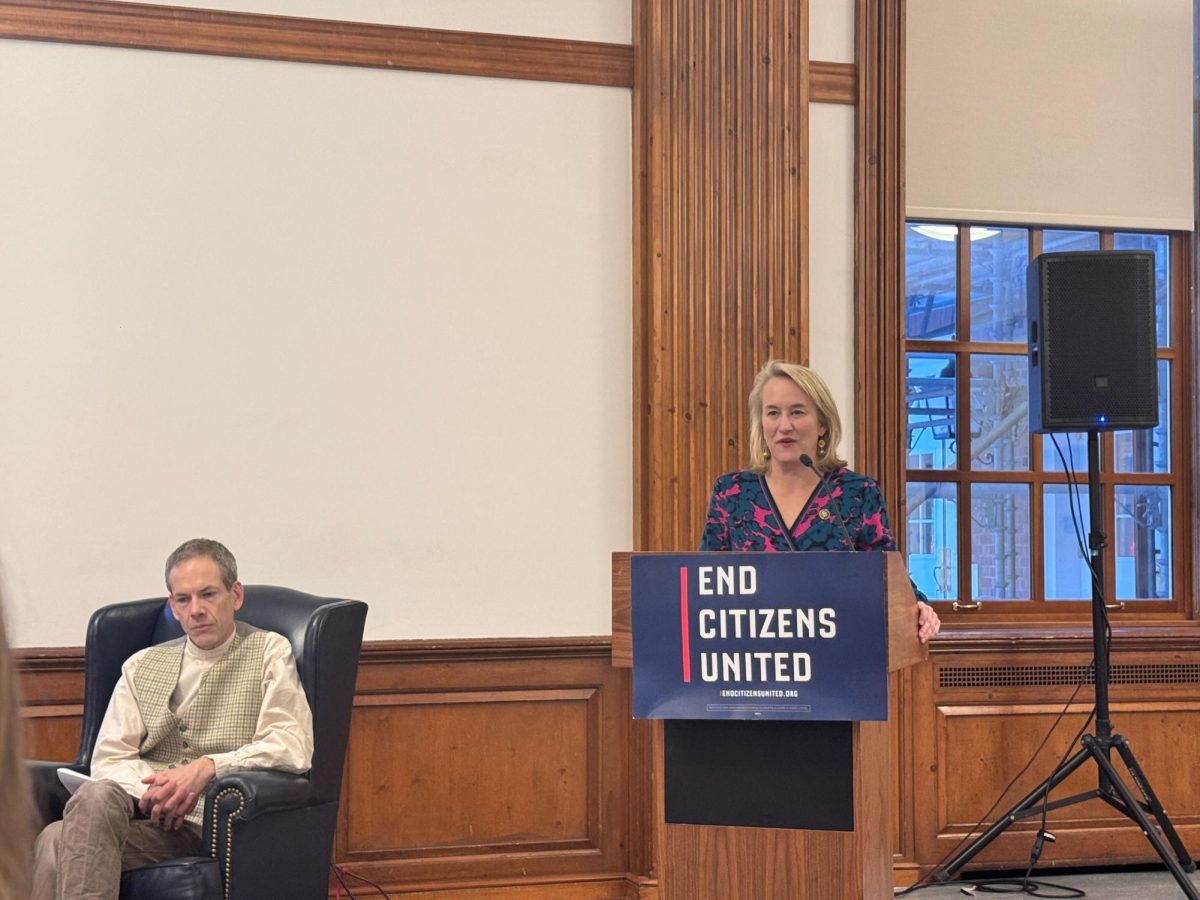
Illinois Rep. Nikki Budzinski, D-13, announced a seven-point anti-corruption agenda, primarily focused on fiscal transparency in politics, at an event with End Citizens United at the Illini Union Wednesday.
Monitored by Brian Gaines, professor in LAS, Budzinski and ECU president Tiffany Muller sat down to discuss the different parts of her agenda and proposed legislation.
“We’re united by a single belief, a belief that our democracy belongs to the people, not the people who can write the biggest check,” Muller said on the ECU mission.
In Budzinski’s anti-corruption agenda, she supports seven pieces of legislation. The proposed legislation’s main goals include ending Citizens United, ending presidential immunity, banning congressional insider trading, increasing judicial transparency and ethics, as well as ending dark money.
“My multi-decade career in the labor movement taught me that everyday Americans have the most to gain or lose based on the outcome of our democracy,” Budzinski said. “And yet they have the smallest megaphone. That system is upside down, and I’m so grateful that ECU is willing to partner with me and my office as we look for ways to address these issues holistically and once and for all.”
Get The Daily Illini in your inbox!
The agenda:
The first goal of the anti-corruption agenda is to end Citizens United. Citizens United v. Federal Election Commission, 558 U.S. 310 (2010) was a Supreme Court case that established corporations as people and enabled unlimited political spending under the protections of free speech.
“I think all voters are outraged by the amount of money that is in our political system,” Budzinski said.
To limit corporate expenditures, Budzinski supports two pieces of legislation.
Firstly, the Citizens Over Corporations Amendment is a proposed amendment that would overturn the Citizens United decision as well as restrict corporate spending and influence in United States politics.
The second piece of legislation is the DISCLOSE Act of 2023, which would require organizations to disclose donors giving $10,000 or more in an election cycle. However, the act was proposed two years ago and has not seen any action since its proposal.
“So much of this is about restoring faith and trust, making public officials accountable to the people again,” Muller said.
Cosponsored by Budzinski, the H.J.Res.108 would seek to end presidential immunity and ensure that other government officials can face criminal prosecution. It would also prevent the president from pardoning themself.
Another goal of Budzinski’s is to ban congressional insider training, consisting of two components. The Restore Trust in Congress Act, which would prohibit members of Congress, their spouses, dependent children and trustees from buying or selling individual stocks. Additionally, Budzinski is drafting legislation that would prohibit government officials from trading on political events on prediction markets like Polymarket.
“If you make the laws, you shouldn’t be able to trade on insider information,” Budzinski said. “I think that’s common sense.”
Budzinski also plans to establish ethics and transparency for the Supreme Court. She is a cosponsor of the High Court Gift Ban Act, which would limit gift amounts to SCOTUS justices to $50 in a single instance.
“That means no luxury gifts, no secret donors, no shadow lobbying,” Budzinski said. “Justices should follow the same ethical standards as everyone else, including myself in government.”
Between 2004 and 2023, Justice Clarence Thomas received 103 gifts with a total value of over $2.4 million. The discovery sparked outrage and calls for reform to the judicial system. Budzinski is also a cosponsor of the Supreme Court Ethics, Recusal, and Transparency Act of 2025, which would create a code of conduct that Supreme Court Justices must follow.
These pieces of legislation have all been supported by Budzinski and are a part of her agenda to end government and judicial corruption.
“Now is the time to get momentum,” Budzinski said. “Change is on the horizon.”