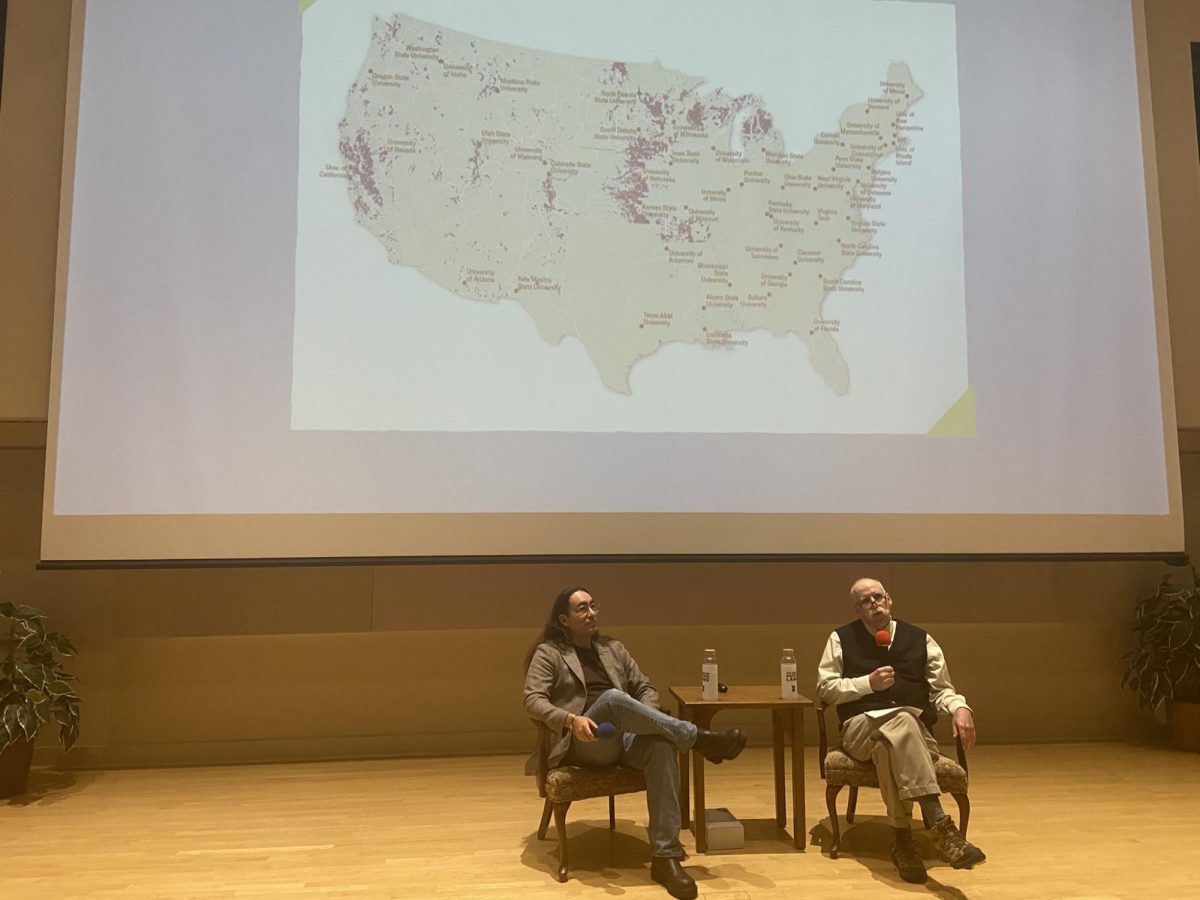
The second lecture in the Sawyer Seminar series, “At Risk U: the Past, Present & Future of Academic Freedom,” was held Thursday evening in the Knight Auditorium at the Spurlock Museum.
Tristan Ahtone, member of the Kiowa Tribe and editor-at-large at Grist, was the guest speaker. He discussed the connection between Indigenous land dispossession and the founding of land-grant universities with moderator Dave Beck, professor in LAS and affiliate faculty in the American Indian studies program.
Why Ahtone researches land-grant institutions
When Ahtone became a 2017 Nieman Fellow, he had the opportunity to take whatever classes he wanted at Harvard University for a full year. One opportunity he stumbled upon was a presentation from students in the Indigenous studies program about their current work.
“That night I had an option to go out to drink beer with friends or go to the presentations,” Ahtone said. “I’m really glad I went to the presentations.”
Get The Daily Illini in your inbox!
There, he met Robert Lee, who was studying land dispossession and colonization in the early United States at the time. Lee was particularly interested in the 1862 Morrill Act, which took just under 11 million acres of land from 250 tribal nations to create land-grant universities, Ahtone said.
The government intended that land-grant institutions provide the working class with agricultural, scientific, military and technical education. The University is one of the original land-grant institutions, with Morrill Hall serving as a namesake for the act’s sponsor.
Ahtone said Lee sought to answer where the land that supports land-grant universities came from in the first place.
By using geographic information systems, Lee started mapping every single land parcel used as a result of the 1862 Morrill Act, Ahtone said. The federal government had already digitized five million acres, but not the other 5.5 million.
“(Lee) was able to look at a particular law, who benefited from it (and) who was impacted by it,” Ahtone said. “It was really kind of standard investigative journalism.”
Two other pieces of legislation relating to land usage — the Homestead Act and the Pacific Railroad Act — were passed the same year as the first Morrill Act.
How Native land became public land supporting education
When the U.S. acquired land through negotiation or force, it became part of the country’s real estate, Ahtone said. What started out as territories later became states, he said, with these states being able to take land from within its borders to establish a land-grant university.
“It’s moving out of the caretaking stage into a money-making capitalist system to sort of extract value from that for universities or other public institutions,” Ahtone said.
In states with land that could not be used under public domain, such as on the East Coast, the federal government provided states with land scripts to be able to take land in the West, Ahtone said. In some instances, such as in California, he said genocide occurred as spectators removed and killed Indigenous people so there was land that the scripts could be fulfilled.
Road to publication and beyond
Following Ahtone’s fellowship, he partnered with Lee to write for High Country News’ Indigenous Affairs desk — one of the first semi-national outlets to have one.
This came as protests against the Dakota Access Pipeline occurred, with the Standing Rock Sioux Tribe fearing the pipeline would harm the reservation’s water supply and run under sacred sites.
With low cultural competency, Ahtone said, outlets were unsure what to do with Indigenous Affairs desks, so they let writers do what they wanted.
“At most news outlets, they were like, sure, they must know what they’re doing,” Ahtone said. “We didn’t, but we pulled it off.”
Ahtone and Lee published their story about land-grant universities in 2020. Then, they published another story, this time about what was being done with land from the Morrill Act that had yet to be sold.
But by this time, Ahtone said, High Country News had been clear that, because of the energy, money and effort required, it was no longer in High Country News’s interest to publish land grant stories, as the outlet did not have the budget.
Their work is now published in Grist, a nonprofit news outlet focusing on climate. They have recently been running a series called Misplaced Trust, which seeks to explain how land and resources make institutions richer through fossil fuel exploration, mining, timber harvesting and more, Ahtone said.
Tension within land back movement
A couple of years ago, the Washington Department of Natural Resources said it would need to be compensated $15 million if it gave back the Yakama Nation’s land. The Supreme Court said it is Yakama land, Ahtone said.
This back-and-forth comes from the fact that the money brought out of these lands enables state governments to fund institutions. This includes K-12 schools, hospitals, prisons and state buildings, Ahtone said.
State governments, according to Ahtone, are starting to see this as an issue pertaining to taxes.
“It’s sort of like, (do) you want your kids to go to school, or do you want to give some (Native Americans) their land back,” Ahtone said.
What more could public universities do
The University created a land acknowledgment and provided in-state tuition to students from federally recognized tribes to honor its sesquicentennial anniversary.
Ahtone sees tuition programs such as the University’s as the minimum, with a step further being adding free tuition, fees, housing and meals.
“This is not something that is a particularly heavy-duty investment,” Ahtone said. “I mean, like, there’s a dozen native students here at the University. We’re not breaking the bank.”
A step further would be for the University to help the Prairie Band Potawatomi Nation — the first federally recognized tribe in Illinois — establish a private college on its reservation, Ahtone said. In addition, the University could create a buyback program for the land it has profited from.
“Justice is just up to the limits of your imagination,” Ahtone said.
The next lecture in the series is March 5 at 5 p.m. in the Knight Auditorium, where Rachel Ida Buff, professor of history at the University of Wisconsin–Milwaukee, will present, “A Threat to What? Private Consultancies Managing ‘Risk’ in Higher Education.”
Correction — Monday, Feb. 23: An earlier version of this article stated that High Country News said it was “no longer interested” in publishing Ahtone and Lee’s stories, which is incorrect. The article has been updated to reflect the fact that High Country News told Ahtone that, because of the energy, money and effort involved in publishing land grant articles, it would no longer be in High Country News’s interest to publish them, because of the news outlet’s budget. The Daily Illini regrets the error.