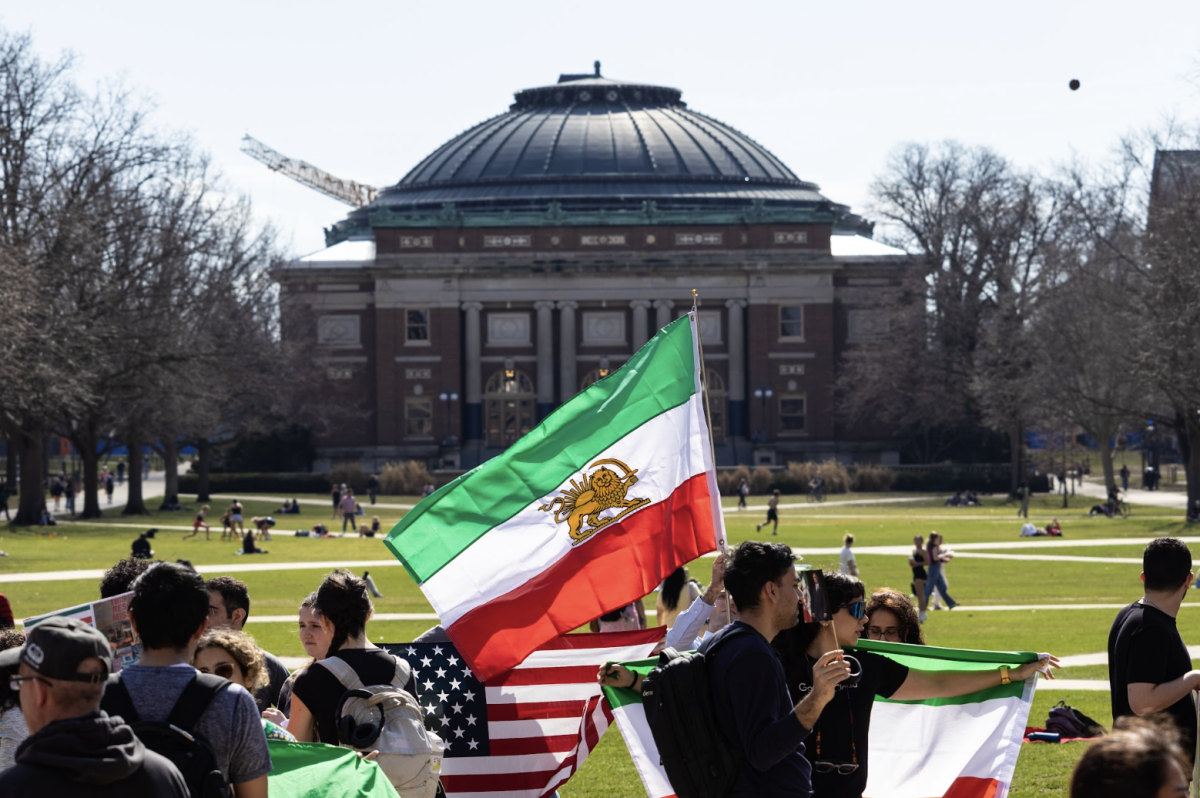
A group of Iranian students and sympathetic allies gathered at Anniversary Plaza Friday to rally in support of the United States-Israel military campaign in Iran. Iranians flew Iran’s former “Lion and Sun” flag, which is banned under the current Iranian regime, as well as the American flag.
Demonstrators who lived under the current Iranian regime told The Daily Illini they were in favor of the removal of the regime and replacing it with a political system elected and appointed by the nation’s people.
Jalal Inanlu, a graduate student studying mechanical engineering, said he lived in Iran until the age of 21, previously attending the University of Tehran.
Inanlu said that, while he is not in favor of war, he believes intervention is necessary to bring liberation to Iran. He pointed to Iran’s violent crackdown on protesters in January.
“We’re not supporting war,” Inanlu said. “We’re supporting this rescue mission. … (The Iranian government) is willing to kill our own people to stay in power. And there is no other way that this vicious government will go away. This government will stay in power until armed people come and remove it.”
Get The Daily Illini in your inbox!
Protesters held posters displaying Reza Pahlavi, Iranian dissident and eldest son of Mohammad Reza Pahlavi, who recently announced he would be willing to lead Iran in a transition government to democracy.
The DI talked to an 80-year-old Iranian individual who did not share his name. Another demonstrator helped translate his Farsi into English.
The man praised Mohammad Reza Pahlavi, saying he helped the Iranian economy and is for Reza Pahlavi. He labelled the current Iranian regime as inhuman and said that although he doesn’t like war, he supports the United States’ regime change operation.
Iranian authorities have committed mass unlawful killings on an “unprecedented scale” to crush a popular uprising that called for an end to their rule, according to human rights organization Amnesty International.
The Iranian government instituted a complete internet blackout, deployed heavily armed security patrols, imposed curfews and prevented gatherings, Amnesty stated. Security forces have arrested thousands of protesters and dissidents, subjecting detainees to enforced disappearance, torture and other ill‑treatment, including sexual violence.
Amnesty reported that authorities have “relentlessly and cruelly harassed and intimidated bereaved families of killed protestors.”
“They have waged a coordinated, militarized clampdown to prevent further dissent and hide their crimes,” Amnesty wrote in January.
Inanlu expressed his desire for a positive outcome rather than simply a bombing campaign.
“I hope that the regime changes,” Inanlu said. “I hope (the U.S. and Israel) don’t just bomb the military bases and leave. That’s not what we’re hoping for. … That’s not good for either side.”
Another attendee, Claire Eisenstadt, sophomore in LAS and president of the RSO Students Supporting Israel, said that, while she isn’t Iranian, she came to the gathering to support the people of Iran.
“The regime has really terrorized the people of Iran,” Eisenstadt said. “All the people of Iran who were protesting several weeks ago were brutally murdered by the regime, and I stand with freeing those people of Iran.”
According to Eisenstadt, Iran should not have nuclear weapons, and if Iran did obtain them, it would be a “very big risk to the entire world.” She also expressed hope that the people of Iran can implement a political system that they prefer.
President Donald Trump, in a speech justifying American intervention in Iran, said the regime was attempting to build a nuclear bomb. However, Secretary of State Marco Rubio told reporters in the week before the strikes that Iran was not currently enriching uranium — a key step in developing nuclear weapons. The New York Times, after talking to officials with access to American intelligence, reported that the claim that “Iran was trying to build a nuclear bomb was also unsupported.”
One of the organizers present asked that The DI not include her name for fear of retribution against her family in Iran. Still, she helped organize and showed up at the rally to ensure the Iranian people’s story does not get changed.
Born in Iran, the organizer came to the U.S. after attending university in Iran. She described her experience growing up, going to school, especially as a woman.
“Since I never saw anything different, for a long time, I didn’t know there (was) something wrong,” she said. “As a 5-year-old, they forced me to wear a hijab. … In the school, they teach you, because you are a woman, you don’t understand enough to be a president. You don’t understand enough to be a judge. … In the university, you can see that they don’t have any respect for you.”
Despite being an excellent student, the organizer said she would have been unable to get a job in Iran and instead would have been expected to become a mother. When she first came to the U.S., she mentioned being afraid whenever she saw the police.
She also stressed her appreciation for her current freedom and expressed that many people born in the U.S. cannot conceive of the lack of freedom in Iran.
Without experiencing it themselves, there is no way for people to understand what she means when she says there is no freedom, the organizer said. While organizing the protest, she mentioned her surprise that the University allowed the Iranian rally on campus.
In 2019, she recalled walking out of her university in Iran after student protests. According to her, the Islamic Republic shot at students from her university in the parking lot, and she remembered seeing the blood on the ground.
When describing her motivations for attending the rally, she focused on giving a voice to the people in Iran.
“People inside Iran don’t have a voice, and, unfortunately, the media and activists don’t cover us,” she said. “I don’t want our story to get changed … I don’t want the world to think we are under attack.”
The organizer relayed her family’s perspective on the war, sharing Inanlu’s sentiment that the intervention is necessary for Iran’s liberation.
“They are living in a war situation, but at the same time, they have hope,” she said. “(My family) said we should thank (the U.S.), thank Israel and thank whoever is standing with us.”
The organizer also cautioned students to not believe text messages sent from the National Iranian American Council. NIAC sent a message in support on the first day of the attacks on Iran, claiming to represent all Iranians in the U.S, she said.
Similarly, in a Facebook post, NIAC claimed, “This is not a war for U.S. interests. This is a war for Israel.”
However, the organizer said the NIAC does not represent all Iranian voices and is instead “whitewashing” Iranian voices in support of the Islamic Republic.
The organizer held two posters throughout the rally: one featured a picture of Ali Mohammad Sadeghi, a 2-year-old shot and killed while on his father’s shoulders at a protest in Iran, and the other called for the release of political prisoners in Iran.
“Because they are scared that they will hit the prison, many of the guards left,” the organizer said. “So (the prisoners) don’t have enough water, enough food. … We want all of them to get free.”