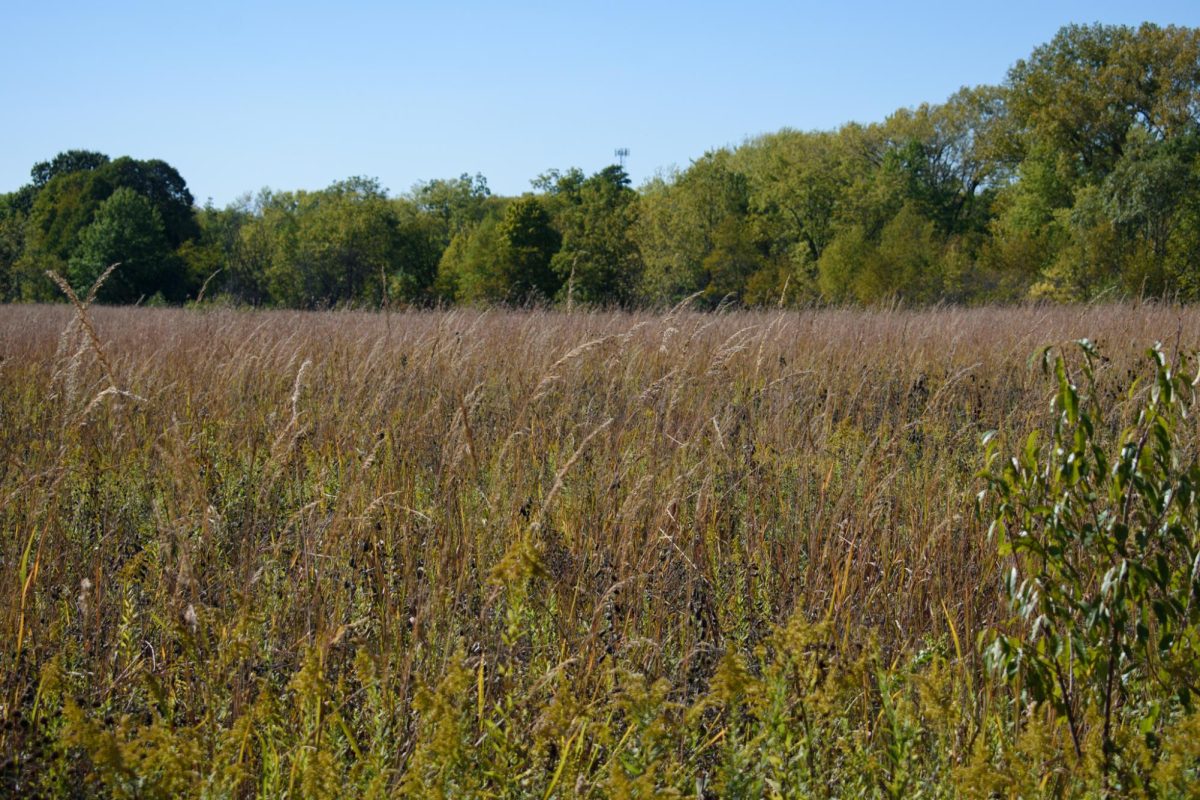
Experts from the University and various public health departments are actively increasing focus on tick populations in Illinois as surveillance and reporting technologies make tick reports easier and more accurate. Ticks are vectors for multiple diseases, some of which can be deadly to humans and pets.
Most of the data that researchers and public health departments have collected is relatively new and insufficient to draw concrete conclusions about tick populations in the state. But, researchers say they are still gaining crucial insights, such as Rebecca Smith’s study, finding Champaign County to be a hotspot for the deer tick.
Robert Davies, director of planning and research at the Champaign-Urbana Public Health District, told The Daily Illini via email that deer ticks, or black-legged ticks, as well as dog ticks, are well-established in central Illinois.
They’re also capable of transmitting multiple diseases, such as but not limited to Lyme disease, ehrlichiosis, rickettsiosis (variants of spotted fever) and tularemia.
The established presence of ticks also applies to the Urbana Park District. Superintendent of Planning and Operations for the Urbana Park District, Derek Liebert, said that in his 22 years at the park district, there have always been ticks in the parks.
Get The Daily Illini in your inbox!
Though the park district is unable to confirm an increase in ticks in its parks scientifically, Liebert said that the park district “did hear from a few people in the early summer that they’re seeing more ticks.”
Davies, in the same email to The Daily Illini, wrote that in April, a squirrel was found covered in ticks and was sent for testing.
“CUPHD was notified that a squirrel in Urbana tested positive for Tularemia,” Davies wrote. “The squirrel was part of a small die-off and was tested because it was found covered in ticks.”
After the CUPHD tested the tularemia-positive squirrel, the Urbana Park District created signs based on flyers CUPHD had shared with them and posted them in parks to raise awareness, according to Davies.
The park district collaborated with Jameson Mori, wildlife epidemiology assistant research scientist at the University, to analyze the ticks in Meadowbrook Park.
Liebert emphasized the park district’s desire to learn more about the ticks as to why the park district collaborated with the University.
Smith, a professor in LAS and epidemiologist, published a study in September that examined the distribution of three species of ticks in Illinois.
The study identified several hotspots in Illinois where there is a higher concentration or amount of certain species of ticks. The researchers identified Champaign County, along with others, as a hotspot for the deer tick.
Smith said the deer tick is one of the most common vectors for Lyme disease, and that species was represented in her study.
In relation to Urbana, Liebert said almost all the ticks reported to the park district are dog ticks. But Liebert was concerned upon learning of Smith’s study’s identification of Champaign County as a hotspot for deer ticks, as almost all of the ticks reported to the park district have been dog ticks.
Davies wrote that CUPHD launched a tick surveillance program in 2023. The program collects ticks and submits them to a laboratory for testing.
In total, CUPHD has submitted 61 ticks to the Illinois Department of Public Health, all of which have been dog ticks. None tested positive for tick-borne illness pathogens.
When asked what the concentration of deer ticks in Champaign County means for residents, Smith said community members should remain aware and informed of the risks.
“They (county residents) need to be aware of ticks and … do their tick checks … because the biggest risk is not being aware and letting the tick go on feeding,” Smith said.
Smith is inclined to believe there has been “a range expansion and a population expansion” of ticks in Illinois, but because of the lack of historical data on tick population, there is no reference point.
The lack of reference data makes it nearly impossible to confirm that claim. Despite that, Smith believes an increase in Lyme disease cases is likely, partially based on the findings in her study.
“Unfortunately, I think that, yes, we will continue to see a rise in Lyme disease cases, and that’s a lot of what my lab is trying to do is to raise the alarm so that people will protect themselves, because that’s the best thing we can do, is to protect ourselves,” Smith said.
There are two other species of ticks that researchers and experts are focusing on: the Gulf Coast tick and the Asian longhorned tick. Liebert said in July 2024, the Urbana Park District submitted a Gulf Coast tick found in Meadowbrook Park to the Illinois Natural History Survey’s medical entomology lab for testing. Liebert said the park district never received results back for that tick.
Smith and her team wanted to include the Gulf Coast tick as part of the study, though a lack of Illinois-specific data on the Gulf Coast tick meant the researchers had to exclude it.
Researchers are interested in the Gulf Coast tick because it can spread a type of spotted fever rickettsiosis, which can be a deadly pathogen to humans.
The Asian longhorned tick, though currently not a threat to humans, is an invasive species and “is a big economic risk for cow farms,” according to Smith.
Teresa Steckler, a commercial agriculture specialist with the University of Illinois Extension, published a report on Sept. 19, stating that the Asian longhorned tick was found on cattle from Clay County, as part of a community-engaged program that focuses on tracking ticks.
Clay County is now the third county in Illinois where the Asian longhorned tick has been identified.
While acknowledging that ticks — no matter the species — do not inherently carry disease, experts from the Urbana Park District, CUPHD and the University all urge people to be cautious and aware of the potential dangers of tick-transmitted diseases.
Smith emphasized that ticks, even in cold weather, remain active.
“Ticks, if it’s above freezing, will come out,” Smith said. “So people should be aware to protect themselves throughout the year.”
For more details regarding ticks, the diseases they transmit and what to do if a tick bites you, visit the CUPHD, Urbana Park District, Illinois Department of Public Health or the Illinois Natural History Survey.