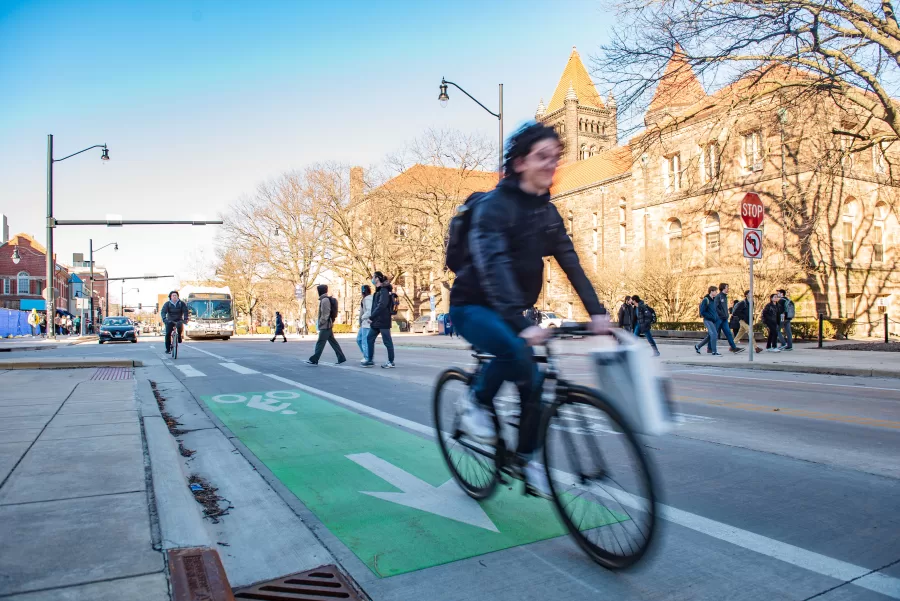
Champaign County, including the City of Urbana, the City of Champaign and the University, are actively working to improve biking and pedestrian infrastructure throughout the county.
The Champaign County Regional Planning Commission is improving the existing Champaign-Urbana Active Transportation Plan, which was last updated in 2014.
The CCRPC also hopes to build safe and reliable access to public green spaces across the county.
“In 2017, there was an initiative from the trust for public lands to get communities to commit to a 10-minute walk to parks commitment, and the mayors of Champaign and Urbana at the time both committed to this,” said Gabe Lewis, transportation planner at the CCRPC.
Infrastructure improvements are aimed at active transportation modes, which include any self-propelled, human-powered transportation methods, including walking, biking and rolling. People with disabilities and people who use strollers are included in this definition.
Get The Daily Illini in your inbox!
Lewis highlighted that the CCRPC plans include accommodations for individuals who use wheelchairs or other assistive mobility devices.
The need for a county-wide improvement plan is growing as younger generations are placing greater importance on active modes of transportation.
“Eighty-five to ninety percent of students use bicycles, Veo Ride, walking and MTD buses, so it’s essential we provide a good network for bicycling and walking,” said Sarthak Prasad, sustainable transportation assistant for Facilities and Services at the University.
Many people outside the University also use walking and bicycling as their main method of transportation.
Lower financial burden, increased personal health, as well as environmental sustainability efforts are creating a push to reduce car use and increase walking or bicycling in communities.
“We see younger people delaying when they want to learn how to drive or when they want to own a car because it’s expensive,” Lewis said.
Lewis also said that people may not have the time to incorporate exercise into their routine after work, leading an increasing number of people to transform their daily commutes into workouts.
Projected improvements are also aimed at widening the network of pedestrian paths across the county.
“Campus doesn’t just end at campus,” Prasad said. “When somebody has to leave, we have to make sure they are in a good spot, so connectivity is huge.”
Throughout October, the CCRPC conducted a survey to gather data from residents on pedestrian and bicycle paths to inform its improvement decisions.
The CCRPC encouraged everyone to fill out the survey, including non-bikers and drivers, to analyze what barriers might exist to prevent people from walking and bicycling.
“If it has something to do with the built environment, like a wide street or the speed of traffic, then that’s the type of information we’d want to know, so then we can work with the cities or the University to slow down traffic or narrow the road,” Lewis said.
The survey also included a web map for people to add points and make comments on specific areas they felt were problematic for walking or cycling.
“The speed that cars travel at can be a big concern, because we’ve also seen a lot of fatalities within Champaign County this year,” Lewis said.
Information from the survey will be used by the CCRPC to make both infrastructure and non-infrastructure recommendations, like education and encouragement events, including Bike to Work Day.
A major component of Champaign County’s infrastructural improvements is the Florida Avenue Path Project.
In January, the City of Urbana received a $10 million Rebuilding American Infrastructure with Sustainability and Equity federal grant that will fund the completion of the project.
“We have been waiting for that project for many, many years, and we’re very excited to see it awarded, to actually get it built,” Lewis said.
The project will see the construction of pedestrian paths on Florida Avenue between Lincoln Avenue and Race Street. Florida Avenue is a major arterial road for the University that many people use to get to campus.
“We don’t have sidewalk or bicycle infrastructure there yet, and it’s a major connecting street,” Prasad said. “It connects to Orchard Downs or to anyone who lives in Urbana in that particular area.”
The project hopes to launch in 2027 and aims to be completed by the end of 2028.
“This will provide a safe path along this really busy corridor, keeping cars separated from pedestrians and cyclists,” said John Zeman, an engineer for the City of Urbana.
Some residents struggle to cycle to campus without any designated paths for walking or other modes of active transport.
“I basically cycle from the south part of Orchard Downs, and I don’t have any difficulties until I reach Florida and Orchard Drive, because then there is no bike infrastructure,” said Camila Madariaga, a graduate student studying urban planning.
Madariaga explained that the lack of bicycle and pedestrian infrastructure along the street puts active transporters at risk.
“That whole stretch doesn’t have any infrastructure, and it’s very tricky — especially Pennsylvania (Avenue). It’s dangerous because it has a lot of holes and there’s a lot of traffic … usually the cars are driving pretty fast, so I can’t really ride around the holes. I have to just throw my bike into them,” Madariaga said.
The $10 million federal grant will fund the entirety of the Florida Avenue Path Project, allowing the money originally allocated for it to be used on other transportation improvements within the city.
“It allows us to do some projects earlier than we were expecting, like resurfacing the street that goes by the high school, that may be able to happen faster than we were expecting,” Zeman said.
The Champaign County improvements to bicycling and pedestrian pathways impact safety and accessibility for residents throughout the area.
“It makes me feel really hopeful and happy,” Madariga said. “I hope it comes into fruition.”