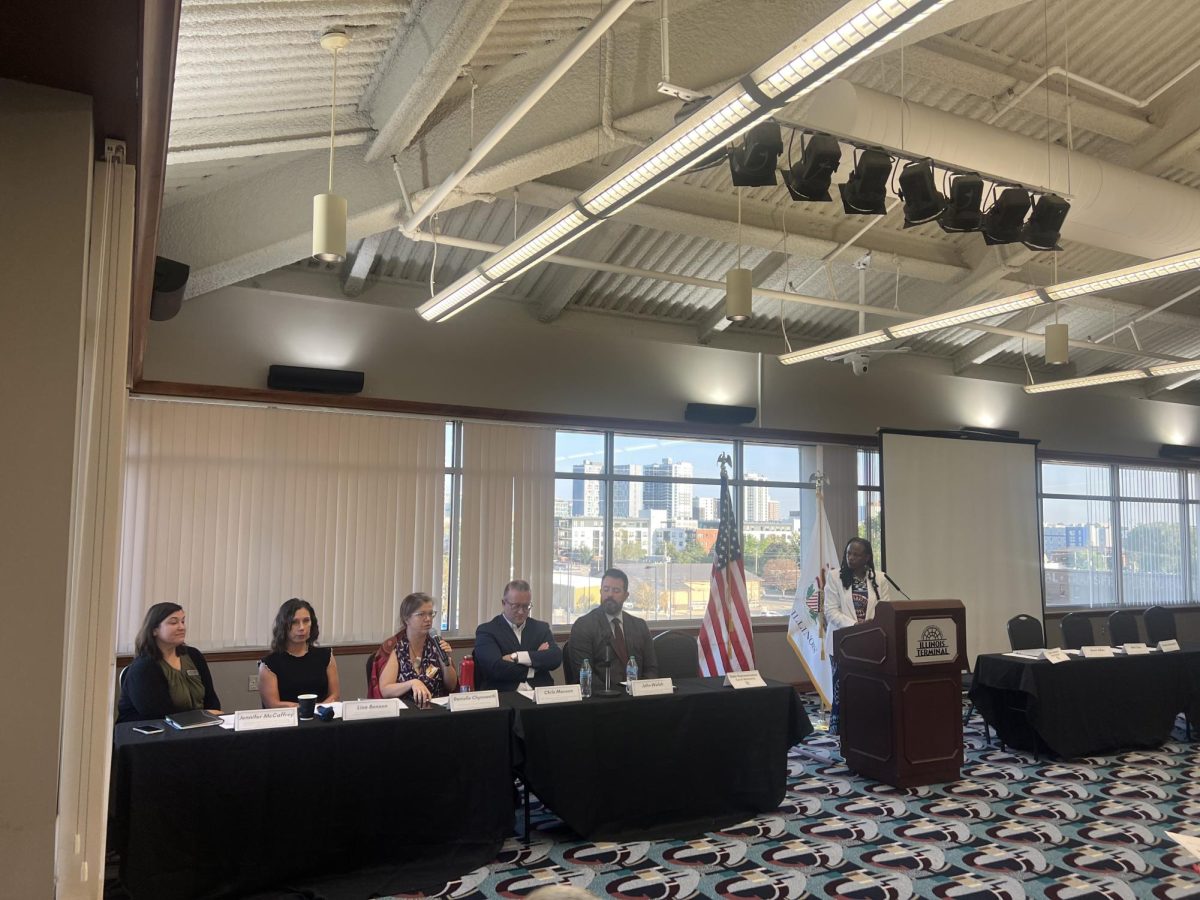
Illinois State Rep. Carol Ammons and State Sen. Paul Faraci hosted a town hall meeting at the Illinois Terminal on Thursday. They moderated panels discussing recent federal cuts to healthcare and social services, as well as rising energy costs in Illinois.
Ammons moderated the first panel, which was about community members’ responses to the omnibus bill President Donald Trump signed into law in July.
The large domestic package will cut over $900 billion in Medicaid funding and nearly $300 billion in Supplemental Nutrition Assistance Program funding over the next decade. The changes serve to pave the way for trillions of dollars in spending on tax cuts, immigration enforcement and national defense.
The second panel, which Faraci moderated, discussed the challenges of rising energy costs in Illinois and the path moving forward. At the end of each discussion, panelists took questions from audience members.
Policy analyst, healthcare executives address Medicaid cuts
Get The Daily Illini in your inbox!
Ralph Martire, executive director of the Center for Tax and Budget Accountability, provided the audience with an analysis of the Trump administration’s domestic spending package. He said the legislation is estimated to cost the state $48 to $52 billion in Medicaid support from the federal government over the next decade and lead to at most nine hospitals and about 90 nursing homes facing closure in rural Illinois communities.
“No area in Illinois is immune to the damage caused by the big, beautiful bill,” Martire said.
Many of the legislation’s healthcare provisions will not go into effect until at least 2026. That leaves Carle Health and other healthcare centers with time to prepare for challenging situations ahead, according to John Walsh, external affairs program executive for Carle Health.
Walsh said Carle Health will work to support community members in navigating federal insurance changes by assisting them with paperwork or eligibility requirements.
“Despite all of the changes that are coming, the reality is that what will not change is folks’ need of healthcare,” Walsh said. “So we have to figure out a way to move forward with that.”
Ammons said the Illinois General Assembly only has so many resources to make up for Medicaid cuts. The state budget for the 2026 fiscal year was $55.1 billion. She suggested residents reach out to local health and social service organizations about how the recent legislation will impact them.
Chris Manson, vice president of government relations for OSF HealthCare, reiterated Walsh’s point and said an increase in uninsured patients will put added stress on hospital systems.
“It has a ripple effect,” Manson said. “Even before the big, beautiful bill, hospitals were under stress, so this just adds to it.”
SNAP cuts will exacerbate hunger, housing crisis, local leader says
Danielle Chynoweth, supervisor of Cunningham Township, which provides financial and housing assistance to Urbana residents, said they are receiving 2,000 calls for services per month, along with hundreds of walk-ins and emails.
That is more than they received during the COVID-19 pandemic, Chynoweth said. And, with increasing food costs, SNAP enrollees are already running out of benefits in the third or fourth week of the month.
Over the last year and a half, Chynoweth said the Hope Center of The Vineyard Church in Urbana, which hosts a drive-through food pantry on Wednesdays, has drawn significantly more residents to its queue. She said people are simply trying to supplement what they receive from SNAP.
“We are tired, and the folks that we work with are already really stretched to the limit,” Chynoweth said. “So it is difficult for us to consider what those next steps will look like.”
Chynoweth also reported a rise in homelessness in the area, coupled with a lack of sufficient emergency beds. These social service cuts will make the situation significantly worse, she said.
Cunningham Township works with the lowest-income residents in Urbana, and over half of them have a disability. Chynoweth said the federal government significantly delays recognizing individuals’ disabilities. But most often, Chynoweth said, applicants are denied and wait for years.
In the meantime, applicants rely on Medicaid, SNAP and housing support. Cuts to these social services will make it even more difficult for people with disabilities, according to Chynoweth.
“Now, how are you supposed to live during that time?” Chynoweth said.
Congress eliminates SNAP-Education funding
Jennifer McCaffrey, assistant dean for the family and consumer sciences programs at Illinois Extension, said she oversees programming in food, family, finance and health. She has worked as the director of nutrition programs for almost 25 years.
The University’s over 30-year-old SNAP-Education program, which received more than $19 million in federal funding last year, had its funding cut by Congress in the omnibus bill. Starting Oct. 1, it will no longer receive funding, McCaffrey said.
At the University, the program — as part of a national nutritional education effort beginning in 1992 — used federal dollars to support over 2,000 community partners to deliver nutrition education and resources to SNAP recipients, according to McCaffrey. Its goal was to teach families how to stretch their food dollars and prioritize their health.
“We were zeroed out in the big, beautiful bill,” McCaffrey said. “That is, as you can imagine — as somebody who’s been doing this work my whole career — pretty devastating.”
The cuts leave 2,000 partners without access to the program’s resources, and about a third of the program’s workforce — 212 people out of 650, McCaffrey said — will lose their jobs.
McCaffrey also said the federal government cut $14 million in funding for a separate program, IL-EATS, on Sept. 7. The program purchases high-quality food from farmers and distributes it to Illinois food pantries and those in need.
The Extension office ran the program in conjunction with the Illinois Department of Agriculture and Illinois Human Resources.
McCaffrey remains hopeful that the Extension office and the community will be able to persevere through the lack of funding.
“We know what works out in communities, being that fabric, being that thread,” McCaffrey said. “Even though they’re trying to unravel our thread, we’re going to sew it back together.”
LIHEAP funding safe for now, CCRPC leader says
Lisa Benson, director of community services for the Champaign County Regional Planning Commission, spoke about the Low Income Home Energy Assistance Program, which leverages state and federal funding to assist individuals with utility bills.
During the most recent program year, the county’s LIHEAP supported more than 7,000 households, according to CCRPC’s website.
Secretary of Health and Human Services Robert F. Kennedy Jr. fired the entire staff that oversaw the LIHEAP in Washington, D.C., in April. Benson said the office received many concerned calls after staff were cut. Federal funding for the program remains, as of now, Benson said.
The Trump administration proposed cutting funding for the program in May, but the Senate Appropriations Committee proposed $4 billion in funding for LIHEAP, which Benson said is “fairly level.”
Even if the federal government cuts funding for LIHEAP, local and state funds would allow it to continue functioning in a limited capacity, Benson said.
“If just federal funds went away for the LIHEAP program, we would still have a utility assistance program,” Benson said. “It wouldn’t be as robust, but there would still be a program.”
Ammons said the state is expected to face cuts, but lawmakers and community members will do everything they can to advocate for affected programs in the state budgeting process. Still, they will face difficulties, she said.
“We can’t guarantee that we will be able to save all the programs based on the amount of dollars that come from the federal government to support our state,” Ammons said.
Ameren executive, policy analysts discuss increasing energy costs
Ameren Illinois customers saw electricity bills rise by 18% to 22% during the summer. The increase is tied to soaring costs in the regional power market, according to Matthew Tomc, Ameren Illinois’ vice president of regulatory policy and energy supply.
Each year, the Midcontinent Independent System Operator runs a capacity auction to ensure there is enough electricity to meet peak demand. Utility companies like Ameren must buy capacity from energy generators, and these costs are passed directly to consumers.
According to Tomc, supply was significantly tight this year. The auction price in Ameren Illinois’ territory rose from about $30 per megawatt-day last year to $666.50 per megawatt-day this summer.
“When I heard the number that they told me, I had to ask them to please repeat that number,” Tomc said. “I knew immediately we had a problem, and we were going to have an affordability issue impacting a lot of our customers. Fast forward to today, and that has manifested itself.”
Not only did those prices go up, but the hot weather during the summer made bills even more expensive, according to Tomc.
However, some relief is coming Oct. 1, according to Scott Allen, energy policy specialist at Citizens Utility Board, a utility customer advocacy group. Allen said the relief will restore Ameren consumer prices to be similar to where rates were around June.
Samira Hanessian, energy policy director at Illinois Environmental Council, an environmental advocacy organization, called for a long-term fix: transitioning Illinois away from fossil fuels and investing in clean, renewable energy.
She suggested the increase can be partially attributed to the development of artificial intelligence data centers and federal legislation cutting clean energy provisions.
Tomc and Allen encouraged people struggling with their utility bills to reach out to Ameren, which offers bill pay assistance. LIHEAP is another option for consumers.
Allen also discussed the Illinois Solar for All program, a state program that allows income-eligible residents to save money on utility bills through a solar subscription. A separate state-administered community solar program, Illinois Shines, could provide energy savings for customers regardless of income.
Faraci proposed collaboration between the University and the state to find a way to harness wasted heat from AI data centers to produce clean energy.
“Those are the kinds of discussions that we’re committed to,” Faraci said. “We’re here to better understand the issues.”
Looking forward
Faraci and Ammons pledged to continue hosting meetings with community members and leaders to address key issues. They thanked the panelists, their staff, attendees and the Illinois Terminal employees.
“We’re here to listen,” Faraci said.