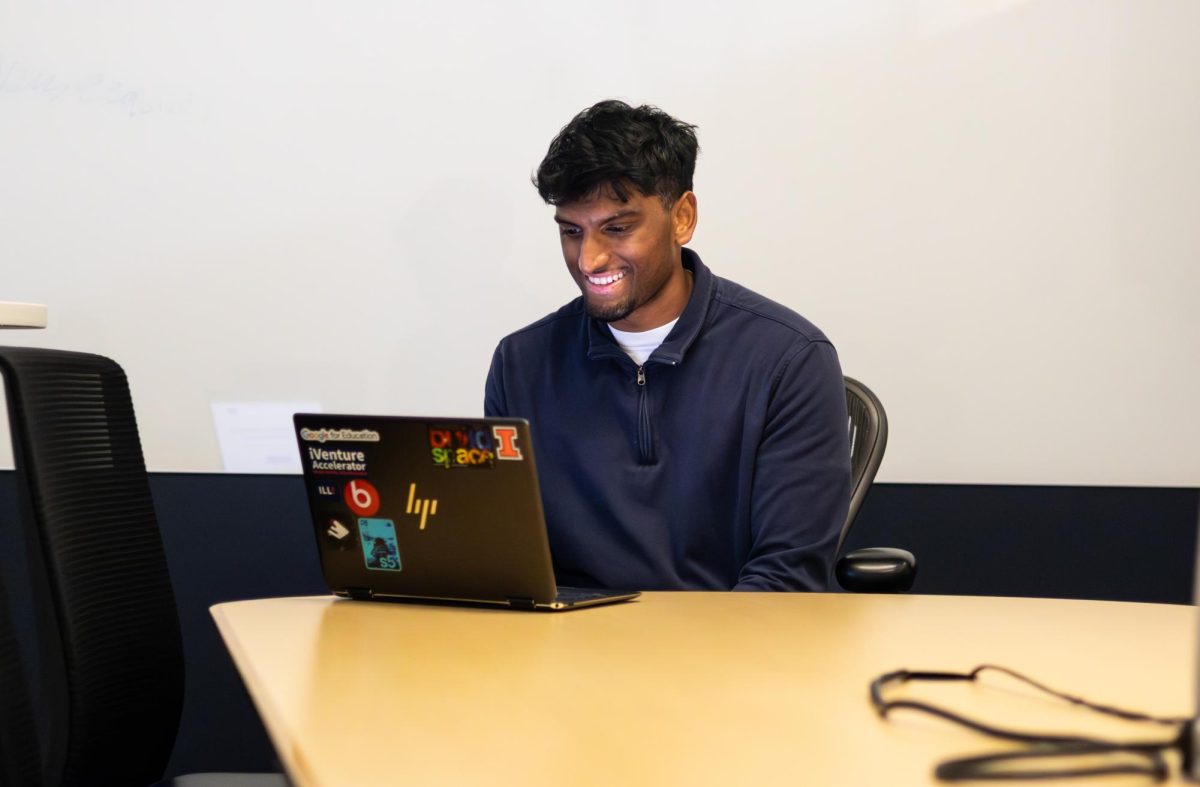
Shrikar Lekkala, senior in LAS and Engineering, had no aspirations of becoming an entrepreneur.
The most experience he had in anything business-related before coming to the University was running a nonprofit in high school. Now, this tech wunderkind’s AI translation software is making $25,000 a month in recurring revenue and is used by media giants like Amazon Prime Video.
“I think the most rewarding piece has been working with like-minded individuals that believe and are driven to accomplish the purpose that we have,” Lekkala said.
Lekkala is the founder of Phraze — a product combining AI, voice cloning and lip syncing technology. Once you upload a video, all you have to do is select an input and output language before you get a translated solution with a lip-sync video to match.
“Instead of saying, ‘I’m going to translate a video,’ I’m going to ‘Phraze’ it,” Lekkala said. “We’re thinking of having that phrase — no pun intended — be used instead of having a translation.”
Get The Daily Illini in your inbox!
Phraze can translate nearly 60 languages with cultural nuance, so everyday slang typically lost in translation is included. On top of that, 150 translators are constantly reviewing translations to make sure that the content, which is produced over 85% faster than original dubbing, is enterprise-ready.
Phraze is hitting the public market mid-November after its beta test concludes.
The inspiration for Lekkala’s idea first came after he binge-watched Netflix’s third-highest-grossing show of all time. He was shocked at how the Spanish show, which was produced by the second-biggest media company in the world, could have such inaccurate translations into English.
“There was one scene in ‘Money Heist’ where two people were talking to each other and they had the same voice, and we’re just like, ‘How is Netflix spending all this money?’” Lekkala said.
Starting Phraze was also personal for Lekkala. His family is from a rural town in India, where a nuanced, regional dialect creates a language barrier that divides everyone, from neighbors to close friends.
“There are people within our town, within our community, that are unable to speak to their grandparents and are unable to communicate with people they love just because of a language barrier,” Lekkala said.
Phraze even helped translate “The Shawshank Redemption,” one of Lekkala’s favorite movies, into Hindi.
Lekkala worked with the Gies College of Business’ iVenture Accelerator — a resource helping student entrepreneurs find opportunities and offering support of up to $20,000 — to get his idea off the ground. According to Lekkala, it took about four or five months of in-house development before Phraze was enticing to investors.
“After that, we kind of hit this exponential growth in terms of quality, where lip synchronization looked almost as if it was the original,” Lekkala said. “The voice clone sounds exactly like the actual person speaking.”
Now, his team of five other employees call the college their home base — and their partner. The school that helped create Phraze has used the service to translate some of its courses.
“My community is here,” Lekkala said. “My group of people that are rooting for me. People that I can go to their office at 8 a.m. or 2 a.m. and they’ll pick up the phone or open the door are here.”
But Phraze has no plans of stopping. After their platform goes public in November, the company hopes to expand into what Lekkala calls a “multilingual content ecosystem” in the next six months to a year. This means that companies could use Phraze as their one-stop shop for running global campaigns.
“We have an operation director that led translation to Apple and Amazon TV,” Lekkala said. “We have a freshman, who’s our growth engineer, who led a company with 50 employees when he was in high school. I do think we’re uniquely equipped to go ahead and succeed five, 10 years down the line.”