Of the 27,882 undergraduate students at the University in the Fall of 2000, only 37 were international students from China. Today, 3,267 of the University’s 38,572 total undergraduates are Chinese internationals. In other words, the group made up roughly 0.13% of all undergraduate students 25 years ago and comprises 8.47% of the undergraduate student body today.
A 2015 Inside Higher Ed article discussed the increase in Chinese international students with students, administrators and professors. In 2018, The Grainger College of Engineering and the Gies College of Business paid $424,000 to insure themselves in the event of a 20% drop in Chinese international student tuition revenue.
International students typically pay more in tuition than in-state residents. At base cost, in-state students who began their studies at the University in the fall can expect to pay $12,992 per academic year in tuition. International students are charged $34,338 for the same duration.
“If the international students were replaced with resident tuition, it would be a loss of $115 million,” read meeting minutes from a May University Senate Executive Committee meeting.
Out of any country besides the U.S., China sends the most students to the University each year, followed by India and then South Korea. Approximately 47% of all international students currently enrolled at the University are from China.
Get The Daily Illini in your inbox!
In early February, Steve Cortes, a political commentator and former campaign advisor to President Donald Trump, released a video investigating the University’s foreign enrollment. He criticized the University for the enrollment increase, and claimed it has “push(ed) aside the state’s own students in favor of students from China.”
Earlier this month, gubernatorial candidate Ted Dabrowski visited campus and made an Instagram post highlighting the enrollment differences between 2000 and today.
Dabrowski said that if he were elected Illinois governor, he would “put a cap on the number of foreign nationals that can attend our flagship schools.” The reel currently sits at 182,000 views, the most popular of any on his account.
“For parents who struggle to get their kids to study, to be smart, to excel, those kids can’t get into this school because the Chinese foreign nationals take the spots,” Dabrowski said in the post.
This article visualizes some of the enrollment data regarding Chinese international students available within the University’s Division of Management Information, illustrating enrollment changes since 2000.
Total enrollment
Students are separated into three categories within the DMI: undergraduate, graduate and professional. Professional students are those enrolled in the College of Law, College of Veterinary Medicine or the Carle Illinois College of Medicine.
Graduate students used to make up the majority of Chinese international students at the University. In 2000, there were over 17 times more graduate students from China than undergraduate students from the country. In recent years, the University has seen both graduate student enrollment from China and undergraduate student enrollment from China at roughly 3,000 students each.
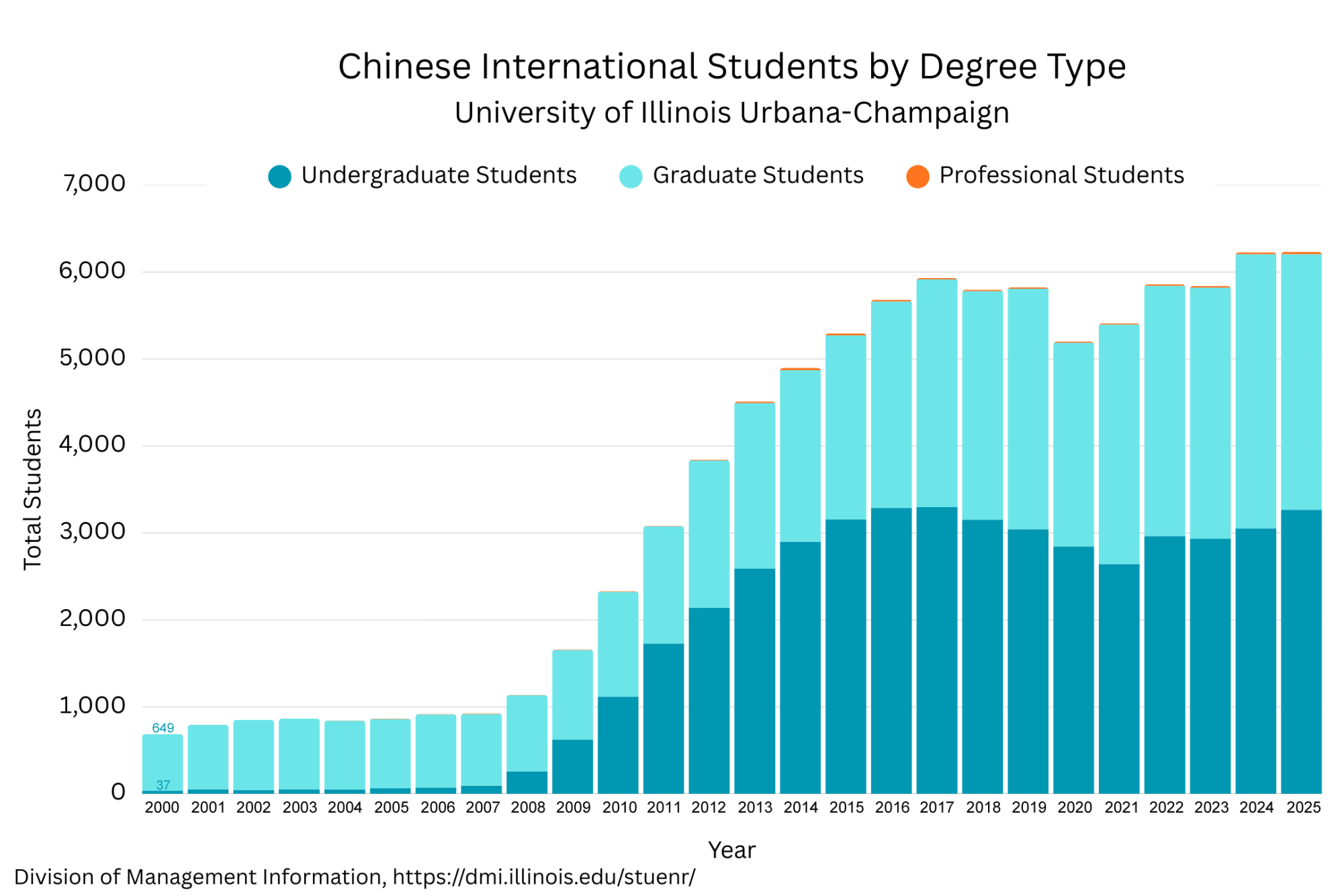
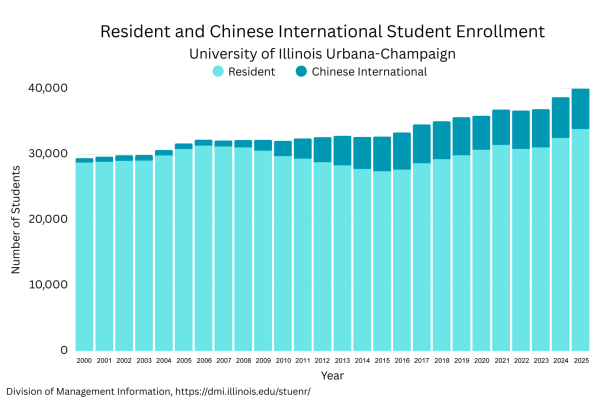
The graphic below compares residential students — those who are eligible for in-state tuition — with the number of Chinese international students enrolled each year between 2000 and 2025.
As a more direct comparison, the University enrolled 5,543 more students from China in Fall 2025 than it did in Fall 2000. On the contrary, it enrolled 5,113 more in-state students in Fall 2025 than it did in Fall 2000.
Percent enrollment by residency
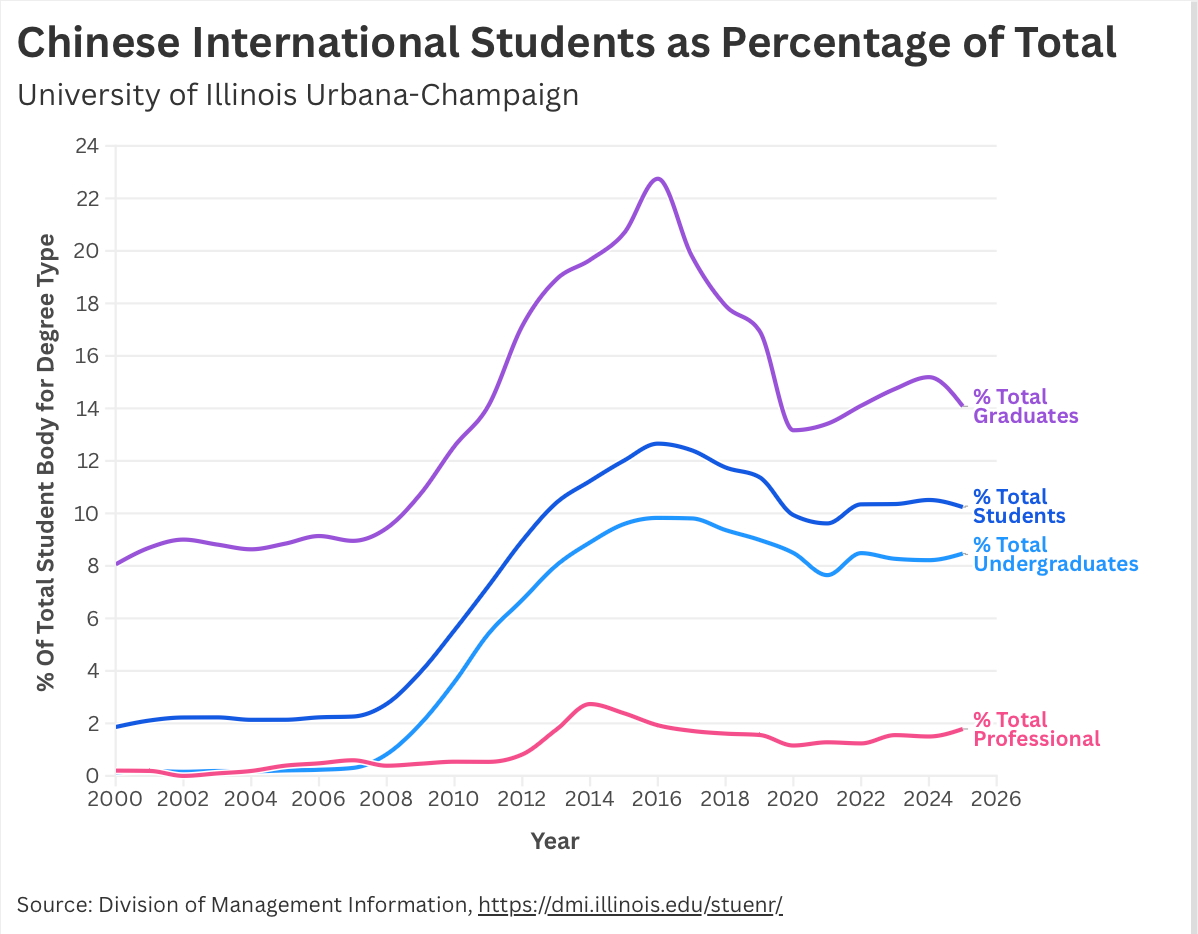
For all three enrollment types, Chinese international students had the largest increase in growth rates compared to the rest of campus between 2008 and 2016. In 2016, more than one in five graduate students came from China.
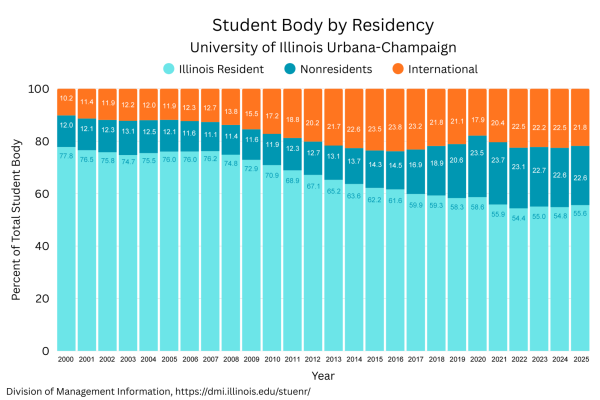
The University saw a decrease in the percentage of in-state students of the entire student body every year between 2007 and 2019. The percentage of its student body made up by out-of-state nonresidents and international students both increased nearly every year in the same time period.
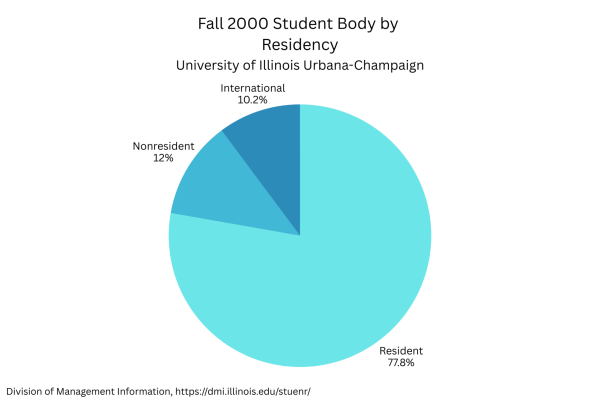
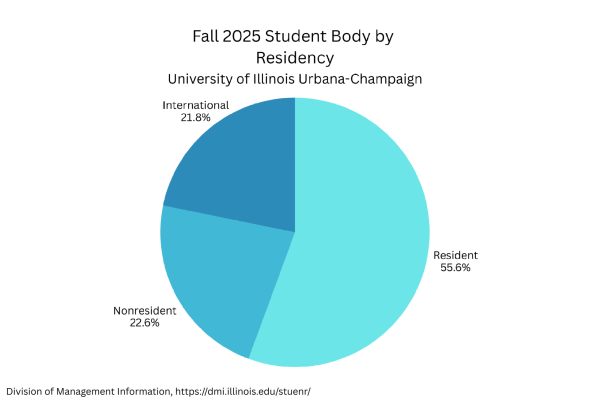
In 2000, 77% of enrolled students were in-state residents, as compared to 55% today.
Percentage enrollment by residency: 2000 vs 2025
In 2000, Chinese international students made up roughly 1.86% of all University students. Today, that number has increased eight percentage points, currently at 10.24% of the student body.
The population of international students at the University has grown from 3,765 total students in Fall 2000 to 13,268 students in Fall 2025. The pie charts below compare the residency types of the full student body in 2000 and 2025.