Last updated on Nov. 16, 2025 at 12:46 p.m.
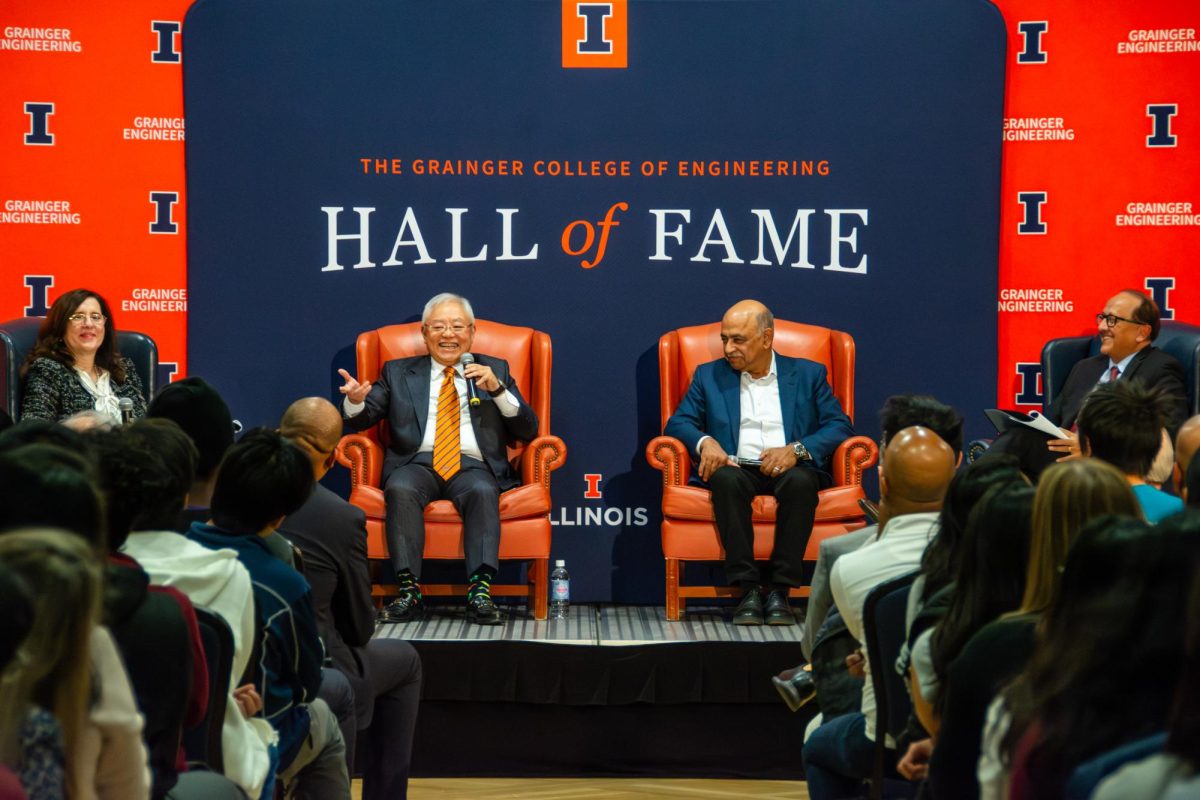
Tech CEOs and University alumni Arvind Krishna and Sidney Lu spoke to a packed room at the Illini Union Friday afternoon, hours before being inducted into the Grainger College of Engineering Hall of Fame.
Krishna, chairman and CEO of IBM, and Lu, chairman and CEO of FoxConn Interconnect Technology, answered questions about artificial intelligence and quantum computing, the environmental impact of data centers and their time at the University, among other topics.
Rashid Bashir, dean of the Grainger College of Engineering, and Mary McDowell, college alum and former CEO of Polycom Inc., moderated the conversation.
“The Hall of Fame has about 60 members (representing) an extraordinary area of contributions across multiple engineering and computing fields,” Bashir said.
Get The Daily Illini in your inbox!
Krishna obtained a master’s in electrical and computer engineering from the University in 1987 and a doctorate in ECE in 1991. He has worked at IBM ever since, in roles ranging from technical research to executive management.
Krishna spoke on quantum computing, a newer type of computing that uses advanced informational units and is one of IBM’s main focuses.
When asked for his estimated timeline of creating a fault-tolerant quantum computer — an advanced computer that can tolerate errors from quantum bits — Krishna said he expected it to be possible in 2029.
Lu earned bachelor’s degrees from the University in mechanical science and engineering, and mathematics in 1981. Krishna at one point noted that Lu earned both degrees in four years, even taking 26 credit hours in one semester.
Both tech leaders gave career advice to students at the University. Krishna said he thought soft skills were as important in a career as hard skills, such as technical skills learned in classes and projects.
“Those soft skills, including how you work with people, are as important to business success as the other pieces,” Krishna said. “If you keep your eyes and ears open, you can implicitly pick them up in a place like (the University).”
Bashir asked the pair about the energy demands of data centers used for AI.
“The speed of development is so fast,” Lu said. “Today, if you talk to the Googles of the world, or even OpenAI, the scene is changing so fast, and they are building so fast. I don’t think there’s time to think.”
Krishna added that using nuclear energy to power data centers is not practical in the short term, as it would take 10 to 15 years to develop. He added that he thought nuclear energy was a “wonderful” long-term answer.
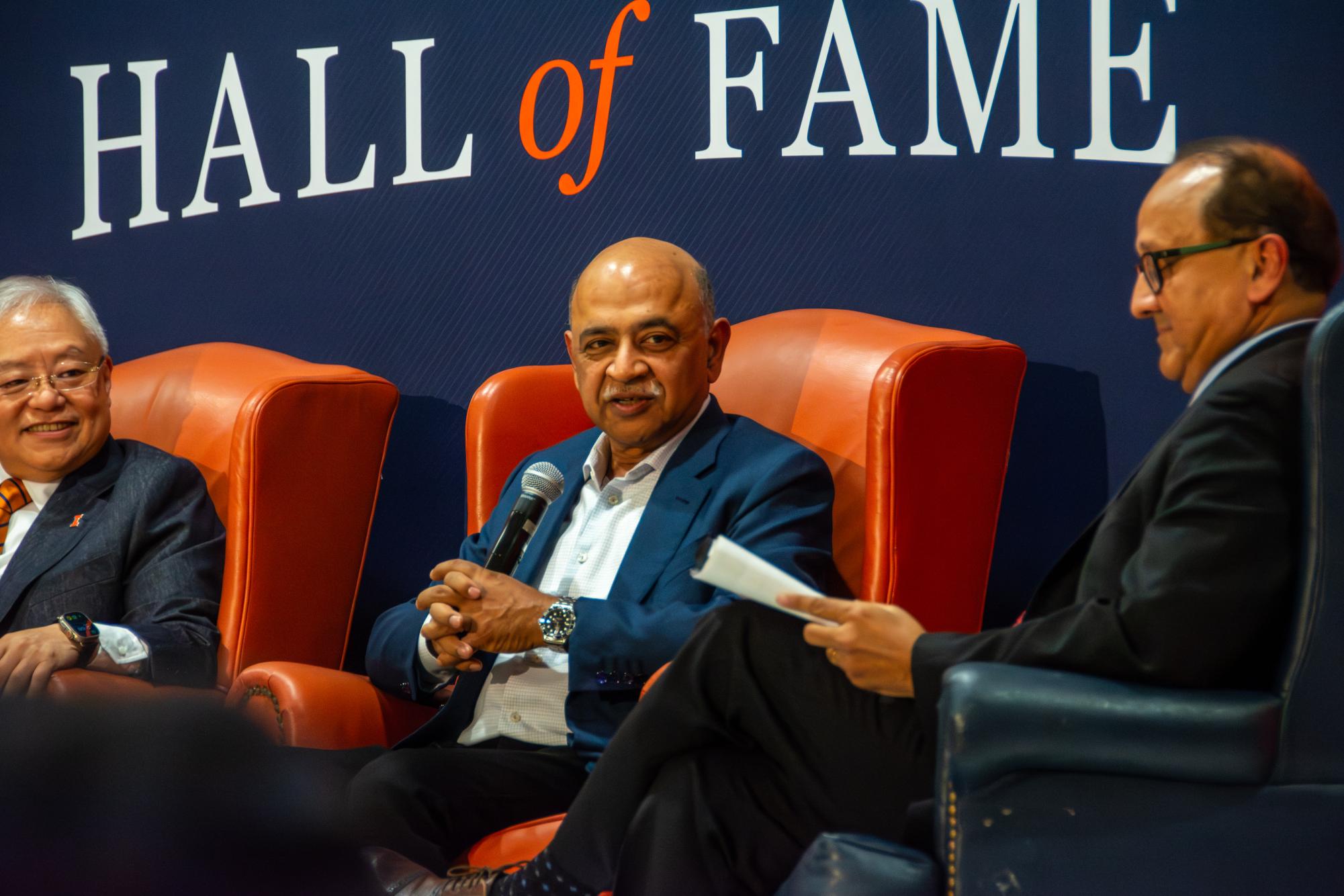
“The only backup, which is somewhat reasonable right now, is probably gas,” Krishna said. “This is the only pragmatic answer for the next five years.”
McDowell asked the speakers about the potential risks caused by AI.
Krishna said he projects 10% of total employment will be displaced by AI, but that it will also create a considerable number of jobs.
“There is displacement, but the net is going to be positive, and our own numbers inside show that,” Krishna said.
Lu spoke about leadership and noted that actually working with a team is more valuable than delegating tasks.
“You got to be able to come in and assist and understand the problem, and actually be in the trenches with a team,” Lu said, “A lot of leaders, they say, ‘I delegate.’ Avoid delegate — understand and also empower.”
The speakers wrapped up their conversation by talking about their personal experiences on campus as students.
“I think that people obsess too much with grades,” Krishna said. “Don’t just do easy classes … have some grit. It’s okay to not do so well and learn how to pick up the material.”
Lu talked about some of his old campus haunts, notably Murphy’s Pub. Both said they spent most of their time studying in their apartments, or in Krishna’s case, his office in the Coordinated Science Laboratory.
Krishna and Lu were inducted into the Hall of Fame Friday night, alongside Grainger Chair Professor Emeritus of Electrical and Computer Engineering Pete Sauer, who is now deceased.