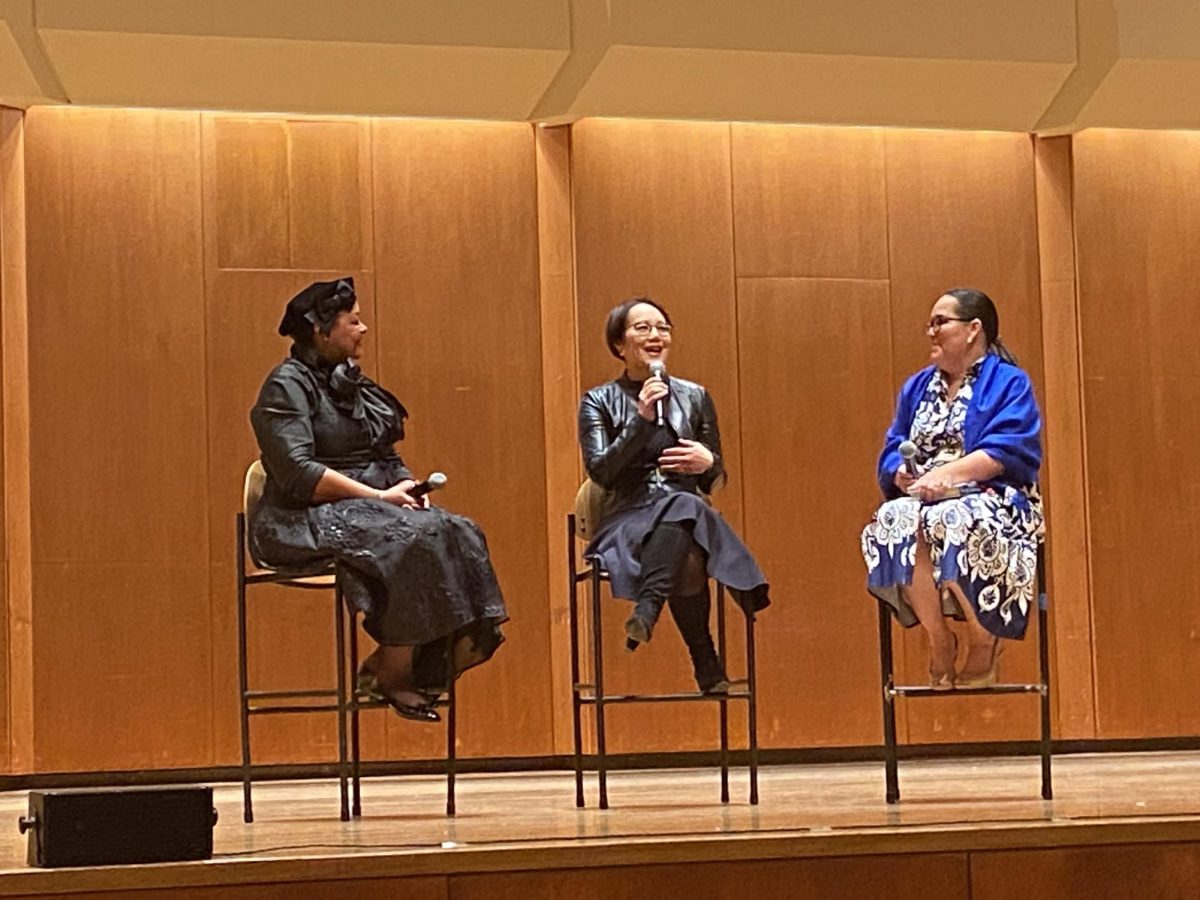
The Office of the Vice Chancellor for Diversity, Equity & Inclusion hosted Rabbi Angela Buchdahl of New York City’s Central Synagogue at Foellinger Great Hall Thursday. She spoke about her new memoir, “Heart of a Stranger: An Unlikely Rabbi’s Story of Faith, Identity, and Belonging.”
The daughter of a Jewish American father and a Korean Buddhist mother, Buchdahl was born in Seoul, South Korea, in the early ’70s and immigrated to Tacoma, Washington, at age 5. She was invested as a cantor in 1999 and ordained as a rabbi in 2001, becoming the first Asian American to hold either position in North America.
Now leading one of the largest synagogues in the United States, with livestream viewers in more than 100 countries, Buchdahl said she hopes everyone, whether Jewish, of another faith or of no faith, finds their story in her memoir.
Ollie Watts Davis, the College of Fine and Applied Arts’ associate dean for academic programs, and Gioconda Guerra Pérez, OVCDEI’s interim vice chancellor designate, moderated a 25-minute conversation with Buchdahl. Before the discussion, Buchdahl gave remarks and sang “Over the Rainbow” from “The Wizard of Oz.”
Right timing
Get The Daily Illini in your inbox!
Buchdahl said another title for her memoir could be “Just in Time.”
“My path to becoming a rabbi was an unlikely one,” Buchdahl said. “It’s a story that only could have happened in America and only been possible at exactly the time that I entered the world.”
When writing her memoir, Buchdahl said she learned that, a few months before her parents got married, the U.S. Supreme Court ruled in Loving v. Virginia that interracial marriage was legal in every state.
A major event that occurred the year she was born was the U.S. Congress’ passage of Title IX, which ensured education equity. Buchdahl’s alma mater, Yale University, existed for over 250 years without educating undergraduate women and only started admitting undergraduate women in 1969.
When she immigrated to the United States, the Reform movement — one of Judaism’s more progressive/liberal branches — shifted its attitude about interfaith marriages. Until the ’70s, when a Jewish person married outside of their faith, they were no longer welcome in synagogues, and in some cases, their families would cut them off, Buchdahl said.
About a month before Buchdahl was born, Sally Priesand became the first woman in Jewish history to be ordained by a major seminary.
“I had no idea that this event (that) happened across the world when I was born in Seoul would impact my life in this way, but I got to grow up never imagining that a woman couldn’t be a rabbi,” Buchdahl said.
Heart of a Stranger
Buchdahl said that many generations after Adam and Eve, Abraham and Sarah came along. According to Jewish belief, they were called on by God to leave their birthplace and head to an unknown place. Buchdahl said God wanted the Jewish people to know that to be Jewish, they needed to know what it feels like to be a stranger.
For over 2,000 years, as the Jewish people traveled across the world and away from their homeland, Israel, they experienced diaspora, according to Buchdahl.
“Rather than thinking this is only a burden — having the heart of strangers — I know that this has also been the source of our empathy and our creativity and our resilience and our strength,” Buchdahl said.
Buchdahl said she has always felt like a stranger, never being fully seen as either Korean or Jewish. She said having the heart of a stranger has become her greatest teacher.
“Like Abraham and Sarah, I had to leave my first home in order to find my truest home, to find belonging and blessing,” Buchdahl said.
The act of welcoming
Buchdahl said when Abraham arrived in a new country, he was a stranger due to his circumcision. Then, when he welcomed strangers, he became more at home as he took on the role of a host. That story reminded Buchdahl of her mother.
When Buchdahl moved to America, she said, her mother never lost her dignity even when others treated her as stupid due to her accent.
Buchdahl’s mother went on to teach English as a second language to hundreds of young immigrants. Buchdahl said welcoming others not only helps the stranger but also the people who are looking for a greater sense of belonging.
Checking boxes
It was after Buchdahl began leading services that her friend told her she “looked Jewish now.” She knew that was meant to be a compliment, but she also saw it as her Korean identity being pushed aside.
“What’s hard is that people want you to fit in only one, so when you have one elevated, it’s almost like the other has to get pressed down,” Buchdahl said of her different backgrounds.
Buchdahl said that when she joined a Korean group in college, most members attended the Korean church, and she felt like she did not fit in the first time she went to the women’s center because she was not yet a “fire-breathing feminist.”
Near the end of her memoir, she shared that the one time when she felt both Korean and Jewish was when she visited Seoul National University as a rabbi.
“It was for (the) particular reason of bridge-building that maybe was the whole point of my life,” Buchdahl said.
Why Buchdahl became a rabbi
Buchdahl said she had known she wanted to be a rabbi since age 16. She said she enjoys helping others notice the beauty around them and navigate through awesome moments, including birth and death, in the biblical sense, as well as liminal moments.
“There were times when it was hard to be Jewish, but I still wanted to be a rabbi,” Buchdahl said.