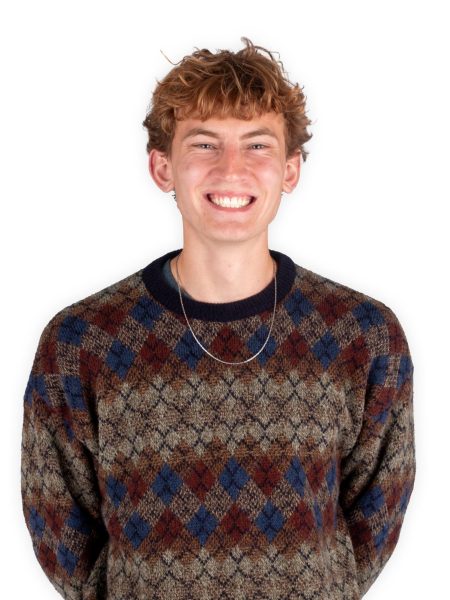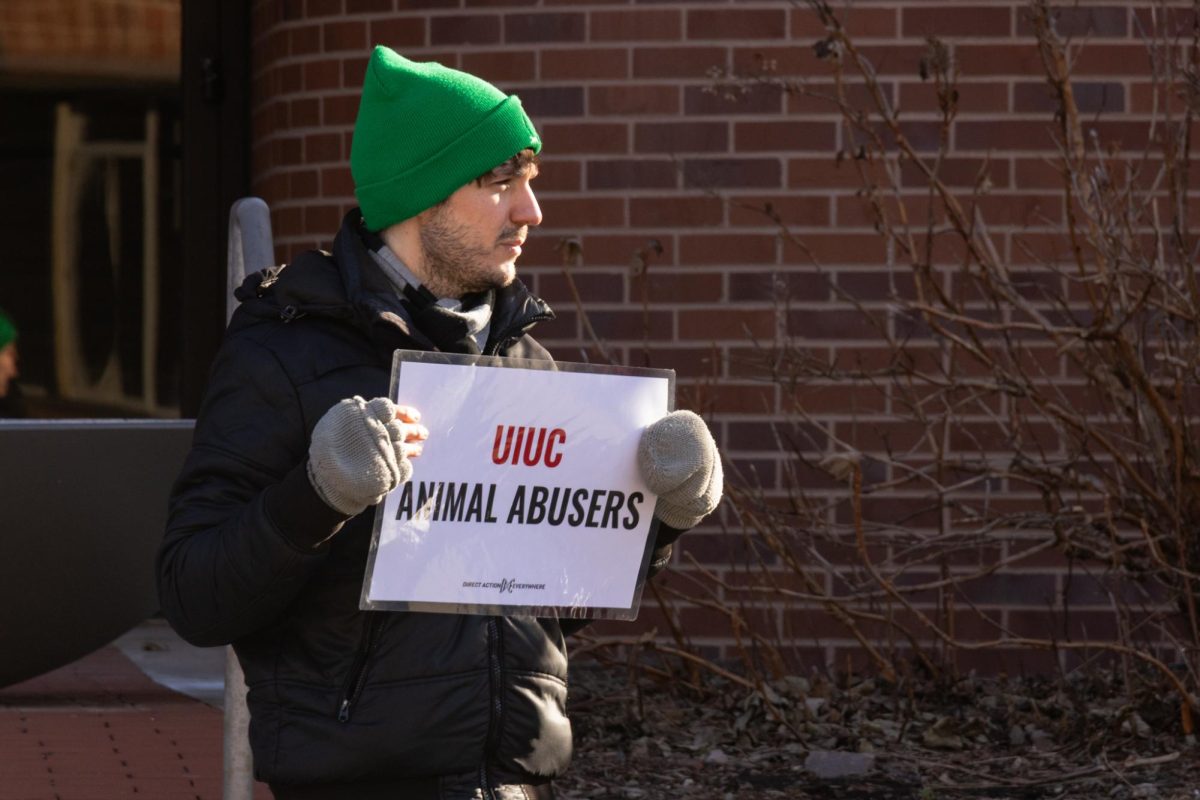
University alum Ilir Sulejmani became vegan in 2016, but he remembers being a peace advocate even as a child.
Now, Sulejmani is one of two organizers of the Illinois Chapter of Direct Action Everywhere, a grassroots network of animal rights activists.
“Over time, I realized I had to put my actions in alignment with the things I believe in,” Sulejmani said. “I knew it was wrong to treat animals this way, so I just stopped personally participating in it.”
Sulejmani said he was drawn to DxE because of its direct approach to animal liberation. The group is actively working to get the University to drop its animal research programs.
“There is a lot of unnecessarily cruel testing going on that could be done in ways that don’t have to involve animals at all,” said co-organizer of DxE Illinois, Haley Gibbs. “I think for Illinois, specifically, looking at getting the big university system to stop testing on animals is a good five-year goal.”
Get The Daily Illini in your inbox!
There are several animal research programs at the University, primarily under the College of Agricultural, Consumer & Environmental Sciences and the College of Veterinary Medicine. A few of these research centers include the Beef and Sheep Research Field Laboratory, Orr Beef Research Center and Swine Research Center.
According to the Office of the Vice Chancellor for Research and Innovation, animal research at the University is done “in accordance with the Public Health Service Policy on the Humane Care and Use of Laboratory Animals.”
The website also states that the University “works with the Office of Laboratory Animal Welfare (OLAW) of the National Institutes of Health to assure the welfare of animals used in research and teaching.”
But according to Sulejmani, there are several instances in the past decade that have either violated the Animal Welfare Act or the standards of the Office of Laboratory Animal Welfare.
An example of this experimentation was in 2015, when one cow died and four were euthanized due to the unsanitary surgery conditions and inadequate post-surgical monitoring.
This incident led to the University taking corrective actions, such as increased veterinary staff monitoring of students.
“People care about animals,” Gibbs said. “You see that your cat or your dog get scared, cuddles you, loves you … And when you meet a pig, you see that same thing in their eyes. They all do feel and love and suffer.”
In a written statement, Patrick Wade, director of executive communications and issues management, told The Daily Illini that the University’s animal research programs meet legal and ethical standards. Wade stated that the programs are committed to providing high-quality animal care.
“The University of Illinois Urbana-Champaign holds NIH assurance, is registered with USDA, and is accredited by AAALAC,” Wade wrote, referring to the Association for Assessment and Accreditation of Laboratory Animal Care. “An ethics review board, the Institutional Animal Care and Use Committee (IACUC), is responsible for reviewing and approving all animal research and teaching at the university.”
Wade stated that the IACUC also reviews and investigates all animal welfare concerns
According to Sulejmani, the mission of DxE Illinois isn’t much different from the general mission of DxE: animal liberation.
The group’s long-term goal is to achieve animal liberation through an Animal Bill of Rights that would free animals from human violence and exploitation.
“Bold is definitely a defining feature of our actions and our message,” said DxE’s director of communications Cassie King. “We’re not watering things down. We are very clear that we want to see animals be protected from being killed, from being exploited for human use in every context … our end goal is an Animal Bill of Rights.”
Outside of the University, DxE has raised awareness about the Right to Rescue and called on Trader Joe’s to cut ties with Petaluma Poultry, which the group investigated for animal cruelty in 2018. DxE is also closely associated with Slaughter Free Network Chicago, which seeks to shut down slaughterhouses in Chicago.
But, according to Sulejmani, the biggest target for DxE is Ridglan Farms, a Wisconsin-based beagle breeder that supplied dogs for scientific research, including to the University.
Following a years-long campaign, Ridglan Farms was investigated and ultimately forced to shutter its breeding program following a settlement with the state of Wisconsin to avoid admitting fault or facing prosecution for alleged animal welfare violations. Ridglan Farms has until July of this year to finish the shutdown.
Gibbs said it’s a partial win, but is concerned because the farm is still allowed to transfer the remaining dogs for research purposes before being completely shut down.
“The real win would have been to get them to agree to shut down and to surrender the dogs to be adopted out,” Gibbs said. “But it is overall still a net positive that Ridglan Farms is no longer allowed to be like this huge puppy factory farm. That’s obviously great, but not the most ideal situation with them being able to transfer them out for research.”
On March 15, dozens of animal rights activists, including DxE co-founder Wayne Hsiung, broke into Ridglan Farms to rescue the remaining beagles. The activists took several dogs, all of which were recovered.
This rescue is one of many of DxE’s open rescues; rather than simply documenting animal exploitation, the group enters factory farms or slaughterhouses without permission to document the conditions and take animals into their care.
“I think open rescue is a really important part of the animal rights movement,” Sulejmani said. “When someone is suffering, when someone is being abused, it’s not enough for you to record that suffering … It’s a moral compulsion, I would say, to give them some relief.”
In the past decade, DxE’s approach to animal liberation has received criticism and even multiple lawsuits, but Sulejmani believes that open rescue isn’t extreme, but necessary.
“I think that it’s extreme to force someone to live their entire life in a small cage two times the length of their body, to be experimented on and cut open again and again and again, just to be killed when they’re no longer useful,” Sulejmani said. “That’s extreme. I don’t think it’s extreme to remove that individual from suffering and give them a chance to live.”
![A single corn (Zea mays) stoma captured at 50x magnification with a two-photon laser scanning confocal microscope while the leaf was manipulated inside a gas exchange system with high light and tightly controlled [CO2] and humidity conditions in the Institute for Genomic Biology Core Facilities in 2025.](https://dailyillini.com/wp-content/uploads/2026/03/TOC-icon.jpg)