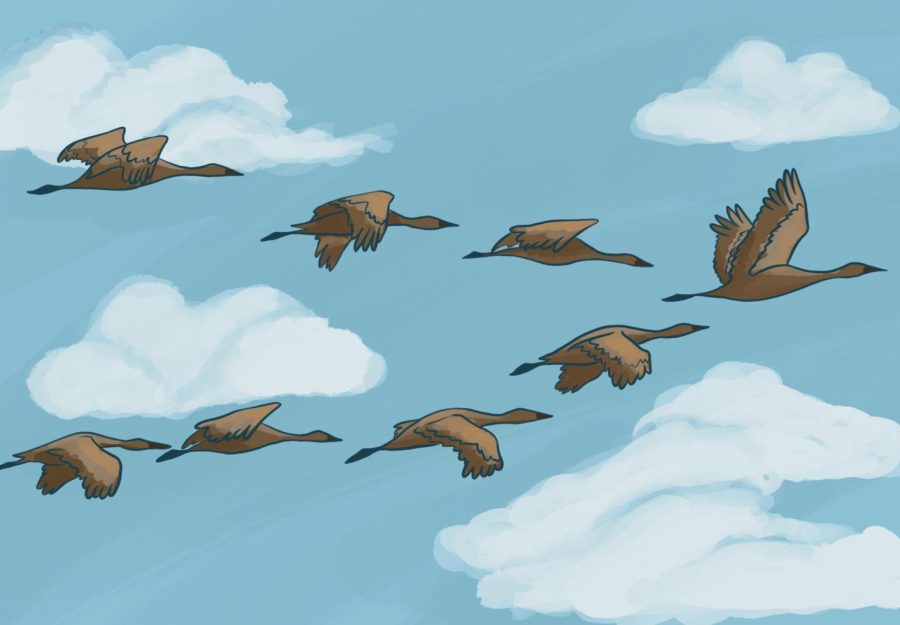
A group of students at the University have come together to form a bird strike committee, doing rounds of campus buildings to look for birds killed in window collisions.
The committee maps hotspots for strikes and uses the data to advocate for bird-friendly architecture, hoping to reduce the number of bird deaths on campus.
Two graduate students began the project many years ago, then passed their work to Colin Dobson, then-sophomore in ACES. In the fall of 2023, Dobson gave the project to the current committee, which includes several students from various disciplines.
When the survey began, its aim was to quantify the number of bird strikes on campus at a set number of target buildings. However, this committee has created new goals as they take the project forward.
“Our goal as a volunteer-based organization is to move towards mitigation, because we have six continuous years of data on which buildings are the worst for bird strikes,” said Wren Dulnev, senior in ACES.
Get The Daily Illini in your inbox!
Volunteers analyze two main routes on the North and South Quads to collect data. They survey 19 target buildings twice daily.
“It’s been really nice getting together a community of bird lovers, and it’s also a good way for people to practice their bird identification,” said Sarah Jacobson, senior in ACES.
The committee has over 40 active volunteers who help survey campus routes, identifying and collecting the dead birds. The committee then logs its data into ArcGIS online, a digital mapping program, in order to compile, organize and rank the data according to which buildings have the highest number of bird collisions.
Bird strikes are caused by the reflectivity of windows, and many modern campus buildings, like the Krannert Art Museum and Beckman Institute are particularly problematic.
“When birds can see the reflection of foliage like trees or plants or bushes, they think it’s something they can fly towards and land on,” said Ciara Roon West, junior in Engineering.
Birds can even strike overnight when lights in buildings are turned on. They also collide with windows more during mating season as they become more territorial and attack their own reflection.
“If they see through one side of the window and there’s a window on the other side and they see the continuity of the sky throughout, they might think they can fly all the way through and that also causes a strike,” West said.
A majority of the birds the group found are healthy migratory species that have traveled thousands of miles.
“It makes you really sad when it’s clear that they survived their migration up north and they’re on the way back and they just don’t quite make it,” said Leilany Fuentes-Garcia, senior in FAA.
Climate change is already creating vulnerabilities for migratory birds and their protection has become imperative to the students.
In 2021, state legislators in Illinois passed a law requiring all new buildings to adopt bird-friendly infrastructure in their designs.
The committee is working to persuade the University to install mitigation strategies on buildings with large amounts of strikes.
“We’ve been cold emailing so many buildings at this point,” Dulnev said. “We want to see some actual mitigation by the end of our senior year.”
The bird strike committee is also giving the dead birds they find a second life by donating them to the Illinois Natural History Survey collections.
“If (preservation) is done well, these specimens can last up to 100 years, so they are made available to researchers who may want to take advantage of looking at specimens that are not in their area or are from a different time period,” said Avi Berger, graduate student studying ecology and evolutionary biology.
Beckman Institute has been the highest-ranked building for bird strikes across all six years of the survey, and the committee is currently trying to convince the University to place decals on the windows in order to reduce strikes.
“It’s also generally such an eyesore to have six or seven birds littering the floor around the South Tower,” Wren said.
Decals are cost effective and do not disrupt aesthetics as much as other mitigation strategies such as paracord. The decals follow a 2-by-2-inch spacing, which the birds see as solid and realize they cannot fly through it.
The Krannert Art Museum has put up bird-friendly glass in the Kinkead Pavilion, but the committee is urging them to take more action. It suggests the museum should create mitigation strategies, like art installations that follow decal spacing guidelines.
“Our advisors, like TJ Benson, Benjamin Van Doren and Joy O’Keefe, are putting pressure on the administration to actually follow the law and put the mitigation up on the buildings that they’re supposed to,” Dulnev said.
Bird strikes across the United States are difficult to measure, but every year the number becomes larger, according to Berger.
The bird strike committee hopes that if the University does put up decals, colleges across the country may do the same.
“It could potentially inspire other students at other schools to start their own window strike programs and make their buildings more bird-friendly,” Jacobson said.